
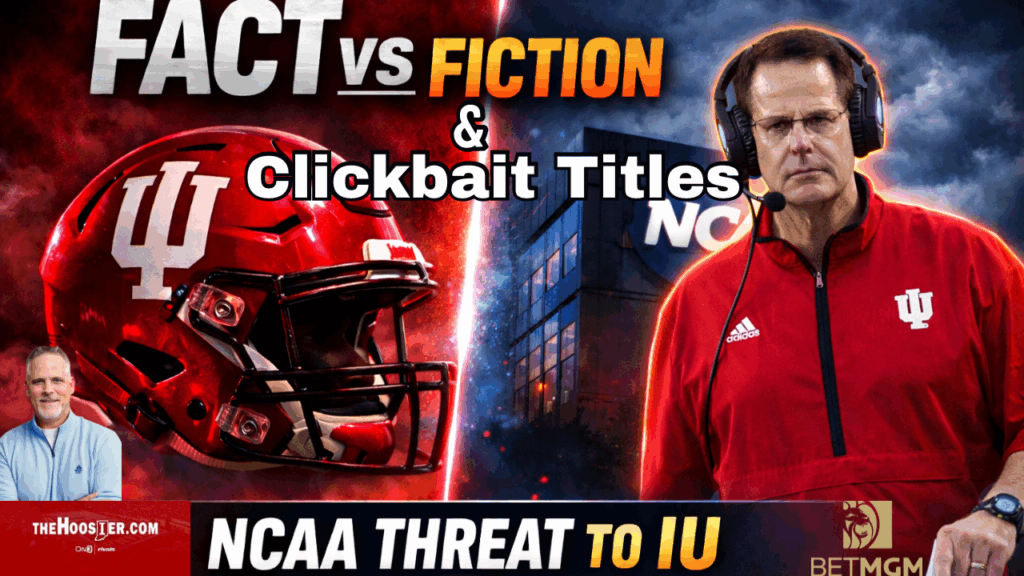
Shannon Griffith | Lead Football Analysts | TheHoosier.com
The Louis Moore eligibility case has taken another turn.
Moore has officially dismissed his lawsuit against the NCAA, ending the active legal challenge that allowed him to compete during Indiana’s championship season under a federal court injunction.
With that development, it’s important to separate what this means — and what it does not mean — for Indiana Football moving forward.
A Legal Dispute — Not a Violation Case
First, context matters.
This was never a traditional NCAA enforcement case. Indiana was not accused of cheating, violating recruiting rules, or engaging in misconduct. Moore’s participation came under the protection of a federal injunction while the court reviewed the legality of NCAA participation limits.
When the season concluded and Moore’s eligibility window closed, the lawsuit no longer carried the same urgency, and it has now been dismissed.
That distinction is critical.
The case centered on eligibility interpretation — not institutional wrongdoing.
Why Is the NCAA Still Appealing?
Even though Moore has dropped his lawsuit, the NCAA continues to pursue appellate review.
Why?
Because this case presents broader questions about eligibility rules and judicial intervention. The NCAA is seeking legal clarity and precedent that could shape how similar disputes are handled in the future.
In other words, this is about governance and rule authority — not retroactive punishment.
What About Restitution?
The term “rule of restitution” has generated significant attention in recent weeks.
Restitution is a legal mechanism the NCAA could theoretically consider if a court order allowing participation were later reversed. It is not automatic. It is not a punishment announcement. And it has not been imposed.
To be clear:
No enforcement action has been issued.
No penalties have been announced.
No formal sanctions against Indiana exist.
Speculation about vacated wins remains hypothetical at this stage.
The National Championship Question
Another key misunderstanding involves governance.
The NCAA oversees eligibility and compliance matters, but the College Football Playoff operates under its own governance structure.
That means the CFP National Championship is not under direct NCAA control.
Claims that the NCAA could “strip” Indiana’s championship misunderstand how the modern playoff system functions.
The Bottom Line
With Moore’s lawsuit dismissed, the active legal dispute is no longer centered on his participation. The NCAA’s continued appellate efforts focus on rule interpretation and future precedent.
Here’s what we know right now:
The lawsuit has been dismissed.
There is no active enforcement action.
Restitution remains theoretical.
Indiana has not been penalized.
The CFP National Championship is not governed by the NCAA.
This situation is worth monitoring. It is not cause for alarm.
Indiana Football remains positioned where it finished the season — on top of the college football world — while the broader legal conversation around eligibility continues to evolve.
Stay informed. Not alarmed.
Join Me Tonight for Hoosier Tailgate Live at 7:30 PM
https://www.youtube.com/live/L8iZXD16GIQ?si=T-yeFF4wkfln4CcE