
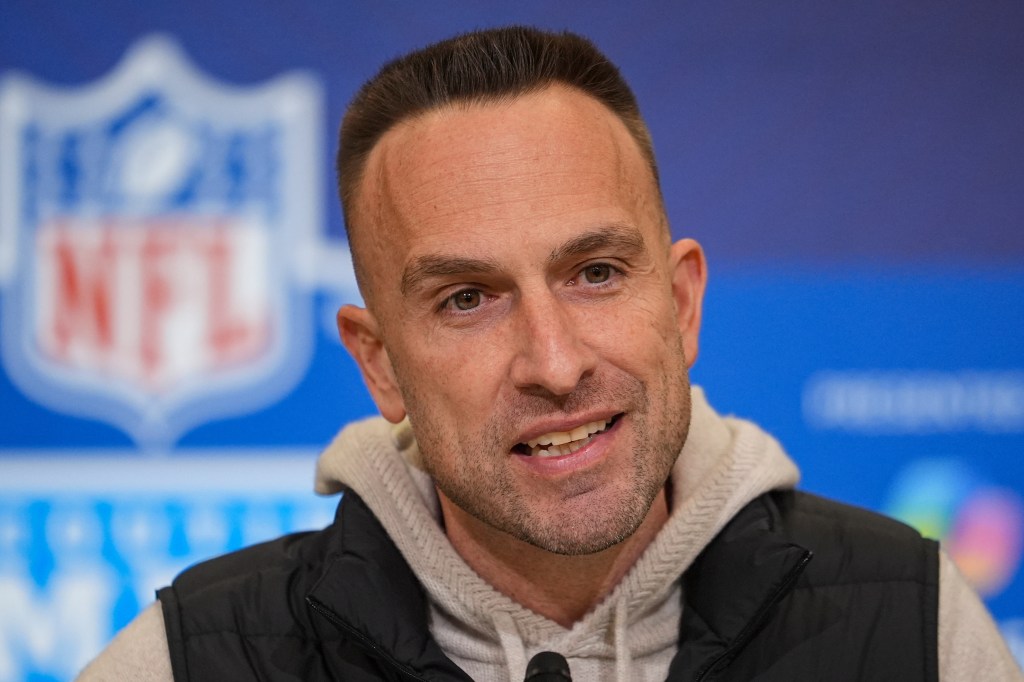
There’s a role we haven’t discussed enough in the Dolphins’ rebuild, and it’s a vitally important role — head coach Jeff Hafley.
Dolphins fans should eye the 46-year-old Hafley with more scrutiny than general manager Jon-Eric Sullivan or the starting quarterback to be named later.
Head coaches, typically, are more responsible for success or failure than any other individual in the organization.
The head coach establishes a tone, a way of doing business, a guide to conducting yourself, and that tone often shows in wins and losses, as well as organizational unity.
Hafley, as head coach, is the public face of the franchise. He’s also the behind-the-scenes driving force. He’s the person expected to have all the answers to all the problems, both on and off field. He must walk lots of fine lines.
The Dolphins’ last coach, Mike McDaniel, was a bit too soft on people, and his teams left too much meat on the bone.
The coach before McDaniel, Brian Flores, was a bit too harsh on people. And while he got the most out of his talent, he failed at in-house politics to some extent. He angered the wrong folks.
Getting the right head coach, someone who establishes a winning, no-nonsense mentality in the locker room and the administrative building every single day, is crucial to ensuring success as the Dolphins move forward.
Every successful build or rebuild that I’ve covered has had a steady hand as head coach. Methods differ whether it was low-key manager Johnny Oates quietly guiding the 1996 Texas Rangers to their first-ever postseason appearance, Miami Hurricanes coach Butch Davis boldly rebuilding that program leading up to the 2001 national title, Dolphins coach Dave Wannstedt wisely relying on defense and run game in the playoff seasons of 2000-01, or Heat coaches Pat Riley and Erik Spoelstra grinding morning, noon and night while building title teams between 2002-12. The head coach was always a major factor.
In fact, I’d argue that getting the right coach is more impactful than getting the right quarterback.
I know that’s a politically incorrect statement in the NFL. And it goes against NFL marketing. NFL media and fans are repeatedly told that everything revolves around a single figure, and it’s the quarterback.
Quarterbacks rule. Quarterbacks are the answer to every problem. Quarterback, quarterback, quarterback.
But you’ve got to admit coaching has made a major difference in the NFL recently, and it’s happened fast in many cases.
Denver quarterback Bo Nix is good, but Denver coach Sean Payton has been more impactful on the Broncos’ turnaround. The same is true in Detroit with quarterback Jared Goff and coach Dan Campbell. I’d argue that’s also been the case in Seattle with quarterback Sam Darnold and coach Mike Macdonald, in New England with quarterback Drake Maye and coach Mike Vrabel, in Chicago with quarterback Caleb Williams and coach Ben Johnson, and even in Jacksonville with quarterback Trevor Lawrence and coach Liam Coen.
Coaching matters.
The general manager is the most important person in the organization because he gathers the talent, and you can’t win without talent. But after the season starts his role is reduced a bit.
The quarterback is the most important on-field person in the organization, by far. But let’s face it, if it’s a running play, defensive play or special teams play, the quarterback’s influence is limited or inconsequential.
The head coach, however, touches every aspect of the game, on and off the field. He’s involved in every major decision during a game. He does it all.
The head coach makes sure all players are pulling on the same rope and in the same direction.
The head coach, in many ways, is responsible for molding players into winners.
The GM finds the players, but the head coach makes them win.
Sullivan is the star of the rebuild right now, while the organization decides what to do about quarterback Tua Tagovailoa, which way to go in free agency, who to select in the draft, how to shape the initial 53-man roster, etc…
But sometime in late August or early September, when training camp ends and the regular season begins, Sullivan will hand off responsibility for the operation to Hafley.
And that’s when the most important part of the rebuild takes place.