
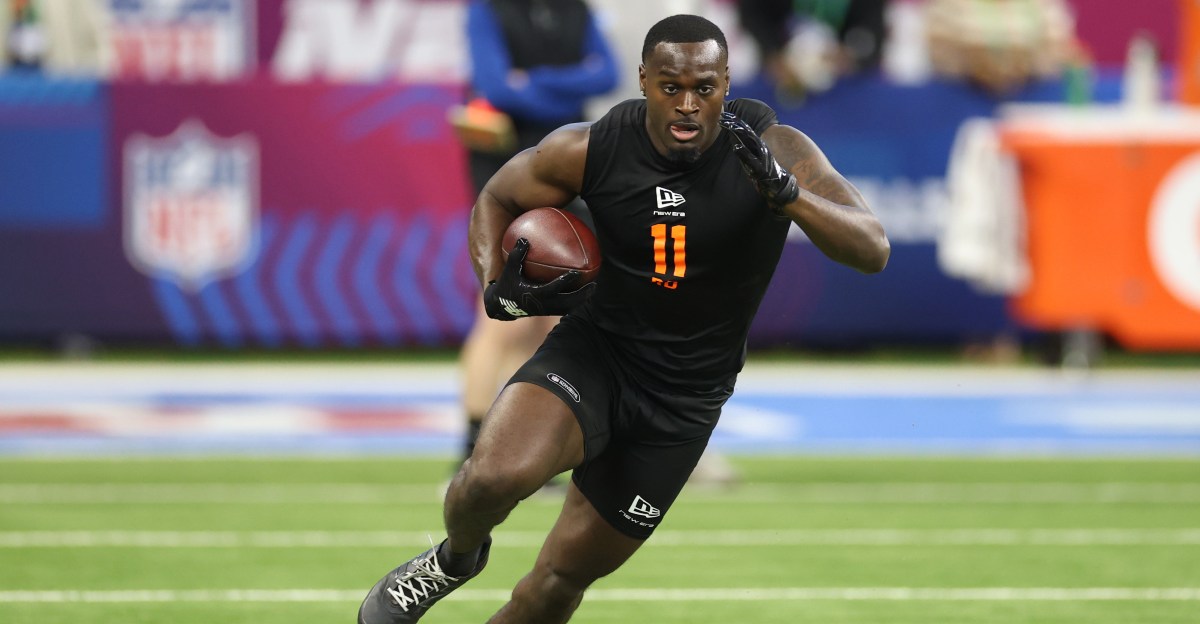
The third day of testing at the combine had the quarterbacks, running backs, and wide receivers take to the field. Although Dallas aren’t in a hurry to draft any of these positions, it is important to take note as prospects showing out here raises their value, meaning defensive players slide and help the Cowboys capitalize on players that will help solidify a much needed overhaul on defense. So let’s get into the risers and fallers from the third day of testing.
Mike Washington Jr., RB, Arkansas
At 6’1”, 223 pounds, Washington produced an official 4.33s forty time, plus a 1.51s 10-yard split, with a 39” vertical jump, and 10’8” broad jump. That is the kind of power back with a true long-speed profile that forces teams to re-evaluate his value.
Jeremiyah Love, RB, Notre Dame
Love backed the top-of-the-class buzz with a 4.36s forty yard time and then looked impressive in the skill work. He showed quick feet, sudden lateral cuts, and the easy elusiveness that shows up on tape. He firmly cemented a top-five value with solid testing and a positive persona.
Brenen Thompson, WR, Mississippi State
The stopwatch headline is huge because it changes how evaluators have to treat him. His 4.26s forty yard time put him on the short list of the fastest humans in the class. Even for smaller speed receivers, that kind of verified vertical speed creates a real role in the NFL, which is enough to spike his draft value.
Zachariah Branch, WR, Georgia
Branch’s value is easy separation and elite hands, and he looked like the best receiver on the field in his group by making confident catches outside his frame, and produced a workout that made it easy to project an NFL role.
Bell stacked explosive numbers in the jumps and a drill session that was professional. He tracked and finished, even if the ball fought him a bit at times. That combination is exactly how you sell top-100 prospect value.
Deion Burks, WR, Oklahoma
He put legit juice on paper with a 4.30s forty time and a wide receiver-leading 42.5” vertical jump, and that’s the kind of explosiveness that tends to show up in routes as sudden acceleration. When a receiver tests like that, teams will live with some polish work because the athletic ceiling creates a real winning path.
Taylen Green, QB, Arkansas
Purely as an athlete, it was absurd. He registered a 43.5” vertical jump, 11’2” broad jump (setting combine records at the position), and a 4.36s forty time (99th-percentile). The throwing session was the reminder he’s still raw when the tempo sped up, his feet and arm timing drifted and balls sailed and arrived late, but the tools are loud enough that some team will justify an investment.
Simpson helped himself by looking steady and consistent relative to the group, which is good enough to keep the second-best quarterback talk behind Fernando Mendoza. He didn’t have to be spectacular, he just needed solid reps, and he largely delivered.
Malachi Fields, WR, Notre Dame
The 4.61s forty time hit the exact concern evaluators already had, and the on-field portion didn’t hide it. His subpar stop-start speed showed up by arriving late to spots, plus some drops in the gauntlet. This was the kind of session that forces teams to reframe him as a ball-skill role player, not an early-round separator.
Emmett Johnson, RB, Nebraska
The testing didn’t match the quick speed on tape. He was the slowest running back on the day with a 4.56s forty time, an ugly 7.32s three-cone (29th percentile), and then in drills he wasn’t as fluid as anticipated and hesitated in space. For running backs, when both the numbers and the movement look ordinary, you lose the selling point to warrant interest to be drafted in any of the first four rounds. That 6.16 Relative Athletic Score for a position that’s all about athleticism will kill his draft stock.
Carnell Tate, WR, Ohio State
The issue wasn’t that his forty yard time of 4.53s is unusable, it’s that it’s average for a 192-pound receiver who needs to threaten vertically to justify top of the draft talk. Without the on-field drills to offset the time, the day ended with more questions than answers, and that’s invited a slide.
Jordyn Tyson, WR, Arizona State Tyson didn’t get to answer the biggest question on durability because he wasn’t able to do the on-field work due to injury. That’s not a bad workout, but in a class where others banked verified speed and clean drill tape, missing the opportunity will create a value drift.