
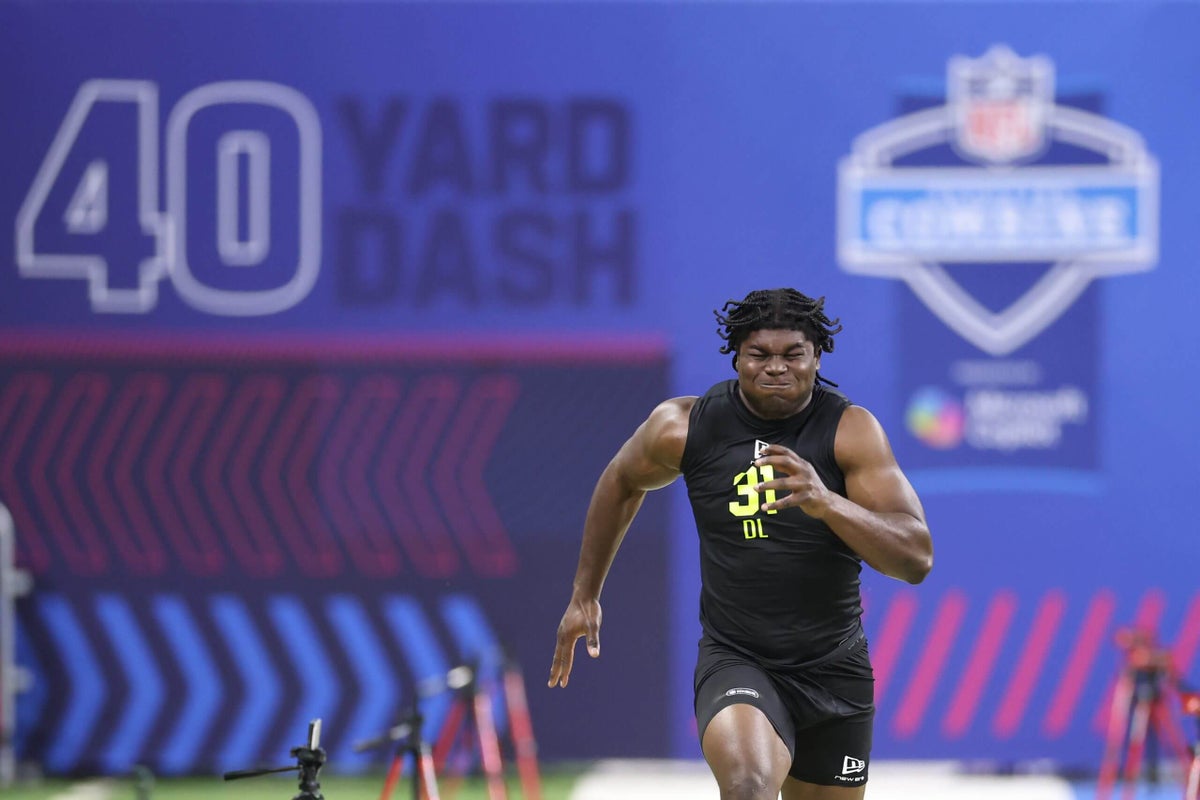
INDIANAPOLIS — On Sunday, NFL Network displayed a graphic near the end of its week-long NFL Scouting Combine coverage showing the average 40-yard dash time for each position. Of the eight position groups, seven — defensive linemen, linebackers, defensive backs, offensive linemen, tight ends, running backs and receivers — all posted the fastest times in combine history. Only one group — the quarterbacks — did not, but they still recorded the second-best average ever. It was quite a testament to how fast this group was.
Wide receivers averaged a 4.44 40 — the same as the DB class — while running backs averaged a 4.45. An impressive 14 wideouts ran 4.40 or faster this weekend. Ten DBs ran 4.40 or faster, including six safeties, which seems mind-blowing. Our pick to be the fastest man in Indianapolis, Mississippi State’s Brenen Thompson, delivered, clocking a 4.26 40. At MSU last offseason, he was clocked at 23.7 mph. Over the weekend, he reached a top speed of 24.07 mph, according to the NFL’s Next Gen Stats.
Having written about college football’s Freak athletes for two decades, I can’t recall a class where so many players not only lived up to their lofty college testing numbers but blew them away.
I had a pretty good idea who was expected to put on the best shows in Indy based on all the intel I’d gathered over the last offseason, but I also spoke to some top combine trainers who had even more insight — including on a bunch of guys I apparently missed last summer.
Arkansas RB Mike Washington Jr., who played at Buffalo and New Mexico State before arriving in the SEC, backed up everything trainer Jordan Luallen told me a week ago. The 6-1, 223-pound back ran a 4.33 40 with the best 10-yard split of all the running backs at 1.51 seconds. He also posted a 39-inch vertical and a 10-8 broad jump.
Oklahoma defensive tackle Gracen Halton also showed out. The disruptive Sooner, at 6-3, 293 pounds, ran a 4.82 40 with a 36.5-inch vertical and a 9-6 broad jump — all elite numbers for an interior defensive lineman. Kentucky defensive tackle David Gusta, at 6-2, 308 pounds, was almost as fast, running a 4.88 40 with a stunning 1.68-second 10-yard split to go with a 32-inch vertical. Only Penn State Freak Zane Durant had a quicker 10-yard split (1.66) and he’s 18 pounds lighter.
Our top two Freak athletes going into the combine, Oregon tight end Kenyon Sadiq and Ohio State linebacker Sonny Styles, exceeded the hype. Sadiq does not have prototypical tight end size. He’s more in the mold of Brock Bowers than Rob Gronkowski, and he’s not quite the football player Bowers is, but he’s a more explosive athlete. At 6-3 1/8, he weighed in at 241 pounds — down from the 255 he weighed last offseason. His 43 1/2-inch vertical and 11-1 broad jump showcased elite explosiveness. He also ran a 4.39 40 — the fastest by a tight end in Indy since 2003. Neither he nor fellow Freak Eli Stowers displayed their receiving skills in the on-field workout. A concern with Sadiq is how consistent his hands are.
Styles blew scouts away when they saw him and his workout. He’s a former safety who is now 6-5, 244 pounds with arms that are almost 33 inches long. He ran a 4.46 40, posted a 43 1/2-inch vertical and an 11-2 broad jump. Based on his remarkable athleticism, frame and skill set, it would not be a shock if he ends up going in the top five in the draft this spring.
Stowers, a former Texas 6A state high-jump champion, improved his vertical jump from 39 inches last offseason to 45 1/2 inches.
Small-school Freak wide receiver Ted Hurst from Georgia State came in taller and bigger than he measured last year. He was 6-4, 206 — up from 6-3, 198. Last offseason, Hurst ran a laser-timed 4.51 40 and broad jumped 10-8. Over the weekend, he improved that to a 4.42 40 and an 11-3 broad jump. His stock, which already got a boost from a strong week at the Senior Bowl, should continue to rise.
From a pure talent standpoint, none of this year’s receivers is close to Ohio State’s Jeremiah Smith, who isn’t draft-eligible until 2027. But this group definitely helped itself — even if projected top wide receiver prospect Carnell Tate was one of the few guys who ran a bit slower than expected, with an official 40 time of 4.53. He’s still an excellent all-around receiver, and we’ve seen plenty of top wideouts clock 40 times slower than 4.50. The NFL star Tate is often compared to, former OU standout CeeDee Lamb, ran a 4.50 at the combine.
Here are 11 other takeaways from my week at the combine:
1. Over the next month-plus, the subject of Rueben Bain Jr.’s arm length is going to be quite the draft subplot. The former Miami D-line standout’s arms measured at 30 7/8 inches — less than ideal for an edge rusher. The 6-2, 263-pounder was the most disruptive defensive lineman in college football last year. On top of that, Bain did more to change the culture of a Canes program that had been spinning its wheels for almost two decades until he decided to stay home.
One veteran NFL defensive coach described him to me as “the anti-measurables guy” and said it wouldn’t surprise him if Bain turns out to be a DE version of Aaron Donald. That is obviously a mouthful. “He dominates in the run game and you can’t block him on the rush,” the coach said. “From what I heard about his interview, he said (Miami D-line coach) Jason Taylor really taught them how to be a professional in terms of practice habits, film study and his overall approach. And it’s obvious on film that Bain took that to heart. He’s trying to snatch guys’ souls on the field. In my heart, I pray he’s there (in the second half of the first round) when we pick, but my brain says no way he falls that far.”
It’s worth noting that no edge rusher over the last 20 years has been picked in the first round with arms as short as Bain’s. One NFL scout told The Athletic that he’ll be shocked if that doesn’t change. He said Bain is too explosive, violent and powerful and that his first-step burst is good enough to help overcome his lack of length on the edge: “I love that kid. He’s just different, and I mean that in a good way.”
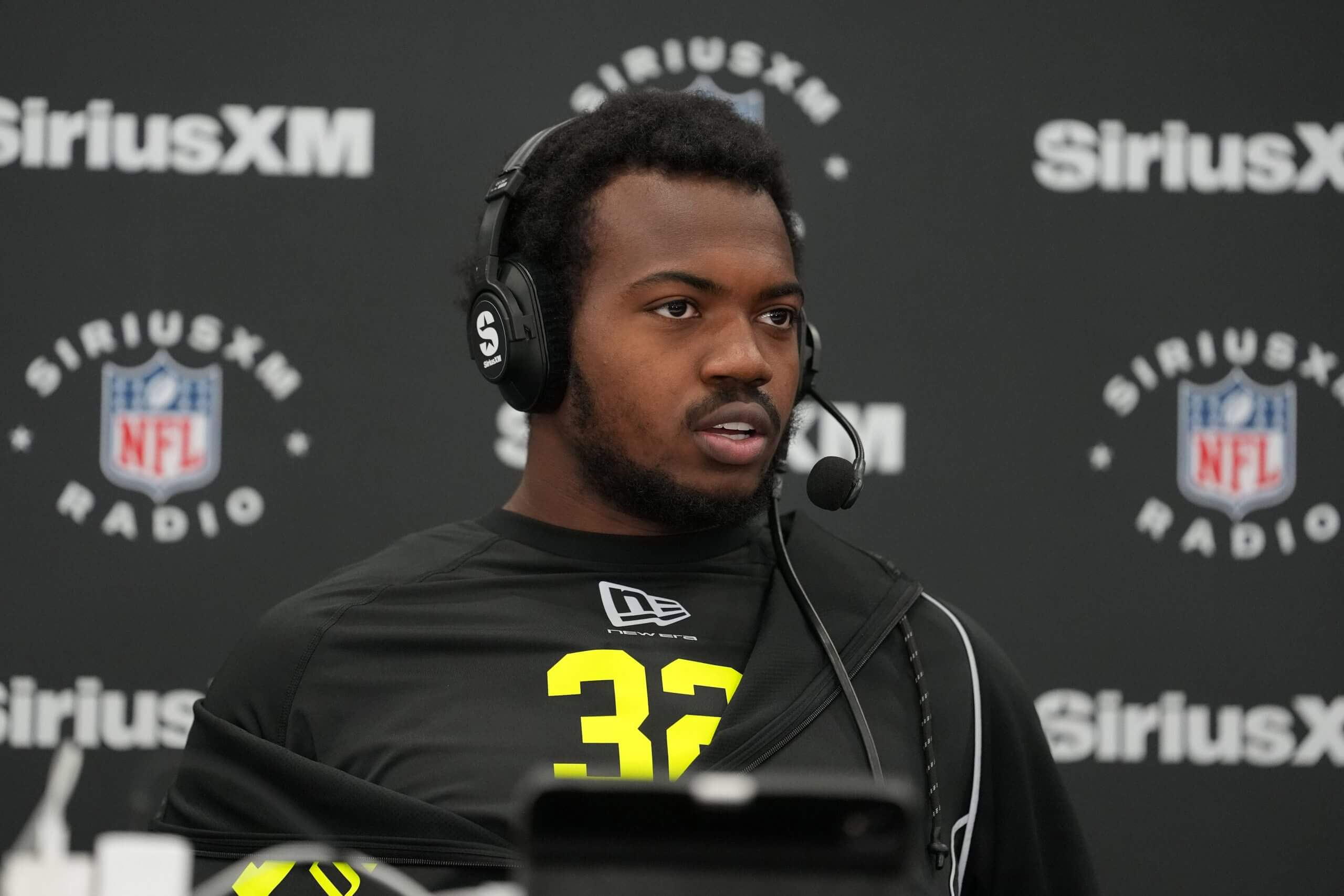
Rueben Bain Jr.’s arm length will be a subplot to the draft, but his explosiveness and power are too much to pass up. (Kirby Lee / Imagn Images)
2. Two other edge players have legit top-10 talent. Ohio State’s Arvell Reese drew some Micah Parsons comparisons from the NFL scouts I spoke to last week in terms of having the ability to be an elite edge player and off-ball linebacker. Coaches love the 6-4, 241-pounder’s range, explosiveness and violent knock-back. His ability to bend and seamlessly change direction is special, too. No one seemed surprised that Reese clocked a 4.46 40 with a 1.58-second 10-yard split. He looks every bit that fast on film when he’s running guys down. He was the breakout defensive star of the 2025 college football season. Some Big Ten coaches we spoke to thought he caused more problems than Caleb Downs.
Texas Tech edge rusher David Bailey was almost unblockable last season. At 6-4, 251 pounds, he ran a 4.50 40 and broad jumped 10-9. I think Bailey is an even better player than Abdul Carter, who went No. 3 overall last year. They’re almost the same size and length, and they test similarly.
3. Another Red Raider D-lineman, Lee Hunter, came up several times when I asked coaches and scouts for their favorite player interview last week. People just love his energy and personality. The 6-3 1/2, 318-pound nose tackle was an integral part of Texas Tech’s defensive turnaround. He had an impressive week at the Senior Bowl, bulldozing his way through blockers, but he didn’t test that well in Indy with only a 21 1/2-inch vertical and an 8-4 broad jump. His 5.18 40, though, is good for a guy that big, and he moved well on the field.
4. Missouri edge rusher Zion Young (16.5 TFLs last year) seemed to be a guy some NFL D-line coaches like more than some of the draft analysts at this point. At 6-6, 262 pounds with 33-inch arms, Young has the ideal size and athleticism and helped himself in Indy.
5. USC’s Makai Lemon won the Biletnikoff Award as the country’s top receiver in 2025. He’s a stocky 5-11, 192-pounder who is the next in a long line of standout Trojan wideouts, and he draws comparisons to former USC star-turned NFL star Amon-Ra St. Brown. Neither guy has prototype size or will run a 40 in the 4.3s, but both are extremely savvy and quicker than fast. Lemon looks more like a running back than a receiver.
While in Indy, I spent some time with Tony Villani of XPE Sports, a combine preparation gym in Florida, who has worked with a range of NFL stars, from Cris Carter and Randy Moss to Darrelle Revis to Travis Kelce. When we talked about Lemon, he showed me a freeze-frame from a video of the USC star doing a shuttle run. Villani was almost in awe of Lemon’s ability to be in a position — crouched so low while changing direction without losing much speed — that it helps explain why he’s so gifted at getting open and making people miss. Lemon didn’t test in Indy, but he shone in the on-field workout, effortlessly getting in and out of his cuts.
6. As expected, Notre Dame star Jeremiyah Love ran very fast, going 4.36 in the 40. Count me as someone who thinks he’ll be even better than last year’s top RB Ashton Jeanty. One thing I heard from a few NFL people was how complete a back Love is, and that he’s as good in pass protection as any back in this class.
7. Last year, Arizona State produced a compelling draft story with Cam Skattebo. The Sun Devils have another one in OT Max Iheanachor, a former high school basketball player born in Nigeria who moved to the U.S. at 13. At 6-6, 321 pounds, he ran a 4.91 40 and broad jumped 9-7, and he moved very well in the on-field drills. I was texting with one of his coaches at ASU, strength coach Joe Connolly, over the weekend, who described him as “super athletic and a great kid.” He also spoke about how glad he is that Iheanachor decided to stay for last season and didn’t leave early. “He’s a true developmental guy. You don’t get that very much anymore.”
Georgia OT Monroe Freeling is another lineman I feel like we should’ve been talking about more. At 6-7, 315 with almost 35-inch arms, Freeling clocked a 4.93 40 and had a 33 1/2-inch vertical.
8. Oregon DB Dillon Thieneman, who began his career at Purdue, is a guy some NFL DB coaches we spoke to love. He’s already been compared to former Iowa star Cooper DeJean. They’re both really versatile defensive backs who grew up in the Midwest. They also make a ton of plays and test very well. The 6-0, 201-pound Thieneman was expected to put up some eye-catching numbers in Indy, and he did. He posted a 41-inch vertical and ran a 4.35 40 with a 1.52-second 10-yard split. Those were even better numbers than DeJean posted at his pro day when he went 4.42 with a 38 1/2-inch vertical. As much as I like Thieneman, I’m going to hold off on the DeJean comp just because of how seamlessly the former Iowa star can play every position in the secondary. That’s rare.
Or, as one of the DB coaches explained to me: “Fast is not the same as fluid.”
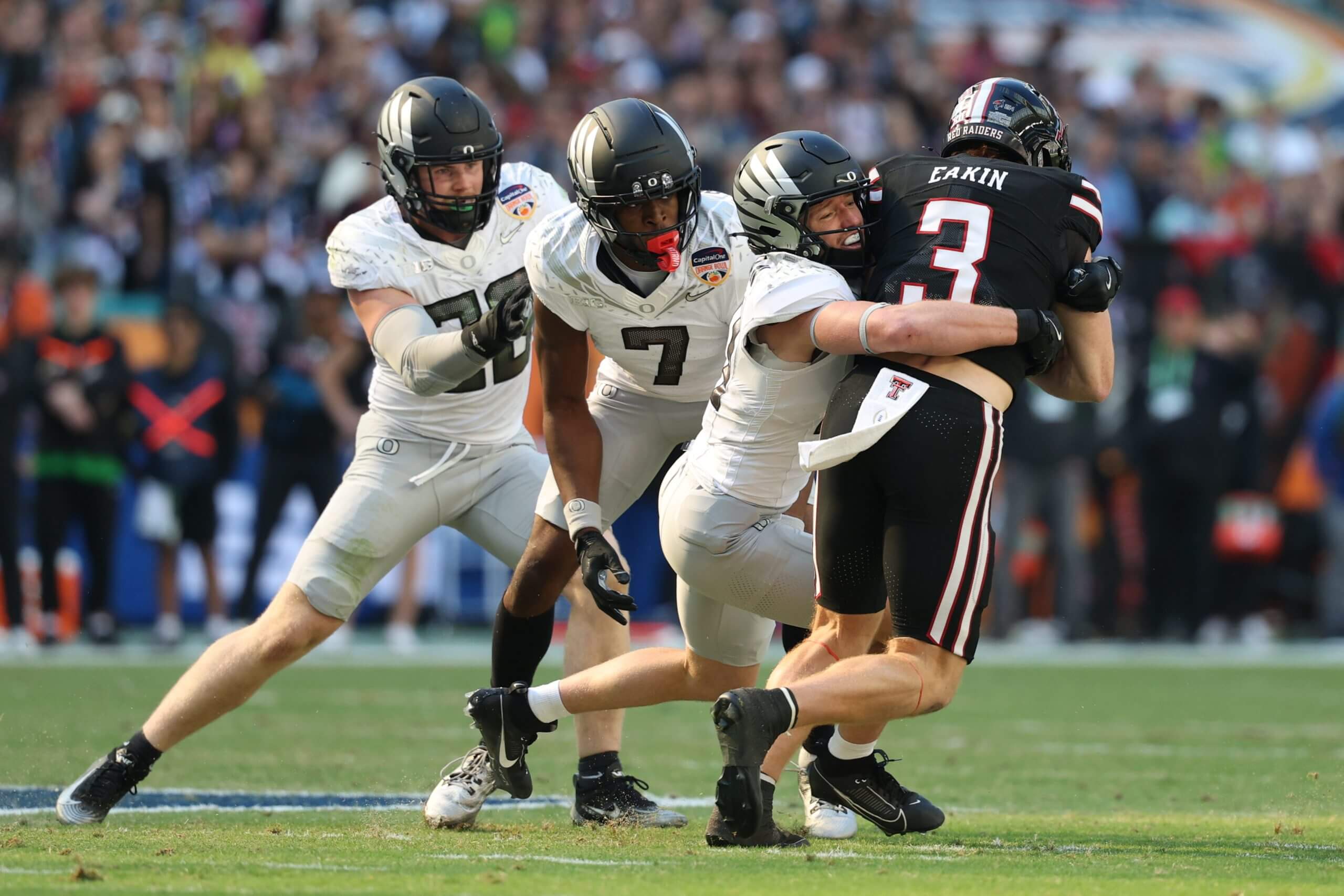
Dillon Thieneman put up more impressive combine numbers to a player he’s been compared to in Cooper DeJean. (Nathan Ray Seebeck / Imagn Images)
9. Another DB whose stock should rise after this week is Arizona’s Treydan Stukes, a former walk-on who has played a lot at nickel and made a bunch of spectacular plays for a much-improved Wildcats team in 2024. The 6-1, 190-pounder with almost 32-inch arms had an impressive showing. His testing numbers were elite: a 4.33 40 with a 1.50-second 10-yard split, along with a 10-10 broad jump and a 38-inch vertical. He was described as a really long, athletic guy with good character — he was a team captain — who has some technique things he needs to clean up, but can fix. The traits and makeup are already there.
10. It’s going to be fascinating to see how NFL teams view Arkansas QB Taylen Green and how some team will try to use him in the next few years. At 6-6, 227 pounds with almost 35-inch arms, he ran the second-fastest 40 time by a QB at the combine, going 4.36 and barely missing Texas A&M’s Reggie McNeal’s 4.35 in 2006. Green also vertical jumped 43 1/2 inches and broad jumped 11-2. We had him on the Freaks List a few years ago when he was at Boise State and expected him to test well, but I was surprised by what a show he ended up putting on in the testing part of the combine.
Green (19 TDs, 11 INTs in 2025) was inconsistent as a passer in college and is still pretty raw, but he has a rare combination of size and athleticism. He had four rushes of at least 40 yards last season, but his team went 2-10 despite having him and Mike Washington Jr. on an offense run by Bobby Petrino. It’s also worth pointing out that, as bad as the Hogs were, they ranked second in the SEC in yards per play at 6.94.
11. Another intriguing prospect to watch will be USC’s other receiver, Ja’Kobi Lane. He’s got one of the most impressive highlight reels of spectacular one-handed catches. He had a very impressive day in the tests and on the field. At 6-4, 200 pounds, he clocked a 4.47 40 to go with a 40-inch vertical and a 10-9 broad jump. There are questions about his maturity and his consistency, but there is a whole lot of talent here.