
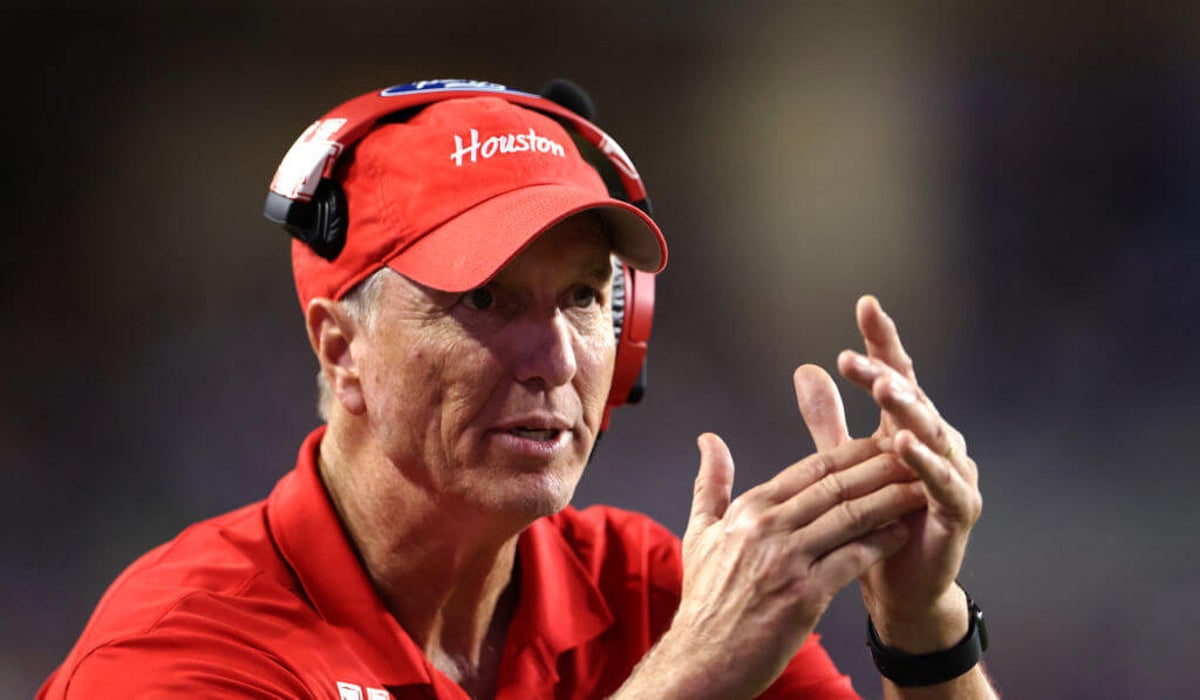
Willie Fritz wanted to go for it. But his coaches told him he was crazy. And the book that would revolutionize college football — and validate Fritz’s instincts — was still a year from coming into his life.
It was the opener of the 2014 season. Fritz was coaching underdog Georgia Southern, which had a 20-17 lead over NC State with 3:35 left. Georgia Southern had fourth-and-1 at the NC State 11. Fritz took the safe route — “because at that time, that was what people do” — and kicked the field goal.
Then he watched NC State go downfield, score a touchdown and win by a point.
A few weeks later, Fritz had another chance to buck conventional wisdom: Fourth-and-short near midfield in the first half against Georgia Tech. But again, Fritz couldn’t do it, so he punted … and watched Georgia Tech go 81 yards for the touchdown.
Fritz’s team lost by 4 points.
Next spring, Fritz welcomed to his office an old coaching friend, Rob Ash, who was now working with a start-up company, Championship Analytics Incorporated. They were trying to add Fritz as a client, and in their presentation, brought up those two games and those two situations.
Both times, they told Fritz, the analytics said he should have gone for it.
“I was friggin’ steaming over there,” Fritz said. “I was like, son of a b—-, they were right.”
Fritz signed on as a client right then. And he’s been a believer in “the book” ever since. As has most of college football, and some of the NFL.
There are more than 100 FBS teams that CAI counts as clients, plus about a quarter of NFL teams. They use “the book,” which is a literal book, with color-coded percentages and recommendations, updated every week during the season and customized for each team. They address all sorts of game situations: Whether to go for 2-point conversions, whether to kick a field goal, when to call defensive timeouts and whether to accept or decline penalties.
But it’s the fourth-down decisions that get the most notice — for better or worse — and where the book has had the most impact:
This past season saw the highest rate of teams going for it on fourth downs, per TruMedia: 27 percent, up from 25 percent in 2024, which had been the highest since at least 2005, the furthest back such data is available. Teams only went for it 18 percent of the time in 2005.
Fourth-down rate and success are both up
Season
Go-for-it rate
Conversion rate
2019
21.4%
53.0%
2020
24.1%
54.8%
2021
23.9%
53.6%
2022
24.8%
52.0%
2023
24.6%
51.8%
2024
25.5%
53.6%
2025
27.1%
54.2%
Not only that, teams went for it 15 percent of the time in their own territory last season, also the highest rate in at least two decades.
Given the increased risk, you’d think teams are making it less on fourth down. But TruMedia reports the 54 percent conversion rate on fourth down across FBS last season was the second-highest in the last 20 years. (The 2020 season was the first.)
In short, the game is being played differently. And much of the credit goes to a statistician from Indiana whose only football experience was watching on TV — and questioning what he saw.
How it started
Mike McRoberts was stuck. A snowstorm had stranded him in Buffalo, so he turned on an NFL game and was stirred to action. McRoberts, then working for Experian, would watch games and see “clear logic errors”: Coaches using timeouts too late or too early, kicking with short fields to go up 6 points rather than going for a game-clinching first down. And he remembers watching this game, he doesn’t remember which, and seeing another bad game management move by a coach apparently guided by his gut, rather than logic.
It was McRoberts’ breaking point.
“The way that I had always viewed sports, to this day I couldn’t diagram a play that could gain a yard, that hasn’t really been my cup of tea,” McRoberts said. “But just thinking through the strategies of the game, how can you create advantages by the numbers?”
And so McRoberts started putting together the book. He found a data set online with plays from the previous 15 years. He started a spreadsheet and charted NFL games. Based on the results, he calculated percentages to guide fourth-down and clock management decisions. After a couple of years, he started reaching out to NFL teams.
There were zero responses. So McRoberts turned his attention to college, where he got one response: Troy, where coach Larry Blakeney agreed to meet. Among other things, McRoberts informed him that going for it on fourth-and-1 at his own 20 was usually a good play.
“This is making total sense,” McRoberts recalled Blakeney telling him. “Except if I miss on this fourth-and-1, and they score on the next play, I’m gonna be sent on the next train out of town.”
Blakeney signed on for a small fee. But the big break for McRoberts came a few years later, thanks to another coach’s misfortune.
After a nine-year run at Montana State, Ash was fired. Ash had signed on two years before with McRoberts, who drove up to Bozeman and showed him how he’d messed up a chance to upset SMU the previous season: Montana State led the entire game, but when SMU was driving late, Ash should have called defensive timeouts to buy enough time for his offense. He didn’t, and lost.
The next season, with Rob’s son Scott now serving as his “book guy,” they faced the same situation against Sacramento State. This time, Ash used defensive timeouts and saved some time for his offense, which won the game. They made the playoffs that year by one game.
“I got into it not because I was intrigued by the math, but because I was intrigued by the winning,” Ash said.
They used the book Ash’s final two years at Montana State, going for it often on fourth down, sustaining more drives and leading the nation in many offensive categories. But the defense struggled and Ash was fired. His son Scott joined McRoberts’ new company, and Rob started tagging along on trips to recruit new clients, which proved critical: Ash’s arguments carried weight with fellow coaches.
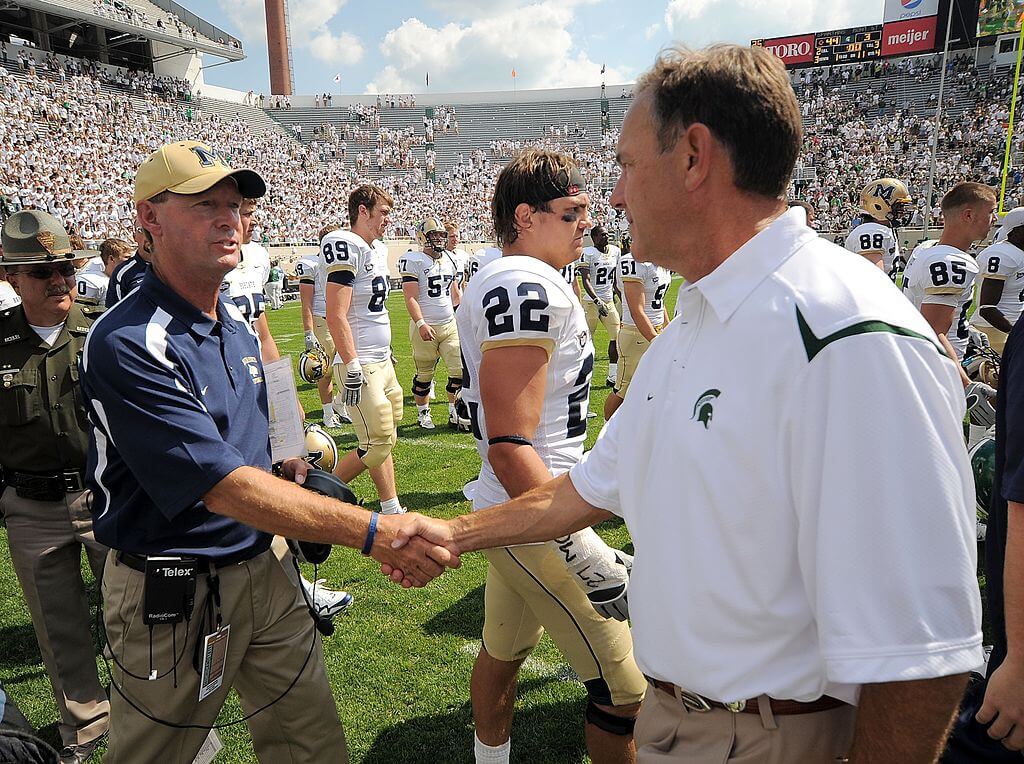
Former Montana State coach Rob Ash (left) was an early adopter of “the book,” and then left coaching to work for the company. (Mark Cunningham / Getty Images)
Utah was the first power-conference school to sign on. Bret Bielema, then at Arkansas, hired Ash to be his book guy in 2016, then Ash quit after one year to go full-time with CAI. The client list grew gradually, as did the scope of the book: The first one was just fourth downs and two-point conversions. It evolved to include things like clock management, or whether to accept or decline penalties in different situations.
They came along at a good time. Everyone was looking for an edge, and that trumped clinging to old notions.
“The idea that analytics was getting involved (in) this hollowed ground of coaching decisions, which a lot of old-timers like myself used to think it was all art — we began to realize there’s also some science,” Ash said. “That piece gradually became more obvious to people, and more prevalent as people used it, and there were enough people whose behavior changed.”
And it changed in ways both obvious and subtle.
For better or worse
Dan Lanning learned about the book at Georgia, where the analytically minded Kirby Smart was a believer. When Lanning got the Oregon head coaching job in 2022, he signed on, and the impact was immediate.
Oregon went for it 19 times the year before Lanning arrived. It went for it 32 times in Lanning’s first year — but its fourth-down conversion rate also went up from 47 percent to 62.5 percent. Of course, it was three failed chances in a game the following season that got the most attention.
In a high-stakes 2023 game at Washington, Lanning went for it:
On fourth-and-goal from the 3 on the final play of the first half, rather than take a field goal that would’ve brought Oregon within 22-21 at halftime.
On fourth-and-3 from the Washington 8 in the third quarter, rather than take a field goal that would’ve whittled Washington’s lead to 29-21.
On fourth-and-3 from the Washington 47, while leading 33-29 with 2:15 left.
Each time failed. After the game, Lanning told the media, “this game’s 100 percent on me.” Speaking a few years later, Lanning said the one call he regretted was right before halftime: The book recommended not taking the easy field goal, but Lanning blames only himself. (And perhaps the play call and execution.)
“It’s a tool to use,” Lanning said of the book. “You’ve got to be able to lean in on it and decide what fits you. I think if you just follow the book wholeheartedly every time, then you’ll probably be frustrated because it won’t always work. But they’re percentages, right? So if it says you have a 60 percent chance of converting on fourth down and you don’t convert, well, that’s the truth, right? That’s the reality. That’s the way it works. Four out of 10 times, it’s not going to work. But six out of 10 times it will.”
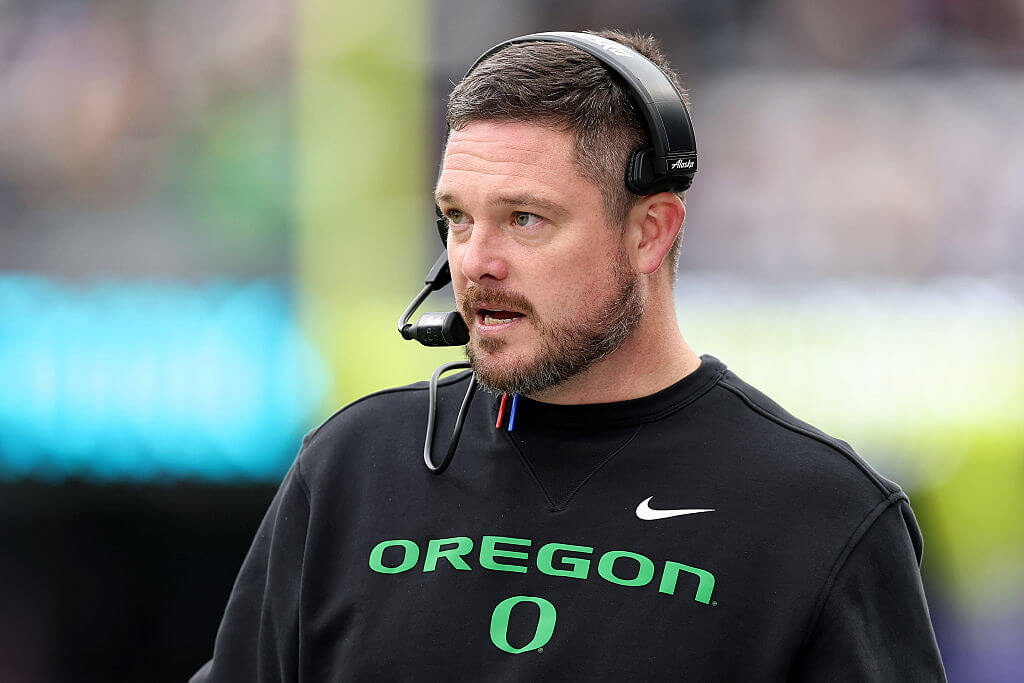
Oregon coach Dan Lanning uses the game management guidance from “the book” as a tool, but sometimes goes by feel. (Steph Chambers / Getty Images)
CAI tracks how often its clients — and non-clients — go by the book. Some do it less than others; these are recommendations, not rules.
But one coach who adheres closely is Army’s Jeff Monken. By its triple-option nature, Army has a lot of short-yardage fourth downs, and whether to go for it is critical. Monken adopted the book in 2016 and started to become more aggressive — and more successful. When Army was 32-for-37 on fourth downs in 2018, CAI told him it was the best fourth-down percentage it had ever seen.
“What the book did, and what CAI did, was take the pressure off of us,” Monken said. “It’s not subjective. It’s math. It is playing percentages.”
It also changed Army’s approach on all downs. Because it was resolved to go for it more often on fourth down, it would set it up on earlier downs.
“There was always that pressure, OK it’s third-and-10, I’ve got to come up with a play to get 10 yards. Well, there’s not many of those,” Monken said. “But now you really call plays to get yourself to under 3 yards on fourth down.”
Go-for-it rate in own territory
Season
Go-for-it rate in own territory
Conversion rate
2019
8.9%
52.4%
2020
10.3%
55.5%
2021
10.2%
55.0%
2022
10.9%
51.7%
2023
11.6%
52.0%
2024
12.9%
54.7%
2025
14.0%
56.4%
And it wasn’t just Army. Across the FBS level last season, the average yardage to go on fourth down was 3.8, per TruMedia, the least it has been over the last two decades. Teams are running or throwing short passes more often on third down: 51 percent of third-down passes last year were thrown to targets short of the sticks, down from 57 percent in 2019.
“The part that’s probably not factored in as much or enough is how different you call third down,” Lanning said. “If it’s third-and-7, and you’re going to go for it if it’s fourth-and-3 or less, or fourth-and-4 or less? Well, now all of a sudden, on third-and-7, you don’t necessarily feel like you have to throw it past the sticks.”
One result, Lanning added, is that there are fewer turnovers on third downs now. Teams committed turnovers on just 2.5 percent of third-down plays in 2025, the lowest rate in any season over the last 20 years.
Another result of this change in thinking: FBS teams averaged just under 12 drives per game last season, the fewest in at least the last 20 years, because they’re sustaining more drives rather than punting away. The clock rules get a lot of credit (or blame) for that. But the book may deserve some, too.
The backlash
The ultimate sign of popularity in the book is that it is now enduring the backlash phase. Such as in this year’s AFC Championship Game, when the Denver Broncos went for it on fourth-and-1 in the second quarter, rather than kicking a field goal. The Broncos were leading 7-0. They ended up losing 10-7.
The Broncos are not one of CAI’s clients, but McRoberts said coach Sean Payton made what mathematically was the right choice. As Payton said afterwards, he regretted the play call — a short pass — not the decision.
“If we could tell the teams what fourth downs would work and which ones wouldn’t, probably the line to meet with us at the booth would be a little bit longer,” McRoberts said, laughing. “It’s telling them just what, in general, should work, what would present the best odds. But it always comes down to the execution.”
Lanning, who took plenty of criticism for being aggressive in that 2023 Washington game, hasn’t been deterred. His book guy is in the press box during games, so Lanning always hears the recommendations, but sometimes he goes by the feel of the game.
“But I think the recommendations are really worth paying attention to, because there’s a reason they’re recommending it,” Lanning said. “It doesn’t always work, and when it does, it’s probably unnoticed, and when it doesn’t, it’s certainly noticed, but that’s part of the decision-making behind it.”
Fritz has been a head coach since 1993. He won a lot of games before the book came along. But he saw analytics as too valuable to ignore, and says he follows the recommendations most of the time. His book guy is Shane Meyer, his director of football operations, and they speak before every series and before every critical call.
“A lot of people say, ‘Oh, it’s a gut decision.’ But that may be indigestion. Maybe you ate some crappy food before the game,” Fritz said. “I’d rather have something to hang my hat on.”
In fact, Fritz has just one big regret about it.
“I wish I had enough money when I first got the book where I had told Rob: ‘Hey man, we’re done, I’m gonna pay you and don’t give s— to anyone else,’” Fritz said. “I didn’t have that kind of money, and still don’t — I’m sure they’re doing pretty well.”