
Join the huddle. Sign up here for Ravens updates in your inbox.
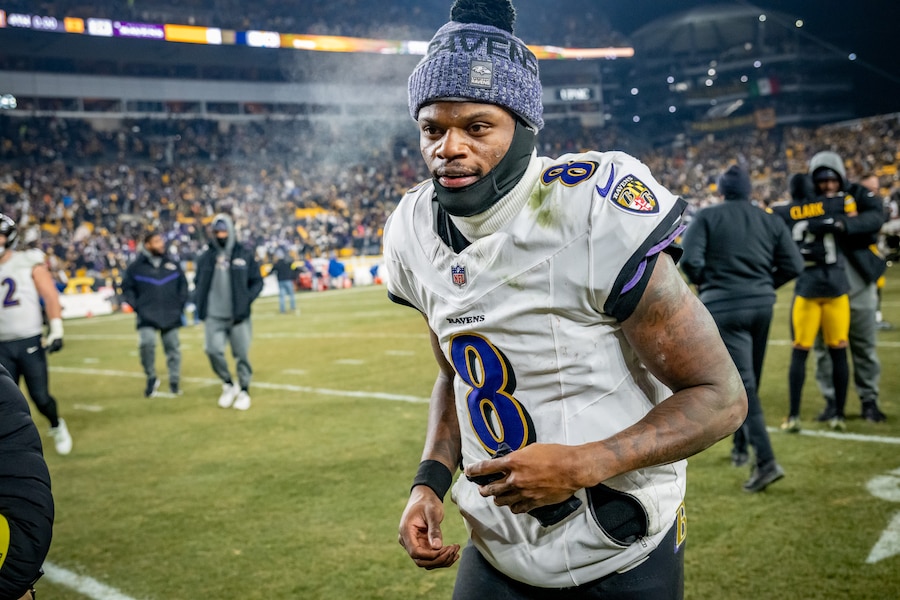
Steve Bisciotti’s deadline for Lamar Jackson is rapidly approaching.
The Ravens owner made it clear in a rare news conference appearance in January he wants the two-time MVP quarterback to sign a contract extension before free agency hits.
“I don’t want to go into free agency with that hanging over our head,” Bisciotti said. “And I made that clear to Lamar, and I think he was very appreciative of my stance, and hopefully willing to work with [general manager] Eric [DeCosta] and not get this thing dragged out into April like it was the last time.”
Although NFL free agency officially opens with the start of the new league year at 4 p.m. Wednesday, the legal tampering period begins Monday.
With Super Bowl aspirations, DeCosta will try to address roster needs through free agency and the draft, all while staying cap compliant.
One hurdle is the megadeal for the team’s biggest star.
The Ravens’ cap status
At the end of February, the league announced the salary cap will be $301.2 million for 2026. According to Russell Street Report, the Ravens had an extra $10,238,790 in space to carry over from 2025, so their adjusted cap for 2026 is $311,438,790.
The team needs to be cap compliant by the rule of 51 by the start of the league year, meaning the top 51 contracts on the team have to come in under the cap number. The contracts smaller than the top 51 don’t count against the cap until the first game of the regular season, giving general managers time to work.
With just 48 players currently under contract, the Ravens are projected to have $291,903,874 in cap liabilities, according to Russell Street Report. That leaves $19,534,916 to sign free agents and add players through the draft.
Jackson’s contract takes up a projected 24.55% of the team’s cap space, according to Spotrac. The next two biggest cap hits are linebacker Roquan Smith (10.78%) and defensive lineman Nnamdi Madubuike (10.21%).
DeCosta said at the NFL scouting combine last week that the Ravens had not approached Smith, who is his own agent, about restructuring his contract. Although he said Madubuike’s contract doesn’t affect their plans, he also had no update about whether Madubuike will return to the field after a season-ending neck injury.
The team is also hoping to extend center Tyler Linderbaum. If they don’t get that done and Madubuike doesn’t return, the Ravens have major holes to address. Less than $20 million doesn’t give them much room unless DeCosta works some cap magic.
What the Ravens can do
There are three ways the Ravens can go: Sign Jackson to an extension, restructure his contract or leave his contract alone and maneuver some of his teammates’ deals.
In 2023, Jackson signed a five-year, $260 million contract extension with a $72.5 million signing bonus and $185 million guaranteed. Under the current contract, his 2026 cap hit is a projected $74.5 million.
Bisciotti made his preference clear.
“If he doesn’t want to do an extension, then we throw those 74 million out into void years, and Lamar’s coming back at the same cap number he was last year,” Bisciotti said. “You can play with that money all you want. That’s not what we want. We want another window, and Lamar knows that.”
Here are the differences among the three options.
Extension
Assuming Jackson’s injury-riddled 2025 was an outlier and the Ravens trust he will be good for years to come, they want to sign him to an extension to keep him in Baltimore longer.
In addition to locking him in past the 2027 season, an extension would allow the Ravens to convert some of Jackson’s $51.25 million salary into a signing bonus. They could then prorate it over five years, reducing the immediate cap hit.
They can also put some of the money in incentives (e.g. play X number of games, throw for X number of yards), although it’s unlikely Jackson would agree to that. In his last contract negotiation, he demanded guaranteed money.
Restructure
Although the Ravens can convert Jackson’s salary into bonuses and prorate them without an extension, the money would come due sooner. If Jackson doesn’t sign an extension this year, the bonus would be prorated over 2027 and then void years, starting in 2028.
And if he doesn’t sign an extension in 2028, the dead money would accelerate onto the cap immediately. This would buy the Ravens only a year or two, and it would make the cap hit worse sooner.
Let it be
The Ravens could also leave Jackson’s salary as is, taking the $74.5 million cap hit this year and next and a $12.5 million void-year hit in 2028, but they’d need to adjust other contracts. This would make it harder to sign Linderbaum, much less other top free agents.
Although Smith and Madubuike are candidates for restructures, they also cause concerns. Smith seemed to have lost a step last year as he dealt with injuries and played next to inexperienced players. He’ll be almost 31 when he hits free agency, and he plays an unforgiving position.
Madubuike’s status is uncertain after he left Week 2 with a neck injury. If he can’t return, the Ravens will have to account for $51.925 million in dead money.
Cornerback Marlon Humphrey, who has the fourth-highest cap hit, was a potential candidate for release, but DeCosta said at the combine he wants him back.
Humphrey could be convinced to restructure his contract with incentive bonuses because his value on the market dropped after last season. This would give him a chance to bet on himself while giving the team a chance to reduce the hit of his salary.
The Ravens can tinker with additional contracts, trade players or release them for more cap relief.
But the easiest solution would be to get an extension done with Jackson.