
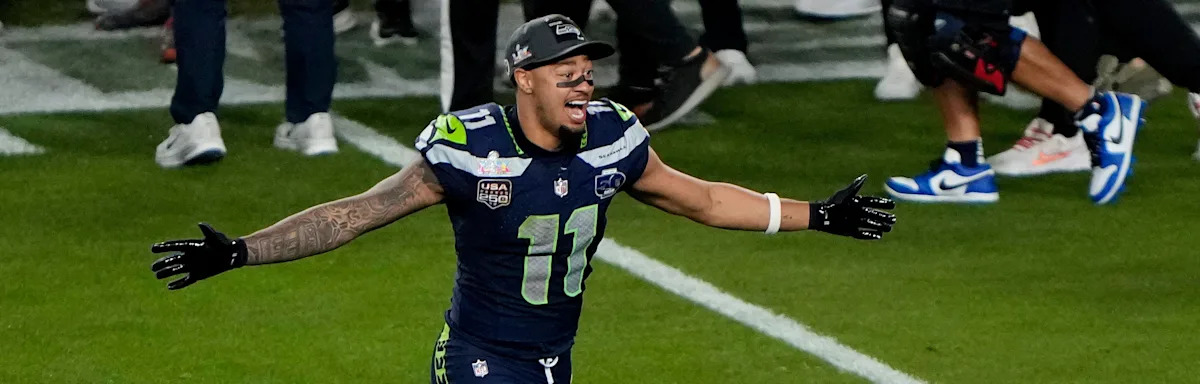
Sunday marks four weeks since the Seattle Seahawks thumped the New England Patriots in Super Bowl LX 29-13, laying claim to the title of World Champions. Sunday also marks four years since the Seahawks sent Russell Wilson to the Denver Broncos in exchange for two first round picks, two second round picks and a trio of players.
The three players who came back to Seattle included Drew Lock, Noah Fant and Shelby Harris, with Fant quickly becoming the first first round pick for whom the Seahawks exercised the fifth year option later that spring. Subsequently, John Schneider used the picks to add Charles Cross and Boye Mafe in the 2022 NFL Draft, before picking up Devon Witherspoon and Derick Hall in the 2023 NFL Draft.
Advertisement
That led to the 2025 offseason when Cross became the second member of the Seahawks to have the fifth year option exercised, and leads into the 2026 offseason where both Witherspoon and Jaxon Smith-Njigba have fifth year options on which Seattle needs to make decisions.
Whether or not to exercise the fifth year options on those two players is as close to a no brainer as possible, given their five Pro Bowls in six combined NFL seasons. This is especially the case for JSN, given the state of the wide receiver market, and the fact that adding a year to his rookie contract at a $23.852M cap hit is a bargain at a time when elite wide receivers can command contracts in the $40M range.
However, while the decision to exercise the option seems like a no brainer, there is another factor at play that complicates things from a cash flow perspective. Specifically, fifth year options are fully guaranteed at exercise, and in the present case of JSN and Witherspoon, the options cover the 2027 NFL season. That means that exercising the options means Witherspoon and JSN would have fully guaranteed salaries in a future league year, which would, of course, trigger the funding rule.
The funding rule, as Field Gulls has explained elsewhere, requires team to put fully guaranteed salary in future league years into escrow, meaning if the Seahawks exercise the fifth year options of Witherspoon and JSN, they would then be on the hook for $45.013M of fully guaranteed 2027 base salary for the pair. Putting that money into escrow is little more than prepaying the 2027 salary of the pair, so it’s not a huge deal.
Advertisement
However, given the cash spending obligations of the Seahawks in 2026 under the minimum spending requirements of the CBA that Field Gulls covered Wednesday, exercising the fifth year options adds tens of millions more in cash obligations for 2026. The reason why is because even though the team must fulfill the funding rule and deposit the money, the salary being deposited is to cover 2027 obligations and therefore would not be included in the calculations for the minimum spending thresholds.
Now, of course, since contract extensions for elite young players can be front loaded with a large cash signing bonus, the easiest way for Seattle to meet its cash spend obligations is to extend Witherspoon and JSN. The signing bonuses of contract extensions alone would likely put the team close to, if not in excess of the 2026 cash spending requirements.
Thus, the conundrum the team faces is that if it exercises the fifth year options while opting to wait until next offseason to sign the pair to extensions, it not only likely costs more by way of a higher APY after yet another year of cap growth, it would require meeting the 2026 league year cash spend obligations on top of making the requisite deposits to satisfy the funding rule. The team can certainly do both, but for an organization as frugal as the Seahawks, it would be out of character. Specifically, it would require tying up tens of million in cash that don’t need to be tied up once extensions are agreed to for both players. In short, the team can kill two birds with one stone. Extending Witherspoon and JSN keeps them in Seahawks uniforms going forward, while also knocking out the cash spend obligations of the CBA.