
GREEN BAY — When the three Marquette University freshmen left the Olympia dormitory on the school’s downtown Milwaukee campus on that late November weekend in 1954, little did they know that their impromptu road trip would change the course of Green Bay Packers history.
The odyssey was the brainchild of Bob Kronschnabel, a Green Bay native and dyed-in-the-green-and-gold-wool Packers fan, who in turn had invited his two best buddies from down the hall to come with him.
One was Leo Scherer, a civil engineering major from Denver. The other was an 18-year-old journalism major from Des Moines, Iowa.
His name? Bob Harlan.
The Packers lost to the Detroit Lions that day at old City Stadium, 21-17 — the beginning of a four-game losing streak that left the Lisle Blackbourn-coached Packers with a 4-8 record at season’s end.
Legendary coach Vince Lombardi wouldn’t arrive in Titletown, USA until five years later. In fact, Green Bay wouldn’t even adopt that moniker until the 1960s, as Lombardi would lead the Packers to five world championships, including victories in Super Bowls I and II.
After that, the once-proud organization would wander in the NFL wilderness for nearly three decades. And Harlan, who after graduating from Marquette would serve as the athletic department’s sports information director before spending five years with MLB’s St. Louis Cardinals in community and public relations, would join the Packers organization in 1971, as the team’s assistant general manager.
Harlan would ascend to the team’s presidency in 1989 and serve as the organization’s chief executive until 2008 — a tenure that would prove transformative for the crown jewel franchise of the NFL.
And not once would he pay for a ticket to a Packers game.
“That’s,” he said with a laugh in a 2003 interview, “my only claim to fame.”
Hardly.
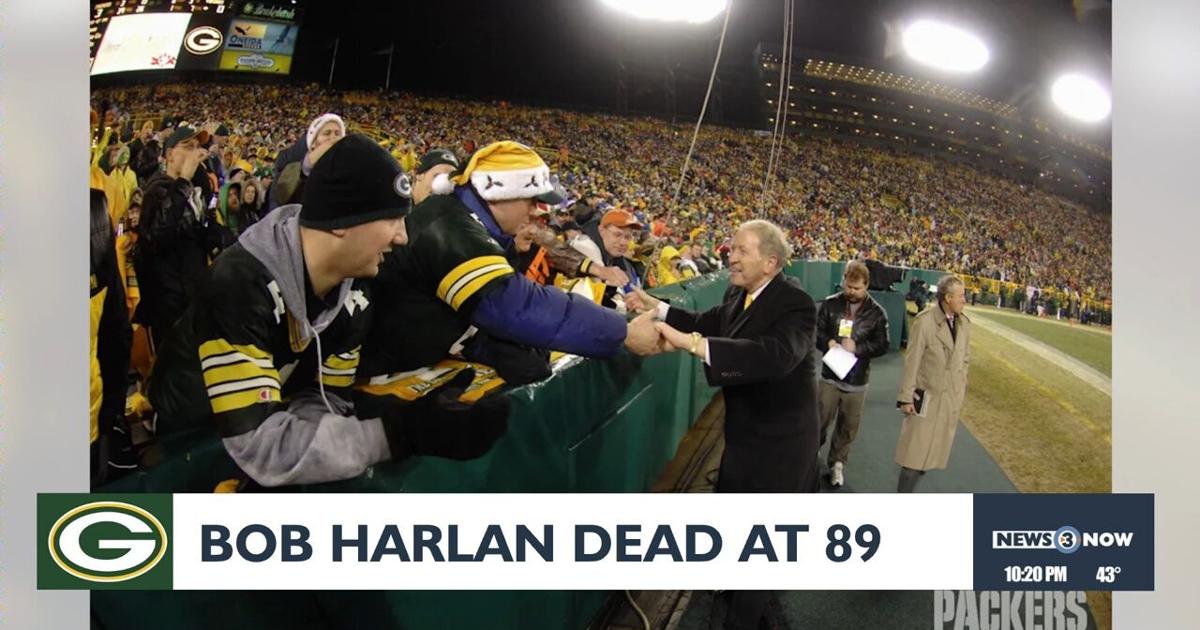
Harlan, who died on Thursday at age 89 at St. Mary’s Hospital in Green Bay after a brief illness, surrounded by his family and with his wife of nearly 67 years, Madeline, by his side, would prove to be a brilliant-and-beloved leader who would make some of the historic franchise’s most future-defining decisions.
“The Packers family was saddened to learn of the passing of Bob Harlan,” new team president/CEO Ed Policy said in a statement released by the organization Thursday afternoon. “Bob was a visionary leader whose impact on the franchise was transformational.
“Bob restored the Packers to competitive excellence during his tenure and helped ensure our unique and treasured flagship NFL franchise was on sound footing for sustained generational success.”
On the field, Harlan hired Ron Wolf in 1991 to serve as the team’s general manager and gave him full authority over the football operation — something the team had refused to give Wolf five years earlier when he interviewed for the same job under then-team president Robert Parins.
“We were all broken, and [Wolf] fixed us. It was that simple,” Harlan once said in an interview. “I’ve always thought that the one thing I was able to do was hire good people, know good people, and then stay out of their way. Be available to them, but not interfere with them.”
Wolf, in turn, became the architect of the franchise’s modern renaissance, hiring Mike Holmgren to be the team’s head coach, trading for a little-known Atlanta Falcons third-stringer named Brett Favre to be the team’s quarterback and signed legendary defensive end Reggie White in the early days of free agency — an addition that altered the way other players around the league viewed the NFL’s tiniest outpost.
Wolf, Favre and White are all enshrined in the Pro Football Hall of Fame. Holmgren was a finalist for induction in 2025. That foursome led the 1996 team to the Super Bowl XXXI title — the franchise’s first championship in 29 years.
“Bob Harlan gave me an opportunity, and I am deeply indebted to him for that,” Wolf said in a statement. “His greatest trait, in my opinion, is that he was an honorable man, a man of his word, a man of character.
“He was an honor to know and a pleasure to work with.”
Said Holmgren: “I was blessed and fortunate to have Bob Harlan as the team president for my first head coaching job. He set an incredible tone for the entire organization.
“He gave us the support we needed and let us do our jobs. He certainly had other things to do in the much larger spectrum of his work, but he also took the time to visit with me. One thing he’d always do was stop in and see me every week and ask, ‘What can I do to help you?’ That was him.
“Bob helped me become a good manager, a good coach, and to understand the responsibilities of leadership. That carried with me throughout my career. He was really good to me. I owe him a great deal. I’m honored to have worked for him.”
In 2005, Harlan hired Ted Thompson, a former lieutenant to Wolf who’d served as Holmgren’s lead personnel man with the Seattle Seahawks, to be the Packers general manager.
Thompson, in turn, hired Mike McCarthy as the head coach and selected quarterback Aaron Rodgers in the first round of the 2005 NFL Draft. Rodgers led the 2010 team to the Super Bowl XLV title and has won four NFL MVP awards — one more than Favre did.
“Bob Harlan is the definition of what the Green Bay Packers embody. The foundation for continuous decades of success falls directly at his feet — and heart,” McCarthy said. “I have so many meaningful memories and moments with Bob, but what I cherish most is the consistency of him showing up to my office every week, with a cup of coffee in hand, asking about Jessica and the kids — and never leaving without asking, ‘Coach, are you getting everything you need?’
“As proud as Bob was of the Packers, that pales in comparison to the pride he had in his beautiful family. My heart pours out to Madeline, Kevin, Bryan, Michael and the Harlan family as they mourn and celebrate a tremendous husband, father, grandfather — and man.”
As vital as that on-field success was, Harlan also made a pair of business decisions that proved prescient — and vital to the club’s survival.
First, in 1994, he pulled the team out of Milwaukee County Stadium and relocated all of the team’s home games to Lambeau Field. Understanding that Milwaukee-area fans had helped save the franchise in the 1940s by supporting it during difficult financial times, Harlan insisted that the club had to “bring Milwaukee fans with us” and hatched a plan in which there’d be two season-ticket packages: One for long-time Lambeau ticketholders, another for the County Stadium transplants.
“Their parents and grandparents helped save this franchise when little Green Bay couldn’t support it in the ’40s and ’50s,” Harlan once said. “I said, ‘We’re abandoning the stadium, but we’re not going to abandon the fans.’ I knew that decision hurt a lot of people, but it had to be done.”
Not long after, the only community-owned franchise in American professional sports again found itself in dire financial straits as the 21st century was set to begin.
The Packers’ quaint-but-outdated stadium, with its green corrugated metal exterior and lack of amenities, had the team rapidly becoming one of the league’s have-nots, in desperate need of improved local revenue streams.
In January 2000, Harlan unveiled a redevelopment plan for Lambeau Field, one with a $295 million price tag that would require $160 million in public funds — funds that would be generated by a 0.5% sales tax in Brown County that needed to be approved by county voters through a referendum.
Harlan campaigned relentlessly, oftentimes waking up at the crack of dawn and greeting workers at local paper mills and factories to court their votes, then spending the rest of the day at diners and other local haunts making his case to voters.
With whatever time remained in the day, Harlan would go door-to-door in neighborhoods throughout the city, then return to his Lambeau Field office and answer phone calls — he always answered his own phone, from the day he took over until the day he retired — from fans who were reluctant to vote in favor of the measure.
“I was worried about him,” Madeline said in a 2003 interview. “I told someone, ‘I’m going to go over there [to Lambeau Field] and bring him back and never let him go back.’ You’re trying to do what you think is a wonderful thing for the community, and people question your motives and your integrity.
“But he was determined. There was no stopping him.”
The measure passed, by a 53%-to-47% margin. In 2003, a renovated Lambeau — with towering statues of Lombardi and franchise founder Earl “Curly” Lambeau standing sentry in the Robert E. Harlan Plaza to welcome fans to the sparkling stadium atrium — opened.
“I’m out there in the shadow of those two statues, two men who are the biggest names in the history of the franchise,” Harlan once said. “One founded it and won six world championships; the other one saved it and won five championships. To be in an area with them, it means a great deal to me. I’m monumentally honored.”
Robert Ernest Harlan was born Sept. 9, 1936, in Des Moines, Iowa, where he graduated from Dowling Catholic High School in 1954. He then enrolled at Marquette, where he met the former Madeline Kieler on a double-date — the only problem being that Harlan’s date was a woman named Pat Walsh, and Madeline’s was a guy named Jack Manning.
“But I liked her, so I called her about a week later and asked her out,” Harlan once recalled. “I just thought I’d try it, and it worked.”
In November 1959 — five years after Harlan’s road trip with his college buddies Kronschnabel and Scherer — Harlan again attended a Packers game, this time with his new wife, and they watched the Johnny Unitas-led Baltimore Colts beat the Packers, 28-24, at County Stadium in Milwaukee.
“I remember he turned to me and said, ‘I hope someday I’ll be good enough in public relations to be the PR director for the Green Bay Packers,’” Madeline once recalled of that game. “It was my first Packers game, and I think there was a feeling there for him that I didn’t know about at the time.”
In addition to Madeline, Harlan is survived by his son, Kevin (Ann) Harlan of Mission Hills, Kan., and their children: Abigail (Bobby) Sight and their daughter, Scarlett; Haley (Jerry) Mancuso and their children, JJ, Mary Madeline, and Matilda; Olivia (Sam Dekker) Harlan Dekker and their children, Harlan Wolf and Christian; and Robert (Gabriella) Harlan and their son, Francis; and by his son, Bryan (Barbara) Harlan of Chicago and their daughter, Katie; and his son, Michael (Cortney) Harlan of Verona.
Arrangements are pending.
COPYRIGHT 2026 BY CHANNEL 3000. ALL RIGHTS RESERVED. THIS MATERIAL MAY NOT BE PUBLISHED, BROADCAST, REWRITTEN OR REDISTRIBUTED.