
The Baltimore Ravens’ list of priorities heading into the 2026 NFL Draft could change dramatically when arrivals, departures and re-signings mark next week’s start to free agency.
For now, though, Baltimore’s roster presents plenty of drafting possibilities. The attention will be on the offensive and defensive lines and positions such as wide receiver and edge rusher. What’s clear, at least before free agency, is that there’s not a single position where the Ravens couldn’t use more depth, including the kicking game with punter Jordan Stout eligible for free agency and Tyler Loop coming off an uneven season.
General manager Eric DeCosta could have as many as 11 picks at his disposal when the compensatory selections are announced, and he’ll need many of them to augment a roster that sprung quite a few leaks last season.
The Ravens will remind everyone ad nauseam over the next six-plus weeks before the draft that they’ll take the best player available when on the clock, and they’ll stick to their board and not chase need.
In our second mock draft of 2026, an effort was made to address the team’s needs while taking players in the general vicinity of where they’re predicted to come off the board.
Round 1, No. 14: Vega Ioane, G, Penn State
This is a case of the best player available aligning with one of the team’s biggest needs. Ioane is one of the best players in the draft, and the only reason he could be available for the Ravens at No. 14 is if some teams don’t believe in selecting guards early in the first round. The Ravens, though, have consistently shown they aren’t overly influenced by positional value.
There’s no obvious edge rush match at 14, assuming Arvell Reese, David Bailey and Rueben Bain Jr. go in the top 10. There’s also no sure-fire interior defensive linemen in the top half of the first round. Using another first-round pick on a defensive back feels dubious, and the top cornerback likely to be available at 14, Tennessee’s Jermod McCoy, didn’t play last year. There are significant questions about all of the first-round wide receivers.
Ioane, meanwhile, is one of the cleanest prospects available. His physicality and athleticism will allow him to make a quick transition to the NFL. He’d be a big addition to an offensive line that needs an injection of young talent and at least two or three new starters this offseason.
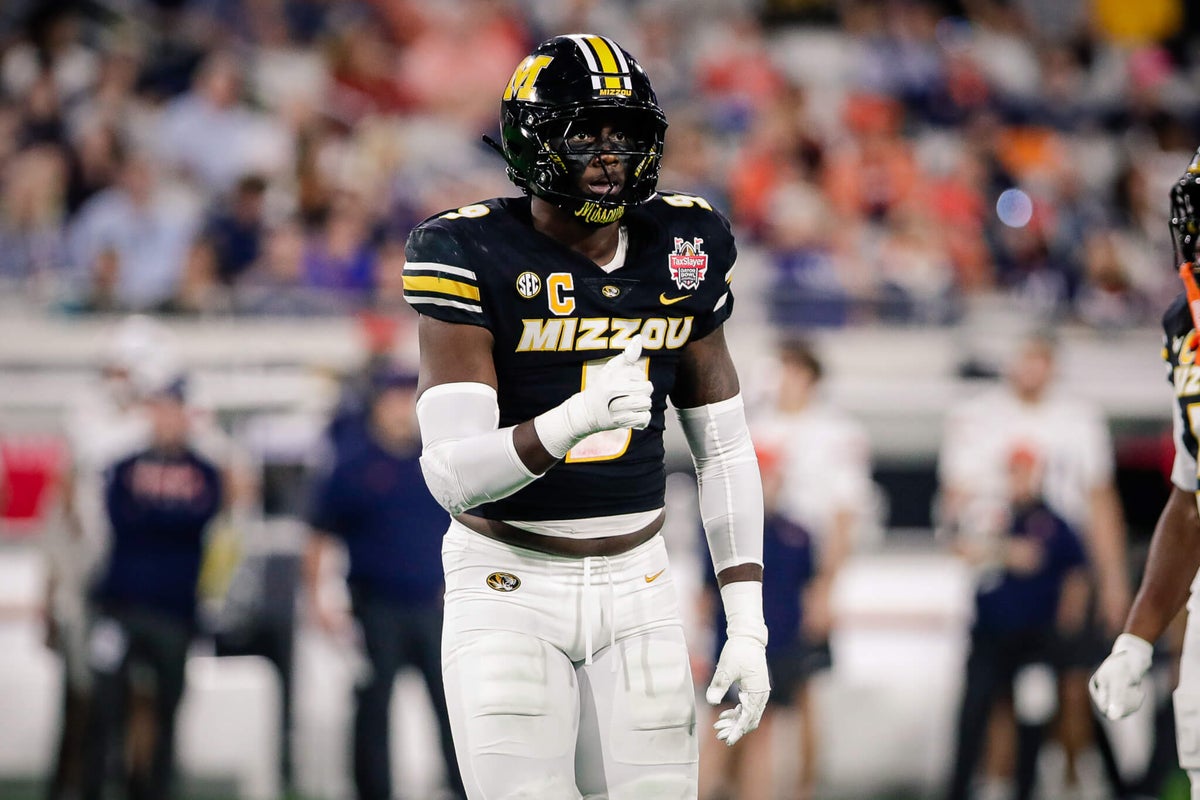
Round 2, No. 45: Zion Young, OLB, Missouri
Day 2 has not been kind to the Ravens when it comes to drafting edge rushers, but banking on finding a high-impact guy on Day 3 doesn’t feel like the sensible approach. If the Ravens don’t take a big swing on an edge rusher in free agency, they won’t be able to wait very long to grab one in the draft.
Young will need to develop more variety in his pass-rush moves and approach, but he has all the requisite tools to grow in that area — and he plays with the physicality, passion and nastiness the Ravens covet. Young will be a factor against the run immediately.
Round 3, No. 80: Darrell Jackson Jr., DT, Florida State
Jackson would continue the Ravens’ trend of loading up on big, physical players early in the draft and trying to reclaim the trenches they lost far too often last year. He’s 6-foot-5, 315 pounds and has a 7-foot-2 wingspan.
When he’s playing with proper technique, Jackson is hard to move as a run defender and has enough explosiveness to flash as a pass rusher. Rounds 2 and 3 in this draft are billed as a sweet spot for a deep interior line class, and the Ravens need to be in the mix. Jackson has his warts as a prospect, but there’s considerable upside here.
Round 4, No. 115: Nate Boerkircher, TE, Texas A&M
That the Ravens, who could lose Isaiah Likely and Charlie Kolar in free agency, will select a tight end feels like one of the safest bets in the draft. Boerkircher is a fast-rising prospect who didn’t have elite production as a pass catcher in college, but he has the skill set to contribute in that area. And he’s one of the best blocking tight ends in his class.
Boerkircher profiles as a solid replacement for Kolar. The Ravens have done well finding useful tight ends in the middle rounds. Boerkircher could be the latest.
Round 5, No. 152: Reggie Virgil, WR, Texas Tech
Virgil is a tall (6-3), athletic outside receiver who is adept at making contested catches and has reliable hands. He averaged nearly 16 yards per reception in college, and he posted 15 touchdowns over his final two seasons.
Virgil performed well at the Senior Bowl and NFL Scouting Combine, and the Ravens put a lot of stock in those workouts. He also has special teams value, which should allow him to get on the field immediately.
Round 5, No. 160 (from Chargers): Tacario Davis, CB, Washington
It’s not ideal to wait this long before addressing one of the league’s most important positions, and the Ravens haven’t exactly gotten a ton of value in recent Day 3 cornerback picks. However, it’s tough to make the position a priority when Baltimore might focus early on adding in the trenches.
Davis is a developmental prospect, but he has ideal size and length (6-4, 194 pounds) and has 4.41 speed. He possesses enticing traits for the Ravens’ new coaching staff to develop. Davis projects as an outside corner, but there’s some thought that he could help as a safety, as well.
Round 5, projected comp pick: J’Mari Taylor, RB, Virginia
Justice Hill is coming off a neck injury and has been mentioned as a potential salary-cap cut, and Keaton Mitchell is an unrestricted free agent. It feels like running back depth is an underrated need for the Ravens, who have never been shy about using Day 3 picks on backs.
Taylor was a productive college player with three-down capabilities because of his receiving skills. He’s been good in short-yardage situations, and he knows how to find the end zone (15 touchdowns last year).
Round 5, projected comp pick: J.C. Davis, OT, Illinois
Despite selecting three offensive linemen last year, it feels likely that the Ravens take at least two more shots at improving their talent up front. J.C. Davis was a four-year starter in college between New Mexico and Illinois, almost exclusively playing left tackle. He joined last year’s fifth-round pick, Carson Vinson, as a potential insurance policy for veteran left tackle Ronnie Stanley, who has dealt with plenty of injuries over the years.
Davis, who is 6-5 and 335 pounds, could also factor in the guard mix, where the Ravens need more depth.
Round 7, No. 249 (from Eagles): Eli Heidenreich, WR/RB, Navy
I mean, why not? Heidenreich has performed extremely well on the All-Star game circuit, and the Ravens were already plenty familiar with him from his productive run at nearby Navy. He’d be a nice option for new offensive coordinator Declan Doyle and potentially contribute as a slot receiver, running back and on special teams.
The reality is, there probably won’t be room for three seventh-round picks on Baltimore’s roster. It’s worth taking a shot at this stage of the draft on high-character, work-ethic guys who can contribute in multiple ways.
Round 7, projected comp pick: Kaleb Proctor, DT, SE Louisiana
Proctor is an undersized (6-2, 291 pounds) but explosive interior lineman who can make plays behind the line of scrimmage and has situational rusher traits. He had eight sacks and 8.5 tackles for loss last season.
Obviously, he’ll be taking a major step up in competition, but he didn’t look overwhelmed on the All-Star circuit. This is the time to take fliers on players with specific traits anyway.
Round 7, projected comp pick: Jalen Huskey, S, Maryland
Huskey said at the NFL combine that he hit it off with Ravens special teams coordinator Anthony Levine Sr. during a meeting in Indianapolis. That’s fitting, because at this point of the draft, any player the Ravens select will have an uphill battle to make the team — and contributing on special teams is the quickest path to doing it.
Huskey had 11 interceptions over his final three college seasons, so his ball skills are there. Speed concerns could cap his ceiling as an NFL safety. He has the skill set to become a special teams standout, though.