
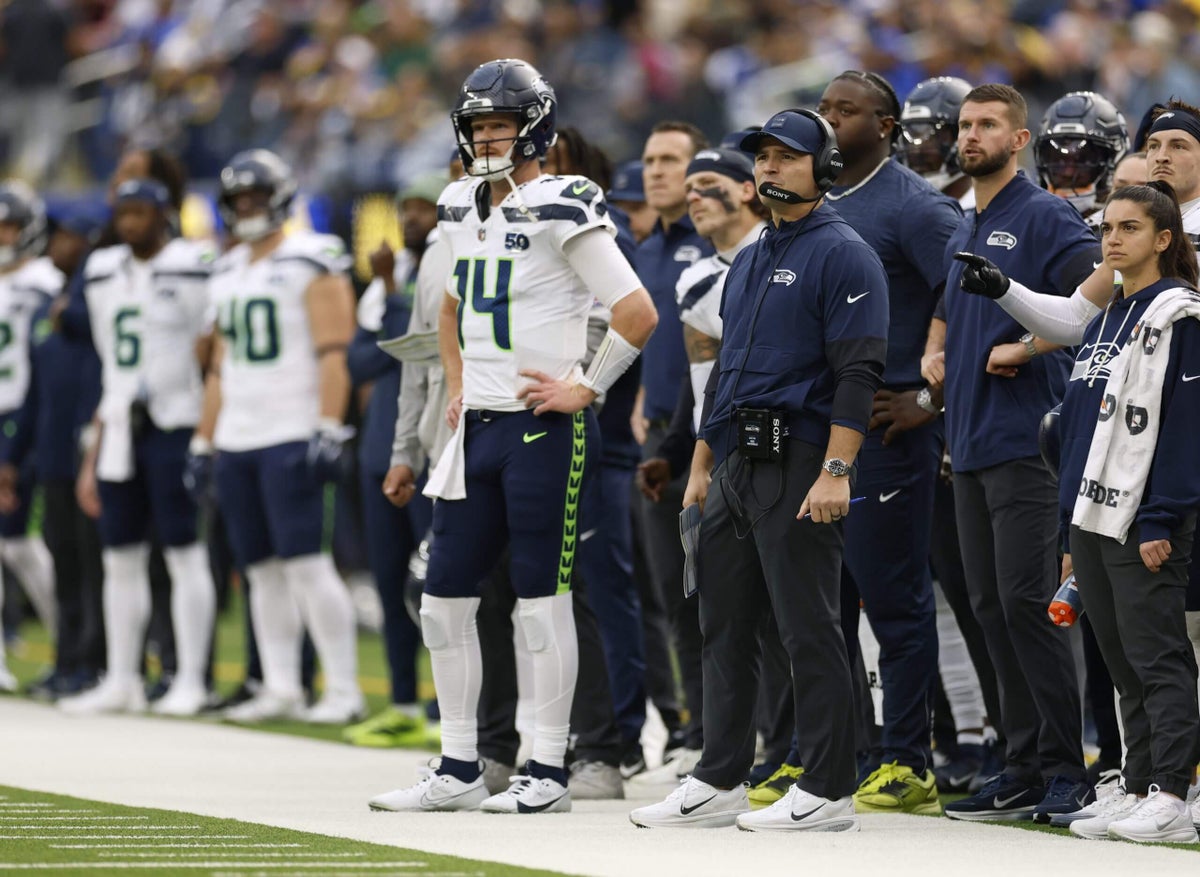
Members of the Seattle Seahawks’ front office can puff out their chests this offseason, knowing other teams will be dissecting their roster-building approach in an attempt to replicate it.
Those Seahawks front-office staffers can also laugh at that thought; replicating the Super Bowl champions’ “blueprint” presents plenty of challenges.
In his first season in Seattle, Sam Darnold vastly outplayed his contract while delivering a dream season and completing one of the most admirable comebacks stories in NFL history. But the Seahawks didn’t land on Darnold until years of calculated decisions to balance out the rest of the roster. All the while, the Seahawks avoided other aggressive, risky avenues at quarterback.
They also benefited from a great deal of good fortune. Darnold signed a three-year, $100.5 million contract with the Seahawks — his average annual value of $33.5 million was the 18th among quarterbacks. There were 11 QBs on the books for at least $50 million in 2025, as teams have often rushed to pay market rate to keep their franchise players happy.
As The Athletic revealed in an August study, that market rate has become more of a burden than teams anticipated. QB contracts have ballooned at a disproportionately higher rate than the salary cap; teams have had to learn how to navigate these murky waters on the fly.
Contrary to popular belief, a highly paid franchise quarterback has not been the shortcut to team success. Of the 10 highest-paid QBs in 2025, five made the playoffs, and four were on teams that finished below .500. Tua Tagovailoa became the first $50 million quarterback to ever get benched for performance.
It wasn’t a one-year blip. Taking the 10 highest-paid quarterbacks each season since 2011 — when salary structures changed with the rookie wage scale — 65 made the playoffs, while 62 finished under .500 and missed the postseason. Of those, 18 advanced to a conference championship game and nine made the Super Bowl, with four winners.
Now, compare that to QBs whose annual salaries ranked in the 11-20 range: 61 made the playoffs, while 66 finished under .500 and missed the postseason. Eighteen made a conference title game, with nine advancing to the Super Bowl and six winning it (including Darnold).
The numbers have been shockingly similar, both in terms of measuring team success (making the playoffs) against team failure (finishing below .500 and missing the postseason) and comparing the 10 highest-paid QBs with their peers in the middle-class range.
The impulsive reaction to this data is a trap. Don’t think: So the Buffalo Bills shouldn’t pay Josh Allen? That’s not the point. Rather, it’s that too many teams have made the mistake of banking everything on the wrong quarterback — or paying the right one while failing in too many other areas on the roster.
Take Joe Burrow and the Cincinnati Bengals. They made the Super Bowl in 2022 when Burrow was on his rookie contract, but the Bengals have missed the playoffs in all three seasons since awarding him a new contract that pays $55 million per year. It’s not because Burrow hasn’t been worth the contract, but because the roster has been in disarray.
Since 2011, the two highest-paid quarterbacks in each season have never won the Super Bowl. In fact, only two of the top-5-highest-paid QBs in any season have raised the Lombardi Trophy (Eli Manning in 2011, Patrick Mahomes in 2022).
The most glaring trend has centered on the contracts at the most important position. We’ll explain by using the same parameters that were explained in greater detail in the August study — dividing the QB’s average annual value into the league’s salary cap to measure a contract’s impact without bonus manipulation.
In 2011, there were seven QBs whose contracts consumed 10-15 percent of their team’s salary cap. By 2018, 18 quarterbacks absorbed at least 10 percent of the cap, and the top seven fell between 14 and 19 percent — that year, Aaron Rodgers became the first to eclipse 18 percent.
Mahomes in 2020 was the first to take up more than 20 percent of his team’s cap space (22.7), but six quarterbacks hit that mark in 2022. There were eight QBs north of 20 percent in 2024, but Dak Prescott of the Dallas Cowboys was the only one in 2025. That dip was due to recent explosions in the salary cap, but also because teams cooled off on paying quarterbacks after a prolonged frenzy.
As for the Seahawks, they went through it with Russell Wilson, who was on his rookie contract when they won the Super Bowl in 2013. While it would be unfair to blame their subsequent decline and rebuild on Wilson’s contract alone, it was part of the equation.
They lost their way in the back half of the 2010s, too often falling into the trap of drafting for need. Seattle traded Wilson to the Denver Broncos in 2022 to accelerate its rebuild by clearing its finances and stockpiling draft assets. The Seahawks also scoured the college ranks for a long-term answer — obviously the ideal strategy — and could have made a play for one in 2023 when they had the No. 5 pick.
But they didn’t like Bryce Young, C.J. Stroud or Anthony Richardson enough to mortgage the future for a move up the board, so they stayed where they were. The Seahawks walked away from that draft with cornerback Devon Witherspoon, wide receiver Jaxon Smith-Njigba, defensive end Derick Hall, running back Zach Charbonnet and guard Anthony Bradford.
Add that group to a strong class from 2022, and the Seahawks began to establish a championship core. But even as the Seahawks restocked, they refused to overstep their means at quarterback. Remember, Geno Smith had started five games in seven seasons before outlasting Drew Lock for the starting job heading into the 2022 season, and Smith was a good starter for the better part of three years.
Last year, though, Smith overplayed his hand in contract negotiations. The Seahawks, whose original preference was to keep him, ultimately traded Smith to the Las Vegas Raiders for a third-round pick. They pivoted to Darnold.
A stroke of good luck? Sure. But everyone needs to catch a break along the way, whether it’s Tom Brady at No. 199, Mahomes at No. 10 or a friendly face and willing trade partner in another organization when you’re looking for Matthew Stafford. For the Seahawks, their Plan B turned out to be more than OK.
The NFL is as impatient as ever. Head coaches hired from 2000-09 were on the job for an average of a full year longer than those hired from 2010-19. For the Seahawks, though, patience is an asset. They parted ways with Pete Carroll two years ago after 14 seasons, but general manager John Schneider has been in place since 2010. The late Paul Allen and his sister, Jody Allen, earned praise for their approach.
While the draft-and-develop model will forever be king with quarterbacks, it’s not always practical. The Raiders will almost certainly take Fernando Mendoza at No. 1 next month, but the QB-desperate New York Jets and Arizona Cardinals are stuck behind them, considering other options.
Will they get desperate for a free agent like Malik Willis and let him take his lumps while they attempt to build up the roster around him, or is that strategy doomed to fail with a tantalizing draft class on the horizon in 2027? On one hand, no one ever wants to repeat the Dolphins’ sin of passing over Drew Brees in free agency in 2006. On the other, reclamation projects are still the exception, no matter how in vogue they’ve become recently with Darnold, Baker Mayfield and Daniel Jones.
The Seahawks nailed their approach with Darnold, but it would be an oversimplification to suggest another team could just tab a middle-class quarterback in free agency and expect success to follow. It’s typically a handy way to stay competitive, but that’s been the ceiling far more often than not.
As teams continue to learn how to adjust to evolving financial dynamics with their quarterbacks, the Seahawks found a process that worked. For anyone trying to replicate it: Good luck.