
For the Chicago Bears and their fans, the offseason–as of late–has been the most exciting part of their season. That all changed in 2025 after they reeled off an 11-6 regular season record en route to their first playoff victory in 15 years. As fate would have it, as soon as the Bears become a contender, their salary cap situation tightens, at least in the short term.
Although Chicago might not have the same cap flexibility we’ve become accustomed to seeing, they still have enough flexibility to add a few impact players before the draft. Speaking of the draft, absent their sixth-round selection, they’ll have a full allotment of picks, which could provide some additional flexibility. Arriving a year early only counts in the moment, which means general manager Ryan Poles and his front office must continue to be aggressive– and calculated– when pursuing each avenue to improve their roster into a perennial Super Bowl contender.
With the table set for what should be another active offseason, let’s dive into how it could play out in Aaron Leming’s annual Chicago Bears Mock Offseason Extravaganza, 2026 edition.
What The Bears Will Be Working With (Finances):
2026 Cap Space ($301.02M + $5.2M rollover) $306.4M
Dead Cap: $19.356M
Current Cap Space (Top 51): +$31.451M
Projected Draft Class: ($10.869M) $4.674M
In-Season Spending (53-man roster, practice squad, roster moves): $9.5M
Total Projected Functional Cap Space: +$17.277M
Roster Specifics:
Current Roster: 51
Minimum Contract: $885K
Per usual, let’s dive into the basics of how an NFL offseason works and what needs to be accounted for along the way. Because the Bears are at the 51-player mark, each contract signed for over $885,000 will take the bottom spot on the Top 51. The minimum contract number will continue to rise as Chicago signs additional players at higher salaries.
The good news: If a player signs a $5 million contract, only $4.15 million (at minimum) would count toward their remaining cap space, and that “lowest accounted for” cap number will continue to rise over a million by the end of next week.
It’s also worth noting that when accounting for a full offseason, you’ll see their current Top 51, projected draft class (also accounting for the Top 51), the eventual accounting for an extra two players to get to a 53-man roster (usually no more than $2 million), the practice squad ($4-$4.5 million), and additional in-season roster moves (usually $3 million). This is why you’ll see a full accounting at the top of this projection that shows where they currently stand, and what else needs to be accounted for. It’s worth noting that once the new league year begins next Wednesday, the only things teams will need to account for are their Top 51 and any dead space they are carrying. For full accounting purposes, I will always factor in the full costs of the regular season when I do a full offseason mock.
Following the trio of cap-saving moves executed this week, the Bears currently rank 12th in available cap space. That number will change constantly over the weekend and into next week as the legal negotiation period begins. While some might see the lower figure and panic, please note that the Bears rank toward the top of the league in restructure potential, at around $69 million on the low side and $129 million on the high side, depending on how they choose to approach their restructures. With that said, fans can reasonably expect them to stay within the confines of their cash budget, which means they won’t come anywhere near that $129 million figure. Frankly, they probably won’t come close to the $69 million mark either, especially given that they cleared $44 million in collective space between Drew Dalman’s retirement, the trade of DJ Moore, and the release of Tremaine Edmunds.
With the table set, let’s dive into the Bears’ needs.
Defining The Bears’ Offseason Needs and Priorities
Top Needs: (8) C, DE1, DT1, LT, FS, SS, LB, WR3
Sometimes, football can be a cruel game. Heading into the Wild Card Round against the Green Bay Packers, it appeared that all five starting spots along the offensive line were secured for the foreseeable future. First came Ozzy Trapilo’s ruptured patellar tendon, and more recently, Pro Bowl center Drew Dalman shocked the NFL world by announcing his retirement at 27. While fans should still reasonably expect a Top 10 offensive line again in 2026– health willing– having to fill two starting roles again this offseason is a tough pill to swallow, especially when neither opening was expected coming out of the regular season.
In addition to the offensive line, focusing on the defensive trenches is another top priority. How the Bears choose to approach that will be interesting, especially after spending multiple high-value resources on that group last offseason. That said, anyone who watched them in 2025 knows that without a drastically improved defense, their chances of getting to and winning a Super Bowl aren’t high. To round out their top needs, both safety spots and at least one starting linebacker should be on the docket, whether that’s through free agency or the draft. Following the trade of Moore, acquiring additional depth at receiver should be considered another mid-level expense priority.
Other Needs: (13) DE4, DT3, CB4, S3, S4, LB3, WR 4 and 5, LS, iOL/C Depth, TE3, K competition, QB3
Considering the Bears were a division and playoff winner just a few months ago, their needs run far past the surface. Defensive line depth, along with additional defensive back depth, is a top priority defensively. Offensively, depth at receiver and on the offensive line should be top priorities, although none of those needs should be overly expensive. These are the types of holes that Poles and his front office filled in early April last year. If they expect to have enough depth to contend for a Super Bowl, they’ll need the same luck, and maybe more this go around.
Dealing With The Current Roster
Retirement: (1)
Total Saved: +$9.15M (+$17.277M) *Already Accounted
C Drew Dalman $10 million in savings for 2026 ($9.15 million in true savings) and an additional $4 million that will be credited to 2027 once they claw back the pro-rated $6 million signing bonus.
Cuts: (2)
Total Saved: +$15.335M (+$$17.277M) *Already Accounted
LB Amen Ogbongbemiga $2.07 million savings ($1.185 million in true savings) Already Done
LB Tremaine Edmunds $15 million savings ($14.15 million in true savings) Already Done
With both Ogbogbemiga and Edmunds accounted for in the current cap equation, the Bears aren’t likely to make any other cost-cutting measures in this department until closer to Week 1, if at all. Despite their efforts to shop Edmunds around, the 27-year-old linebacker will be free to choose his next team, albeit at a discounted rate from what he was expected to earn in Chicago on the final year of his contract.
Restructures: (5)
Total Saved: +$31.901M (+$49.178M)
CB Jaylon Johnson $6.968M
RG Jonah Jackson $6.883M
NCB Kyler Gordon $6.05M
LG Joe Thuney $6M (3 void years)
DE Montez Sweat $6M
In my original projection, I had the Bears restructuring Dalman and saving around $5 million. With his abrupt retirement, I’ll stick to the five names listed above. Any time a team restructures a contract, there will be added dead money for the life of the contract in the form of a prorated bonus. We won’t focus too much on that for now, but know that these restructures will not severely hamper them in 2027 and beyond. Instead, it provides them with some immediate savings.
It’s also worth noting that Poles might not choose to do a bulk string of restructures, but instead execute them as needed. No matter how it happens in real time, this is about what I would expect in the end.
Trades: (2) Total Spent: -$5.365M (+$43.813M)
WR DJ Moore and 2026 5th Round Pick to Buffalo Bills for 2026 2nd Round Pick $16.5 million in savings. Already Done
LB Pete Werner from New Orleans Saints for 2027 5th Round Pick $6.25 million in spending
Of anything that happens in an offseason, trades are always the hardest to project. Poles has been active in the trade market in almost every offseason since taking over as general manager, and nobody should expect that to change now. Creativity is key for any short offseason with limited financial resources, and gaining a few extra picks in the process sure helps.
Trading Moore felt certain, dating back to the early parts of last season. Being able to land a second-round pick for him was the cherry on top after saving $16.5 million this year and plenty more moving forward. While Moore will be missed, the team’s impressive number of talented pass catchers made this much easier to swallow. Werner is a player who makes a lot of sense, especially if Dennis Allen is looking for a lower-cost option with scheme familiarity. Finally, trading Bagent may not be something the general manager or head coach wants to do. Still, given the free agent market and draft class, the opportunity to receive the highest value may never be higher. I don’t see them parting with Bagent for anything less than a Day 2 value, which is exactly what the first pick in this year’s fourth round and a 2027 fourth would equal out to.
Extensions: (2) Total Saved: $2.6M (+$46.413M)
TE Cole Kmet (1-Year Extension/Added Guarantees) 3 years, $24M ($16M guaranteed) $5.6 million saved Cap Hits: $6M, $7.5M, $13.7M
RT Darnell Wright 4 years, $112M ($43M guaranteed) plus fifth year option ($19.072M) ($15M signing bonus) $3 million spent Cap Hits: $9.671M, $22.072M, $20M, $26M, $28M, $32M
Similar to Poles’ tendency to make trades, he’s been good about extending players before they hit free agency. For Wright, it’s a no-brainer to pick up his fifth-year option, while giving him a market-value deal as one of the league’s best right tackles. Regarding Kmet, the idea behind this extension is to give Kmet more long-term security by extending him for a year while lowering his cap hit in the short term. This allows the Bears to keep both tight ends, keep Kmet at home, and have everyone happy.
Re-Signs: (13)
Total Spent: -$12.172M (+$34.241M)
OL Theo Benedet 1 year, $1.05M (Exclusive Rights) Already Done
S Kevin Byard 2 years, $20 million ($11M guaranteed) (Comp: PFF)
Cap Hits: $5.5M, $8.5M, $5M (Void)
OT Braxton Jones 1 year, $5M ($3.5M guaranteed) (Comp: PFF)
Cap Hits: $3.5M, $1.5M (Void)
DB C.J. Gardner-Johnson 1 year, $3.5M ($3M guaranteed)
Cap Hits: $2M, $1.5M (Void)
TE Durham Smythe 1 year, $2.5 million ($1.5 million guaranteed) (Comp: Durham Smythe 2025)
Cap Hits: $2M, $500K (Void)
LB D’Marco Jackson 2 years, $5.5M ($3M guaranteed) (Comp: Troy Dye)
Cap Hits: $1.5M, $3M, $1M (Void)
DE Daniel Hardy 2 years, $5M ($2.45M guaranteed) (Comp: Josh Blackwell/Amen Ogbongbemiga)
Cap Hits: $1.5M, $2.5M, $1M (Void)
QB Case Keenum 1 year, $2.25M ($2.155M guaranteed) (Comp: Case Keenum 2025)
Cap Hits: $1.5M, $750K (Void)
WR Olamide Zaccheaus 1 year, $1.5M ($250K guaranteed)
Cap Hits: $1.5M, $500K (Void)
S Eijah Hicks 1 year, $1.8M ($650K guaranteed)
Cap Hits: $1.3M, $500K (Void)
iOL Jordan McFadden 1 year, $1.5M ($500K guaranteed)
LS Scott Daly 1 year, $1.338M ($168K guaranteed) $1.198M
WR/RET Devin Duvernay 1 year, $1.215M ($500K guaranteed)
Historically, Poles have not kept a lot of their pending free agents from year to year. A large part of the equation was simply rooted in how bad their roster was. Coming off an 11-win season and a clear need for depth, retaining some of their players feels important to maintaining continuity and showing players that if they play well, they can be extended, even if they aren’t a starter.
With Moore traded, Dalman retired, and Edmunds out the door as soon as this weekend, keeping some semblance of their core together from last year would make sense. Byard is the one player on this list who feels like a priority, and assuming the money lines up, it feels safe to expect him back. Gardner-Johnson is another “glue”- type player who gives the defense a needed edge, in addition to valuable versatility at both safety and nickel. The rest of these players are simply depth pieces that should help them keep a safe floor while adding more upside later in the draft.
Key Free Agents: (5)
Total Spent: -$27.485M (+$6.756M)
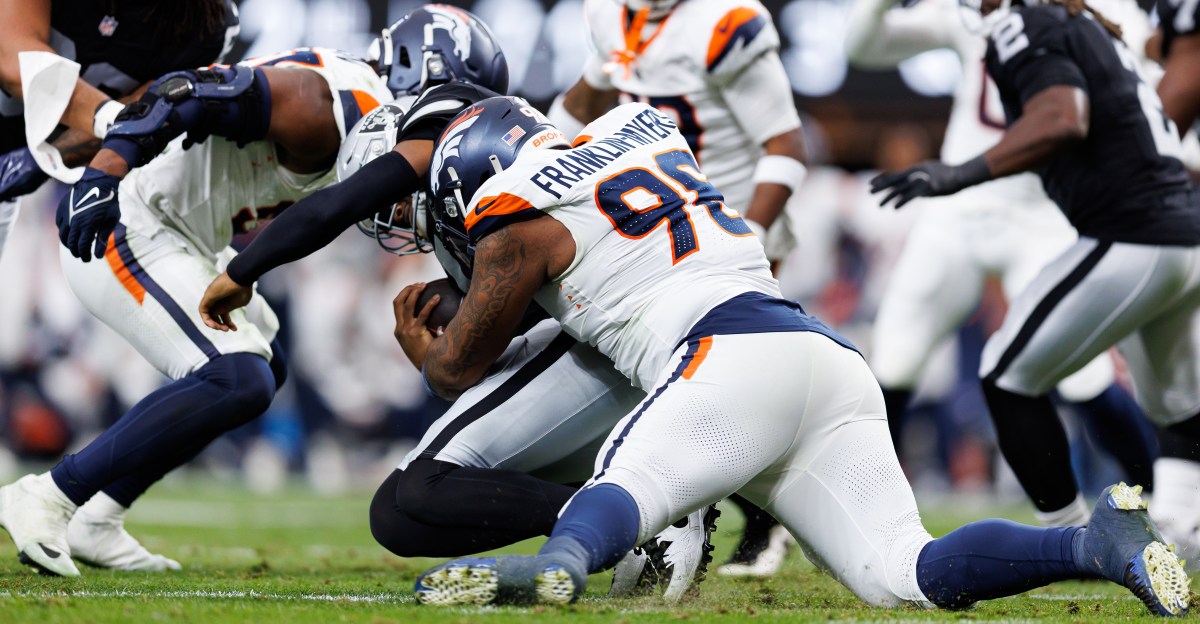
DT John Franklin-Myers 3 years, $51M ($23.255M guaranteed) (Comp: Jonathan Allen)
Cap Hits: $9M, $16M, $18M, $8M (Void)
Coming into the offseason, I’m not sure there’s a greater need on the defensive side of the ball than a pass-rushing tackle. The issue, at least on the surface, is that the free-agent group isn’t particularly strong, which means the Bears will be competing for names with many other teams. Franklin-Meyers is a player who has impressed during his time in Denver and is due tfora gigantic pay raise in what might be his only true free agency. JFM would immediately give their entire defensive line more credibility in getting after the quarterback. More importantly, it wouldn’t preclude them from adding another high-round player in April’s draft.
C Connor McGovern 3 years, $42M ($28M guaranteed) (Comp: Drew Dalman)
Cap Hits: $7M, $14M, $16M, $5M (Void)
If the Bears want to continue playing at the level they did in 2025, an aggressive free-agent swing may be necessary. McGovern’s time in Dallas was primarily seen at guard and was widely regarded as uninspiring. The 28-year-old’s last two years in Buffalo have gone a long way in giving him instant credibility. Some have even argued that he’s on a similar level, if not better than Dalman. He’s bigger for sure, and tends to hold up better in pass protection. After losing Dalman to an early retirement, this would be a move that everyone can get behind, even if it’s not swinging for the fences with Tyler Linderbaum.
DE Khalil Mack 1 year, $14M ($14M guaranteed) (Comp: PFF)
Cap Hits: $10M, $4M (Void)
Return of the Mack Part 2.0? You betcha! Last year, I was *this close* to mocking him to the Bears, but in the end, the Dayo Odeyingbo smoke felt palpable. Although I ended up hitting the nail on the head with that projection, it has not worked out nearly as well for the Bears as they had hoped. With that in mind, maybe the second time is the charm? Mack’s career is winding down, and while he’s not the same pass-rushing threat that he was earlier in his career, he’s still a damn-good player that would fit very well in this defense. His days of playing upwards of 85% of the defense snaps are over, but I’m not sure that’s what the Bears are looking for anyway. Mack would give them a nice 1-2-3 punch off the edge, and anything they got from Odeyingbo or a draft pick is just icing on the cake.
CB Rasul Douglas 1 year, $6.5M ($2.5M guaranteed) (Comp: PFF)
Cap Hits: $4.5M, $2M (Void)
Plenty has been made about a potential reunion between Alonte Taylor and Dennis Allen, but at what cost? Jaylon Johnson remains one of the highest-paid boundary corners in the league, and the same could be said for Kyler Gordon in the nickel. Does it make sense to potentially spend another $15-$18 million per year on a boundary corner who might be better suited inside? That’s what brings me to Douglas. The veteran had an impressive yet under-the-radar season in Miami and could provide a quality CB2 option opposite Johnson at a much lower price. It also allows Tyrique Stevenson to stay in the mix and potentially prove himself in a contract year.
WR/KR Kalif Raymond 2 years, $6.185M ($3.2M guaranteed) (Comp: Rashid Shaheed w/ Higher Guar)
If money were no object, I’d be pounding the table for Rasheed Shahid. That said, it wouldn’t make a lot of sense for the Bears to trade away Moore to save $16.5 million this year, just to turn around and give a lesser receiver similar money. Instead, why not let Ben Johnson bring in a familiar face, like Raymond, who can provide some quality upside as a depth option, not to mention his additional value as a returner. Raymond likely won’t see much of a raise from his last contract in Detroit, which makes this a low-cost move worth making.
Draft: (1st, 2nd, 2nd, 3rd, 4th, 5th, 7th, 7th)
Previously Acquired Picks:
– 2nd from Bills (For WR DJ Moore and 5th round pick)
– 4th from Rams (For 2025 trade down with 5th round pick)
– 7th from Browns (For Joe Tryon-Shroyinka and a 6th round pick)
Previously Traded Picks:
– 4th to Chiefs (For Joe Thuney)
– 5th to Bills (Moore trade)
– 6th to Browns (Tryon-Shroyinka trade)
Projected Trades:
– 3rd (#89) to Eagles for 3rd (#98), 5th (#151), and a 2027 6th Rounder
1st (#25) DT Peter Woods (Clemson)
The good news: The talent between pick 15 and the remainder of the first round is a toss-up. The bad news: The Bears will be looking at a lot of flawed players at No. 25 and might overthink it. No matter how you feel about the different names at each position, one thing is for sure: Chicago needs a lot of help on the defensive side of the ball. Woods didn’t measure well at the combine, and because of that, he’s gone from a Top 10 projection to some having him out of the first round. It doesn’t help that he had an uneven 2025 campaign, but if he’s on the board right here, I don’t think the Bears can go wrong. Sure, he’s undersized, but that’s exactly how Allen likes them on the interior. After signing Franklin-Meyers, they can give Woods some time to develop and get his feet wet before taking on a more significant role down the stretch of the season.
2nd (#57) S A.J. Haulcy (LSU)
With the additional second-round pick gained from the Moore trade, the Bears are sitting in a much better spot to address some of their defensive needs with high-ceiling players. Safety is always a bit of a toss-up, but Haulcy is a player that I keep coming back to when I look at ideal scheme fits in Allen’s defense. He can play near the line or deep as a centerfielder. He’s well built, and even if his testing numbers aren’t eye-popping, he’s a player who shows a lot of range, on top of his physicality. In this mock, he would start as the team’s third safety, but it won’t take him long to find a starting role, which would push Gardner-Johnson into more of a rover role, which would give Allen even more to work with in the secondary, assuming everybody stays healthy.
2nd (#60) DE Derrick Moore (Michigan)
This is where the true value of the additional second-round pick comes into play. In my first mock of the draft season, I had to get creative with trades, but even then, it felt like I overlooked the defensive end position. In this scenario, there should be an edge rusher that fits Allen’s mold of a long, athletic pass rusher. Whether that’s Moore or maybe even someone like Dani Dennis-Sutton, there’s bound to be at least one player on the board worth taking and developing without as much pressure.
3rd (#98) LB Kyle Louis (Pittsburgh)
Not only did the team move on from Edmunds earlier in the week, but I’d be shocked if T.J. Edwards is on the roster in 2027. He’s coming off a serious leg injury, and even if he’s healthy for the Week 1 opener, he’s not a great fit in this defense due to his lack of speed and overall coverage ability. Re-signing Jackson is a good step in the right direction, and Werner is exactly the type of player that fits Allen’s defense up the middle. That said, they need more upside, and that’s exactly what Louise brings. He’s an instinctual linebacker who might be undersized but is great in coverage and has the speed to flourish in this defense.
4th (#129) C Logan Jones (Iowa)
Dalman’s abrupt retirement shocked the NFL world, but after having a few days to process what happened, it’s clear that the Bears will value this position moving forward. Also worth noting is that while Joe Thuney and Jonah Jackson played at a high level in 2025, both are under contract only through 2027. My best guess is that once Thuney finishes out his three-year commitment in Chicago, he’s going to call it a career. Even with a lucrative free-agent deal for McGovern, the Bears must start planning and strengthening their offensive line pipeline. Jones is a perfect fit in Johnson’s blocking scheme, and even if he’s ready to start Week 1, a year or two worth of development could do him good. That’s what most good teams do. They draft and stash offensive linemen.
5th (#151) OT Aamil Wagner (Notre Dame)
Speaking of drafting and stashing offensive linemen… Wagner is the type of player who doesn’t have a super high ceiling, but with a year or two of development, he could slot in as a starter on the outside or interior. Again, this pick would be much more focused on drafting and developing replacements, with little expected return in Year 1. The Bears already have a good roster; now it’s time to fortify their depth.
7th (#239) S Lorenzo Styles Jr. (Ohio State)
The final round of the draft is always a crap shoot. As I noted in my first mock draft, I’m not going to sit here and pretend to know who is going to be available this late in the draft. Instead, I’ll rely on mock draft simulators and the few big boards that have 250-plus players on them. Styles is the brother of Sonny, who is expected to go in the Top 5-10 in April’s draft. Even if he’s not as talented, he’s still a good player in his own right and might develop into a starter down the line. With Byard on another two-year deal, this is the way to try to develop his long-term replacement. Again, this is what good teams do.
7th (#241) RB Desmond Reid (Pittsburgh)
My final pick in this mock draft is going to be Tarik Cohen 2.0. If you read my first installment, you’ll know a bit about Reid. What he lacks in stature, he makes up for in excitement. Just a year ago, he averaged 140 yards from scrimmage. Although he’ll likely never be a full-time running back, he gives the Bears a change-of-pace option and some special teams value as a returner. For an RB3, that’s perfect.
Depth Chart
QB: Williams/Bagent/Keenum
RB: Swift/Monangai/Reid/Johnson/Brown/Hankins
WR1: Odunze/Raymond
WR2: Burden/Walker
WR3: Zaccheaus/Duvernay
TE: Loveland/Kmet/Smythe
LT: Jones/Amegadjie/*Trapilo
LG: Thuney/Newman/McFadden
C: McGovern/Jones
RG: Jackson/Benedet
RT: Wright/Wagner
LDE: Mack/Booker/Hardy
DT: Franklin-Myers/Jarrett
DT: Dexter/Woods
RDE: Sweat/Moore/Odeyingbo
WLB: Jackson/Hyppolite
MLB: Werner/No.Sewell/Ne.Sewell
SLB: Edwards/Luois
CB1: Johnson/Smith/Frazier
CB2: Douglas/Stevenson/
FS: Byard/Hicks/Styles
SS: Gardner-Johnson/Haulcy
NCB: Gordon/Blackwell
K: Santos
P: Taylor
LS: Daly