
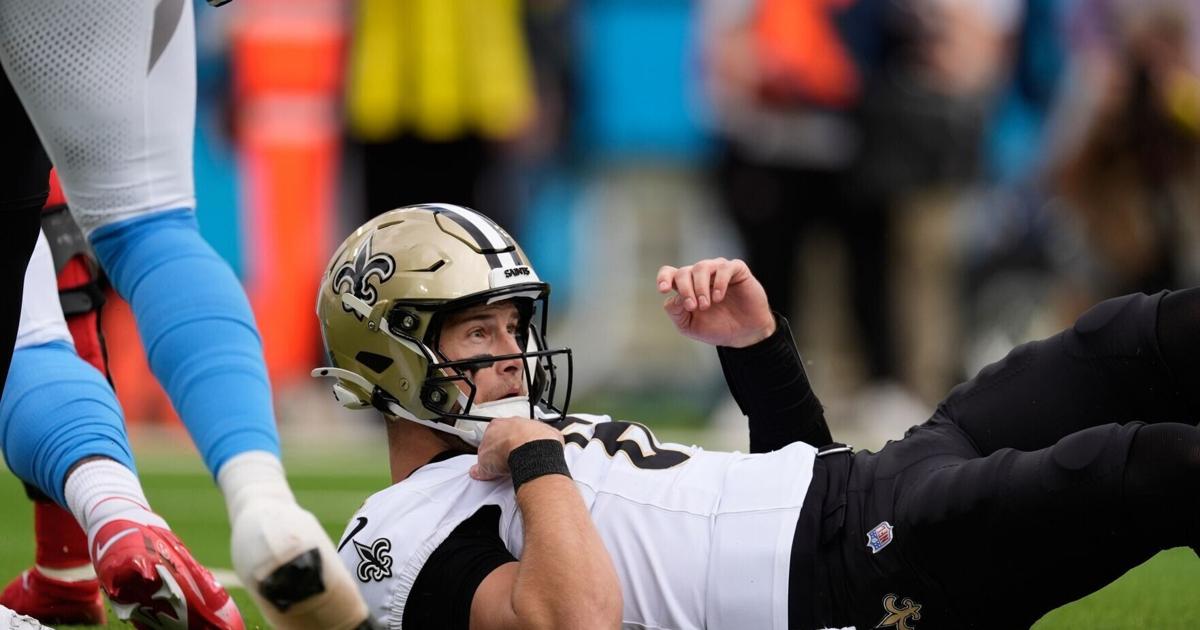
For a team that never wanted to rebuild, the New Orleans Saints seem to have embraced it.
Think back to last offseason. The plan to run it back with Derek Carr instantly shifted when the quarterback first suffered a mysterious shoulder injury and then retired. Everything since then has caused the Saints to “recalibrate,” general manager Mickey Loomis acknowledged after this past season.
That recalibration — not to be confused with a rebuild, wink wink — unfolded in stages. The rookie quarterback. The push to get younger. The growing pains under a first-year coach, followed by genuine momentum near the end of the season.
“It just changes your course a little bit,” Loomis said in January. “That’s the best way to describe it.”
But the Saints’ change of course looks to have been the best thing for them. And it took another significant turn Monday when NFL free agency effectively began.
Simultaneously, the Saints were major players while further pivoting away from their previous era.
They spent big to beef up the supporting cast around quarterback Tyler Shough, agreeing to terms with former Jacksonville Jaguars running back Travis Etienne (four years, $52 million), former Buffalo Bills guard David Edwards (four years, $61 million) and tight end Noah Fant (two years on a deal yet to be disclosed).
They made the hard but disciplined choices to say goodbye to linebacker Demario Davis and cornerback Alontae Taylor. Davis struck a two-year, $22 million deal with the New York Jets. Taylor earned a whopping three-year, $60 million contract from the Tennessee Titans.
New Orleans even signed a punter, making former Minnesota Vikings and Tulane Green Wave standout Ryan Wright (four years, $14 million) one of the highest-paid players at his position.
From the moment that Shough showed enough promise that he was worth building around last season, these were the logical next steps for the Saints.
They took them Monday — full steam ahead.
“Any offense is going to be steered by the quarterback position,” Saints coach Kellen Moore said last month at the NFL scouting combine. “Once that narrows its focus, it allows me to be a lot more specific as to what you want to do. That’ll be a full offseason journey.”
Moore now can focus on revamping the running game to help Shough, something that’s badly needed after New Orleans ranked last in yards per carry and explosive run rate last season. The coach acknowledged that improving it would be a priority in Year 2, and the Saints’ two big additions should help.
In Etienne, who returns to his native Louisiana, the Saints landed a productive rusher who has run for more than 1,000 yards in three of his four seasons. In Edwards, the Saints get an accomplished veteran who provides stability at a spot that has been a rotating door recently.
The Saints’ other additions also figure to guide Shough. Fant is coming off of a quiet season with the Cincinnati Bengals, but the seven-year veteran gives the Saints a notable red-zone target and the option to deploy two pass-catching tight ends alongside Juwan Johnson. Wright should give the defense better field position. Heck, even re-signing defensive tackle John Ridgeway (two years, $6.2 million) doesn’t hurt.
Notably, the Saints were willing to spend to address their biggest needs.
Etienne’s reported annual average value of $13 million would make him the league’s seventh-highest paid runner, and it was the second-largest deal for a running back to start free agency — behind only the Chiefs’ three-year, $45 million deal with Super Bowl MVP Kenneth Walker. Edwards, at $15.25 million per year, also didn’t come cheap.
The signings also don’t appear to be an overpay, let alone be crippling toward the team’s future.
That disciplined financial approach was even more evident in whom the Saints let walk. Start with Taylor. The Titans paid him as an outside cornerback, because they view him as an outside cornerback. The Saints didn’t. New Orleans wasn’t going to pay $20 million per year for Taylor to be its slot cornerback, even though his departure creates a notable hole.
Likewise, $11 million per year for a 37-year-old linebacker likely was too great a cost for the Saints. From an on- and off-field perspective, losing Davis hurts. He became a franchise staple during his eight years in New Orleans, emerging as one of the league’s best linebackers in that span. He was an instrumental leader for New Orleans, both as a player and as a person.
But changing your franchise’s course, as the Saints have, requires tough decisions. And they’ve gotten noticeably younger, as Davis’ departure creates an opportunity for 22-year-old Danny Stutsman to seize. Or if the Saints don’t feel the 2025 fourth-rounder is ready for that role, perhaps they bring in a veteran or draft a rookie to compete.
Taylor’s agreement with the Titans allows him to play in the state where he grew up. Davis returning to the Jets for a third stint gives him the chance to end his career where it began. They appeared to get what they wanted.
For the Saints, the question is how many more goodbyes are left? Cam Jordan and Taysom Hill were among the 17 Saints to hit the market when the league’s negotiating window opened at 11 a.m. Monday. Running back Alvin Kamara’s future also is up in the air after a recent contract restructure and Etienne’s signing.
The Saints are transitioning from one era to the next. Monday showed the latest cost.