
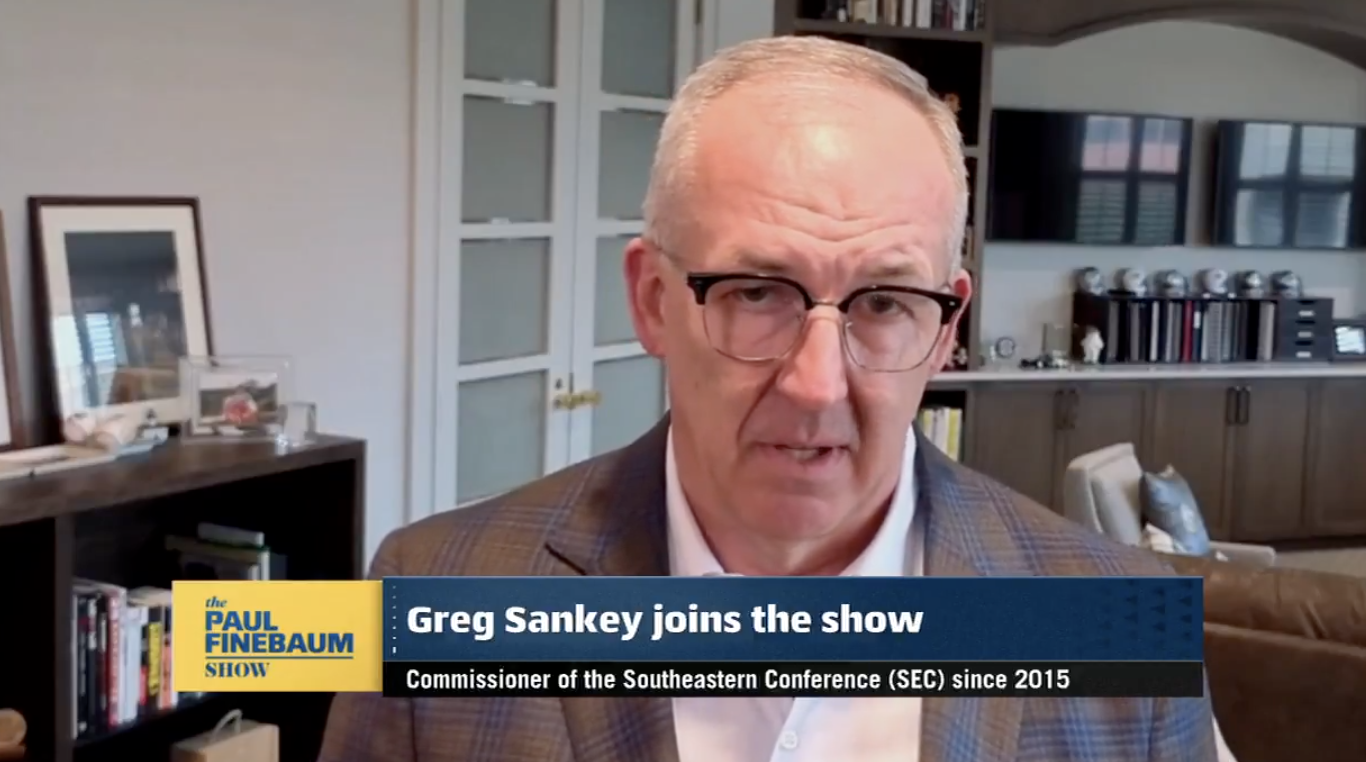
College sports is at a crossroads and nobody is in the middle of it quite like SEC commissioner Greg Sankey.
Sankey’s leadership has seen the SEC reach the pinnacle of college athletics, culminating in their 10-year, $3 billion exclusive deal with ESPN. But radical changes with NIL and the transfer portal has also seen the conference fall from its dominant perch as the Big Ten has won the last three national championships in college football.
While Sankey has done the best job of any commissioner in promoting his own league, he also recognizes the importance of everyone sticking together. But after a White House meeting on the state of college athletics produced no actual fruit or even a direction forward aside from another meaningless executive order from the president, the calls are getting louder to blow the whole system up if some sense of progress can’t be made.
In an appearance with Paul Finebaum, the host asked Greg Sankey what he says to those that are calling for the SEC to break away from the NCAA and finally go into even more lucrative business for themselves. The NCAA commissioner resisted those calls, saying that he is an institutionalist at heart. However, he recognized the deep frustration that may make that eventual conversation unavoidable.
What role does the SEC have in the greater landscape of current college sports? Commissioner Sankey dives in: pic.twitter.com/T0YCTwz8aK
— Paul Finebaum (@finebaum) March 9, 2026
“We’ve taken what has been historically a regional sport in college football in particular, or college sports broadly, used the platform of a great region in our 12 states, and elevated the interest to a national level. That doesn’t mean I just think you leap to something. Because I think that’s filled with its own political and legal and relational realities,” Sankey said.
“But Paul, I’ll tell you there is great frustration in my league that we’ve not been able to work collaboratively through some of the challenges or opportunities that we face. There’s great frustration that as we go through the economic transition with our student athletes we haven’t better defined the boundaries, the guardrails, and held people to those. And we have a responsibility in that. So I’m not just casting blame, that’s part of us solving problems. And I think properly, that’s where our focus should be – how do we work with colleagues to solve problems, can we do that collectively?”
College athletics has reached a massive stumbling block with making any tangible progress on a myriad of issues that are affecting the institution. Even with its popularity at an all-time high across not just football, but many different sports, you can take your pick among the various crises that are playing out from NIL to the transfer portal to coaches leaving playoff teams to realignment to pooling rights. The SEC and Big Ten can’t even agree on a College Football Playoff format after amassing all the power over it for themselves.
As frustration continues to build, Sankey acknowledges that even for an institutionalist like himself, there may be a point of no return for the SEC to hit the eject button on the NCAA.
“If there’s a point at which we cannot do so, I think the conversation that informs the question that you ask, is there something you do alone, I think that starts to generate more and more interest. But right now I think for the medium term, we’re certainly focused on how do we keep the opportunities connected in Division I while still how do we make decisions effective for those of us particularly int the four conferences, that being the SEC, the Big Ten, the ACC, and the Big XII,” Sankey stated.
After the made-for-TV White House summit with Donald Trump and dozens of political figures and college sports dignitaries accomplished nothing, the exasperation that exists within college sports is increasing exponentially. And as much as Trump and Nick Saban might like to wave a magic wand and go back to a day and age where players weren’t getting paid (at least not legally) and there was no freedom of movement, that is not happening. But with a lack of realistic progress or options emerging, one day the SEC and Greg Sankey may have finally had enough and feel there is no other choice but to take their ball and go home.