
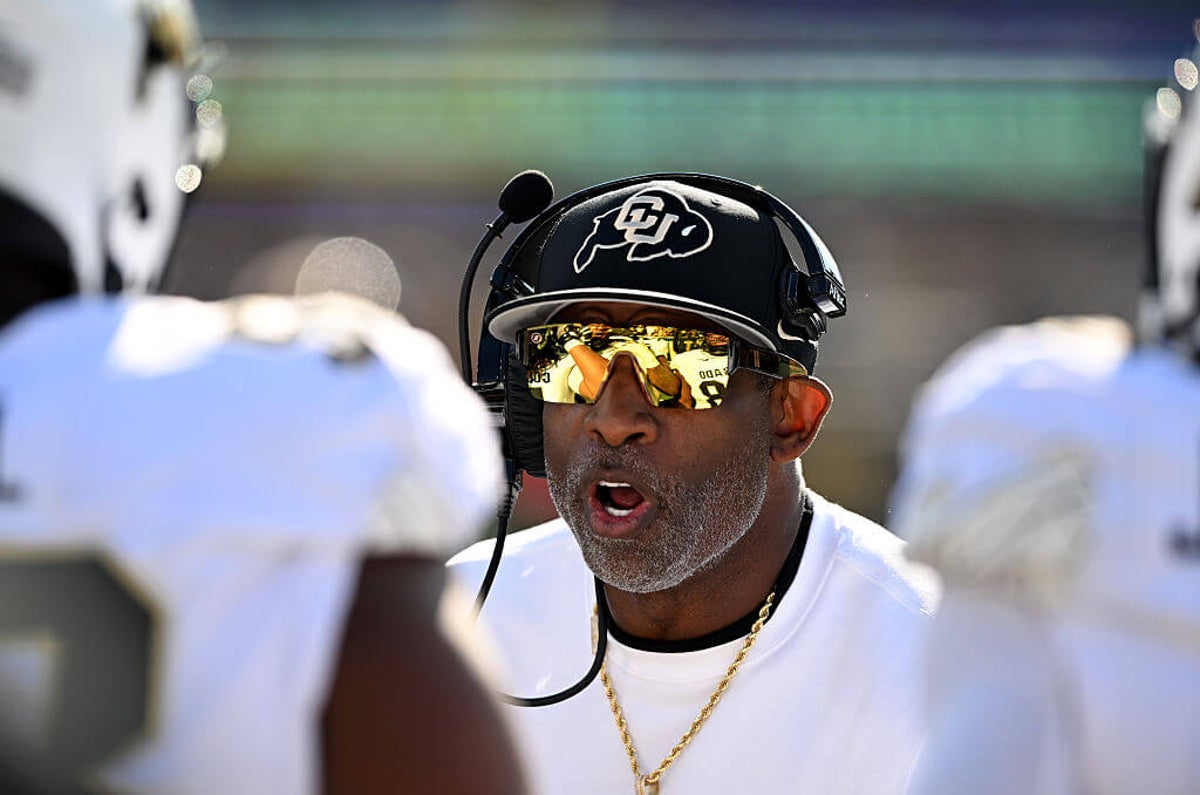
Deion Sanders enters his fourth season at Colorado with as much change around him as his first.
There’s change above him: Athletic director Rick George, one of the biggest reasons why Sanders arrived in Colorado, is retiring after the academic year, with New Mexico AD Fernando Lovo replacing him.
There’s change below him: Both coordinators are new, including his third offensive coordinator to begin a season in four years.
And there’s change all over the roster: The team will feature 58 new players, a transfer portal class that ranks 18th nationally and will be tasked with turning around a program that ended last season at the lowest point of Sanders’ tenure, raising questions about the trajectory of the program. The only major carryover is likely starting quarterback Julian “JuJu” Lewis, the jewel of Colorado’s 2025 recruiting class, who started two games last season.
Sanders’ Buffs quickly went from the highs of a Heisman Trophy winner in two-way star Travis Hunter and a star quarterback in Shedeur Sanders to a nightmare 3-9 season and a rotating cast at quarterback. All of it adds up to a pivotal 2026 season for Colorado and Deion Sanders, who makes $10 million a year after reaching a new deal last offseason.
“We’re in a critical juncture right now in our enterprise,” Lovo told The Athletic in a recent interview. “We need a successful and healthy football program for us to make sure that we’re continuing to put our best foot forward.”
Sanders, 58, says he’s built for adversity. That he’s built for change. That he’s built to overcome.
“You’ve got the right man. I promise you, you do. And I’m going to prove that to you. I am,” Sanders said to fans as last season wound down. “Just give me an opportunity and give me a little more time and I’m going to prove that to you. I will. I promise you that.”
If Sanders had wanted to walk away, he’d have plenty of reasons. His son looks poised to enter 2026 as the Cleveland Browns’ starting quarterback. Sanders traveled to see Shedeur’s first NFL start on Nov. 23, the day after the Buffaloes lost 42-17 to Arizona State.
Watching Shedeur make his debut last fall left Sanders in tears alone in his office, he said.
George’s exit was expected, but Sanders now has a new boss. Lovo said Sanders has his “unequivocal support,” and the two met before Lovo took the job in Boulder.
“Every conversation is rooted in what does Coach need to be successful and how do we deliver that to him?” Lovo said. “At the end of the day, it all comes down to trust and alignment. He has to trust me and I have to trust him, and that only happens with time.”
Then there’s Sanders’ health. He needed another surgery during the season to remove blood clots in his leg, his 16th surgery in just the last few years. Last spring’s discovery of cancer in his bladder meant a full removal of the bladder, which required an in-depth recovery and an adjustment to a new life.
Sanders’ contract allows him to retire without making any payment to Colorado, provided he doesn’t return to coaching. He could return to media work if he wanted, now that all his sons — the reason he started coaching in the first place — are no longer playing college football. He’s already coached one season longer than many who forecasted his detour into college football was motivated by smoothing Shedeur’s path to the NFL.
But he’s rebooting the roster again after last season’s disappointment, insistent on fixing the problems in his program.
It’s nearly an entirely fresh look from the 2024 team that Hunter and Shedeur Sanders led to nine wins. Just five players who were on that team remain.
Only 22 players from last year remain, including zero defensive linemen.
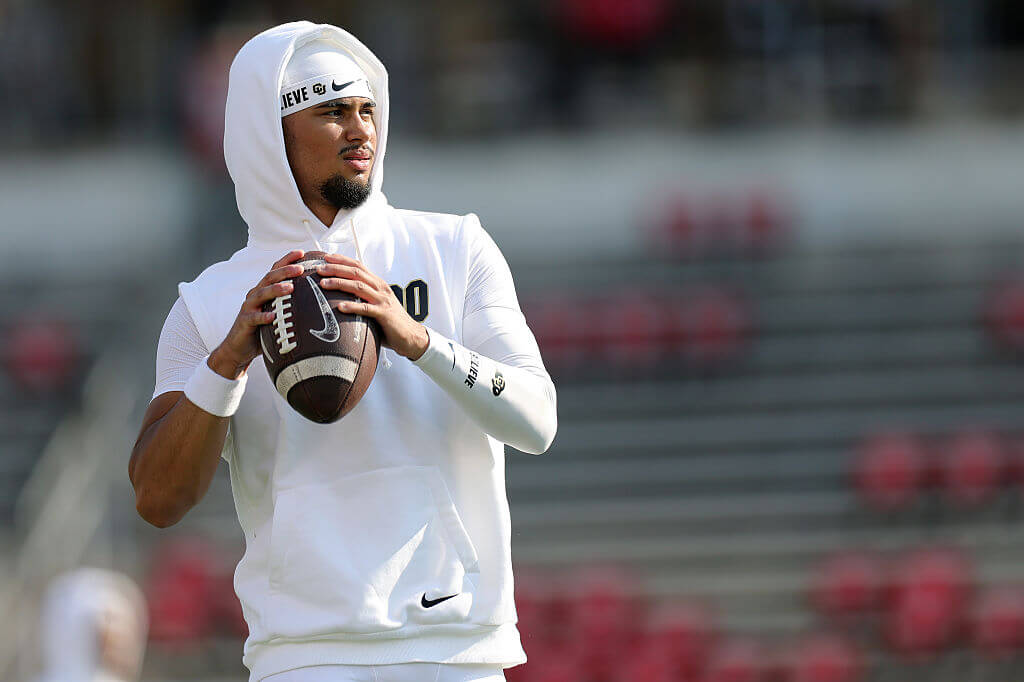
Colorado will lean on Julian “JuJu” Lewis to provide stability at quarterback after the Buffaloes cycled through three in 2025. (Alex Slitz / Getty Images)
The biggest exit was starting tackle Jordan Seaton, the No. 1 overall recruit in the 2024 class, who appeared poised to return to Colorado but exited in the final days of the portal window and landed at LSU with Lane Kiffin.
“We wish we could retain players throughout, but you gotta understand with all this money floating for average nowadays, you could have a backup backup who backs up the backup go get a quarter of a million dollars,” Deion Sanders said. “That don’t make sense to me, but it is what it is.”
Colorado reloaded well, adding more than 34,000 career snaps. Top receiver Omarion Miller left — one of three of Colorado’s four leading receivers who won’t return — but the Buffaloes added Danny Scudero (San Jose State), Kam Perry (Miami of Ohio) and DeAndre Moore (Texas) to backfill. That trio combined for 2,805 receiving yards and 20 touchdowns last season.
Leading tackler Tawfiq Byard left for Georgia Tech, but the Buffaloes added defensive back Randon Fontenette and linebacker Liona Lefau, who started at Vanderbilt and Texas last season, respectively.
All-SEC Freshman defensive back Boo Carter also arrived at Colorado after a rocky 2025 that ended with his dismissal from Tennessee.
Sanders is bullish on the incoming talent.
“They look different. They’re built different. The attitude is different,” Sanders said.
There’s a lot of work to do.
Outside of an upset win over Iowa State, which came right before five consecutive losses to end the season, the Buffaloes’ only wins came over FBS newcomer Delaware and Wyoming, which finished 4-8. The Buffaloes finished ahead of only one Big 12 team, Oklahoma State, which fired legendary coach Mike Gundy early in the season and went 1-11.
Colorado says Sanders has brought a $200 million financial windfall since his arrival. More than 9 million viewers watched Colorado’s season opener against TCU in 2023, and the Buffaloes were one of the sport’s biggest draws.
“What he’s been able to bring not to just this department, but the institution in terms of notoriety and attention and eyeballs, it’s incredible. And it’s made a huge impact,” Lovo said.
Last season, Colorado was an afterthought for television viewers. The Buffaloes’ 52-17 loss to Arizona garnered just 374,000 viewers. Most games hovered just around 1 million.
Lopsided losses offered unsavory flashbacks to the previous era of Colorado football. Utah — without starting quarterback Devon Dampier — led the Buffaloes 43-0 at halftime. A week later, Arizona led 38-7 at halftime. Arizona State scored the game’s final 21 points in a 42-17 win.
“I’m not a loser,” Sanders said. “I don’t handle it well.”
In response to the losing, he reworked his coaching staff.
New defensive coordinator Chris Marve — who was most recently an on-field coach under Brent Pry at Virginia Tech — is the most recent major change. Sanders promoted him late last month after Rob Livingston joined the Denver Broncos as defensive pass game coordinator.
Sanders called Marve “overqualified” for the position and said he brought him aboard, anticipating that Livingston might leave the program. Livingston had interviewed with the Dallas Cowboys earlier in the offseason.
“They’re changes to you all. They’re not changes to us. You think Marve just magically appeared on the staff?” Sanders asked reporters at his spring news conference earlier this month. “You didn’t think we knew there was a possibility of something that could possibly happen?”
Offensive coordinator Brennan Marion was arguably the biggest addition of the offseason. He arrived after a season as Sacramento State’s head coach, but before that, his “Go-Go” offense helped fuel 20 wins in two seasons at a downtrodden UNLV program that had two winning seasons since 1994. Marion’s Rebels offenses finished in the top 25 in scoring twice. Scoring 30 points per game was a prerequisite, Sanders said.
“When we score 30 points per game, we win,” he said. “When we don’t, we lose.”
The Buffaloes are 13-3 under Sanders when scoring 30 points and 3-18 when scoring fewer than 30 points.
Marion will inherit Lewis, the biggest returning talent on the roster. He looked like the lone bright spot in the five-game losing streak to close the season, with his best game a 299-yard, two-touchdown outing in a road loss to West Virginia.
Lewis, a four-star recruit in high school, should bring stability to a position that missed it in 2024. Sanders brought in Liberty transfer Kaidon Salter and Lewis to replace Shedeur Sanders. Salter won a preseason competition but was benched after two games in favor of former walk-on Ryan Staub, who struggled in a loss to Houston. The Buffaloes turned back to Salter, but he was benched again in the loss to Arizona.
Salter struggled to transition from the unique spread option offense in which he thrived at Liberty. Colorado’s run game averaged just 3.54 yards per carry (121st nationally, up from 133rd last season), and the passing game tanked without Sanders throwing to Hunter and Jimmy Horn Jr.
Colorado was expected to improve on the lines of scrimmage, but the Buffaloes fell from 45th to 132nd in yards per carry allowed and fell from 29th to 78th in opponent passer rating.
“They were predictable (in 2024) — played a bunch of man coverage — but had the players to make it hard on offenses,” said one opposing Big 12 assistant coach about Colorado’s defense. “They didn’t have the players this year and never really adjusted.”
Whether Deion Sanders and an evolving staff improved their evaluation and roster-building ability remains to be seen. Colorado’s transfer class ranked 19th nationally last year, but the Buffaloes took a major step back without their two stars and a host of complementary pieces.
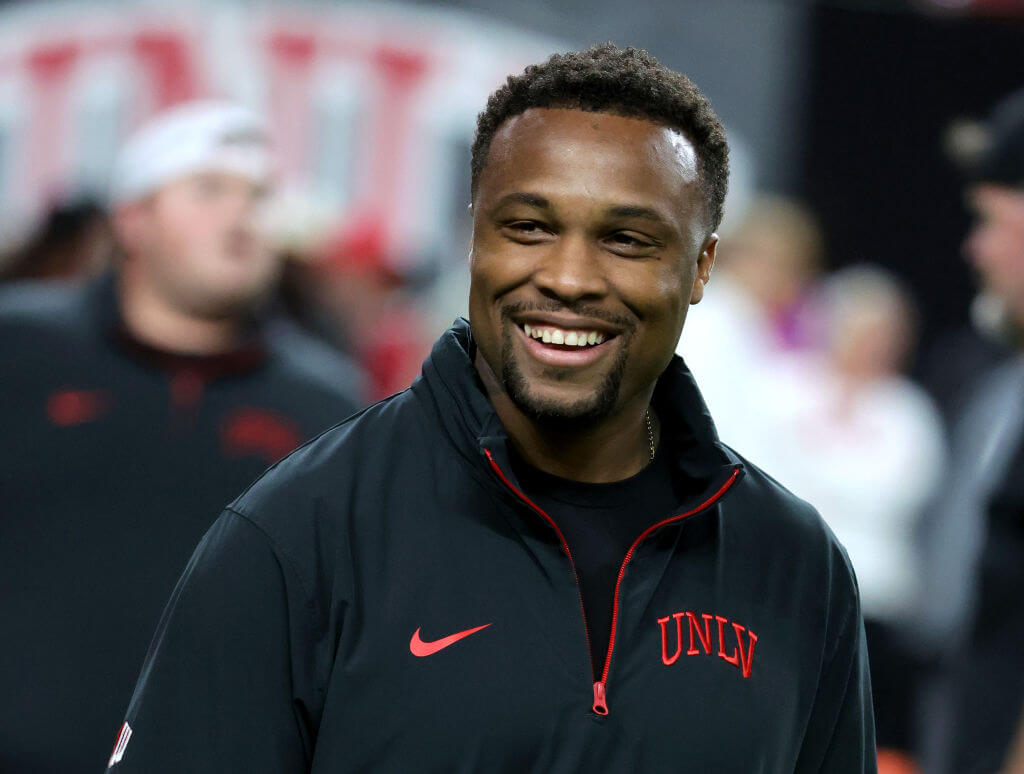
New offensive coordinator Brennan Marion led UNLV offenses that ranked in the top 25 in the country in scoring. (Ethan Miller / Getty Images)
“We missed,” Sanders told Fox during the season. “We missed on several players.”
After a 42-6 loss to a top-10 Oregon team in 2023 – his first loss at Colorado – Sanders stared into the camera lights and offered a warning.
“You better get me right now,” he said. “This is the worst we’re gonna be.”
After finishing 3-9 with losses by 46, 35 and 25, Sanders is back there again.
Colorado ended last season in chilly Manhattan, Kan., where snow dotted the field and swirled in the air as Kansas State handed the Buffaloes a 24-14 loss. When the season was officially over and his team returned to the locker room, away from the frigid Kansas wind, Sanders stood in front of his team and made a similar vow.
“We won’t be in this situation again,” he said. “I promise you that.”