
The Winnipeg Jets begin the 2025 offseason with a high-profile, homegrown UFA to sign — or an abundance of cap room to go shopping with.
Once it has Nikolaj Ehlers’ future sorted out, it has Dylan Samberg and Gabriel Vilardi’s long-term futures to prioritize. But what next? In what order? How much cap space do the Presidents’ Trophy-winning Jets have to work with — and how do Kyle Connor, Adam Lowry, and Winnipeg’s other 2026-27 free agents impact what the Jets do this summer?
This offseason has the power to cement the Jets as perennial contenders, solidifying their roster and addressing their playoff shortcomings — or leave them behind as they take their next steps toward the Stanley Cup.
We’ll dig deeper into each of these in the coming weeks but for now, here are the Jets’ eight biggest offseason priorities:
Winnipeg’s 2025-26 salary cap
This incomplete version of the 2025-26 Winnipeg Jets would have $26.4 million to work with, highlighting the team’s flexibility as the offseason begins.
Winnipeg gets out of Blake Wheeler’s buyout, leaving only $1.6 million from Nate Schmidt’s buyout as dead money on the cap. While there is the potential for upheaval via Nikolaj Ehlers’ departure — and Winnipeg’s efforts to replace him, if he does sign elsewhere — there’s a lot of roster stability on defence and in goal.
LWCRW
Kyle Connor
Mark Scheifele
Cole Perfetti
Nino Niederreiter
Vladislav Namestnikov
Alex Iafallo
David Gustafsson
Adam Lowry
LD
RD
Josh Morrissey
Dylan DeMelo
Logan Stanley
Neal Pionk
Ville Heinola
Luke Schenn
Colin Miller
G
Connor Hellebuyck
Eric Comrie
RFA forwards: Gabriel Vilardi, Morgan Barron, Rasmus Kupari
RFA defence: Dylan Samberg
How much does $26.4 million get you in 2025?
There are still two forward jobs available once Vilardi, Barron, and Kupari have signed. Ehlers could take one, if the Jets do manage to sign him. Perhaps more likely, there is the possibility of signing a centreman — I can’t shake Winnipeg’s interest in Jonathan Toews, if he’s ready — and then promoting whichever of Brad Lambert, Nikita Chibrikov, Jaret Anderson-Dolan, or Parker Ford is most NHL-ready.
Samberg’s contract would give Winnipeg eight NHL defencemen under contract, necessitating movement. This could be as simple as waiving Ville Heinola at training camp, given how little they used him, or it could involve an offseason transaction that preemptively clears that room.
The Jets can afford to sign all three of Ehlers, Vilardi, and Samberg if they make $23 million or less collectively.
1. Get clarity on Ehlers — and plan for life without him
Winnipeg is not blindsided by Ehlers’ UFA uncertainty. Cheveldayoff’s two-hour meeting with Ehlers’ agent should leave the Jets with clarity on Ehlers’ contract hopes — including how likely he is to be a free agent on July 1. It’s not that the Jets can’t afford to sign Ehlers, mind you: Cheveldayoff said last week that he’s prepared to offer Ehlers a “Jet for life” type of contract.
How might that look?
I believe the Jets could sign Ehlers to big ticket money without upsetting their existing contractual hierarchy.
Mark Scheifele is Winnipeg’s highest-paid forward, earning $8.5 million per season — 9.66 percent of the 2024-25 cap — but that contract was signed toward the end of the flat cap era. The new $95.5 million cap maximum changes things: the same percentage Scheifele signed for would earn him $9.2 million contract in today’s dollars. Put another way: Winnipeg could sign Ehlers to Scheifele’s same $8.5 million — or any $8.x million number — without it being a statement that Ehlers is worth more than Scheifele is to the team.
It may be that Ehlers is simply prepared to move on. Perhaps he’s ready for a new opportunity. His promotion to the Jets’ top power play unit helped him play the fourth-most all-situations minutes among Jets forwards this season — closer to his value — but there may be teams that can afford to play him in an even bigger role. New Jersey, Carolina, and Washington come to mind as markets with cap space, ambition, and room for another top winger. (Montreal, a frequent fan-suggested landing spot, won’t have the cap room and is already well-stocked in skilled forwards.)
If the Jets find themselves without Ehlers, they’ll have his $8.x million projected cap hit available to spend on other players. The UFA market hasn’t traditionally been kind to Winnipeg but does include players the Jets have been interested in before. There’s Brock Nelson, who the Jets worked to acquire at the 2025 deadline, and Brock Boeser, who they were keen to draft in 2015, for starters. There are also players who balance truculence and skill — a combination Winnipeg could use more of — including Sam Bennett, who seems at home in Florida, and Andrew Mangiapane, whose ice time and output dipped in Washington.
It’s hard to know what to project from Toews, if he’s healthy enough to play, while equally famous options like John Tavares, Mitch Marner, and Brad Marchand seem like unrealistic points of discussion. The only UFA signings on Winnipeg’s everyday roster last season were Eric Comrie and Colin Miller, each of whom had prior experience with the Jets.
It’s Winnipeg’s job to know their options — with Ehlers and without him — and one expects they’ve been assembling contingency plans for months, if not longer. The sheer size of his potential cap hit makes clarity on Ehlers No. 1 in the order.
2. Seek term with Vilardi and Samberg
Samberg is 26 years old; Vilardi turns 26 in August. Winnipeg would do well to sign both players for as many years as they’re able to budget, but arbitration rights and the desire to see how the new cap affects UFA prices — plus the outcome of Ehlers’ future — could push the timeline deeper into summer.
Samberg’s case seems like the more straightforward of the two. The Jets defence corps is rock solid with him and Josh Morrissey playing on the left side and problematic without him. Samberg shares his hometown, his agent, and his offseason lake with his defence partner, Neal Pionk, while his wife — Dr. Destiny Samberg — has started her dental practice in Winnipeg. It helps the Jets’ case that Samberg has delivered top flight top-four minutes for one season, instead of several, or that the best-in-class shutdown defenceman, Jaccob Slavin, starts his eight year, $6.4 million AAV contract next season.
It helps Samberg’s case that he’s UFA-eligible as soon as 2026 — in fact, all he’d have to do to fast track a Winnipeg departure is file for arbitration, take the one-year award it creates, and then walk next summer. (I don’t expect that kind of hardball. If Samberg files for arbitration this summer, I don’t expect it will be done with the intention of cutting off long-term contract discussions.)
Vilardi’s situation is similar to Samberg’s: He has arbitration rights and he hit a new plateau last season. Vilardi’s earliest UFA eligibility is 2027, though, giving him a few options: While he can’t fast-track UFA status by filing for arbitration, he could decide to bet on himself by signing a one year pact. The cap maximum will increase from $95.5 million in 2025-26 to $104 million next season; Vilardi could earn himself a bigger payday just by repeating his 71 game, 61-point season — and more power to him if he continues to improve.
Both parties will need to weigh their feelings about Vilardi’s injury history. There may be incentive for the player to lock down guaranteed long-term money, despite the opportunity to pursue an 82-game 2025-26 season and improve upon his point totals. There may not be as much incentive for a max term deal on the Jets’ part as is typical of a 26-year-old with such a dynamic offensive toolkit. They haven’t seen him drive five-on-five play away from Connor and Scheifele and may want to see that happen before committing to a more expensive, long-term contract.
Given the rising cap and a belief in Samberg and Vilardi as quality players, I expect the Jets’ best outcome includes long-term contracts for both players.
3. Lay the groundwork for Connor, Lowry, and Perfetti extensions
We’ll keep this section short but rest assured: Winnipeg is going to put in long hours this summer to prepare for Kyle Connor, Adam Lowry, and Cole Perfetti’s contract extensions. Connor is at the front of that line, given the dollars in play, and his projected contract — which would start in 2026-27 — will impact this summer’s long-term thinking. Lowry won’t command the same kind of money and may wait until September or beyond to finalize a deal but, like Connor, he’s also in line for an extension as soon as July 1. Perfetti’s bridge deal is half over and the Jets may do well to sign him long term before he’s played a full year on the top power play unit (assuming Ehlers signs elsewhere).
It helps that the cap is increasing to $104 million in 2026-27 and that the Jets will be free of Schmidt’s buyout by then, too. Rest assured that these future contracts — Connor’s in particular — are already part of Winnipeg’s thought process.
4. Make a new plan to find a second-line centre
Vladislav Namestnikov is versatile, tenacious, a pain to play against, and a good stylistic complement to Winnipeg’s finesse-first forwards. He’s not an ideal second-line centre, nor have the Jets treated him as one: Winnipeg traded for Sean Monahan in 2024 and then tried to extend him last summer. It made Nelson their top target at this year’s trade deadline, then watched as Nelson arrived at his preferred destination in Colorado.
Winnipeg has traded three first-round picks for second line centres that didn’t stay in Winnipeg: Paul Stastny (2018), Kevin Hayes (2019), and Monahan (2024). It also traded Patrik Laine and Jack Roslovic for Pierre-Luc Dubois, although Dubois’ departure worked out in the form of Vilardi, Alex Iafallo, Rasmus Kupari, and a second-round draft pick (Alfons Freij).
The asset drain is continuous — and would have continued this year had Winnipeg landed Nelson — and it will continue until the hole is plugged. Vilardi, Perfetti, and Brad Lambert are internal options (although Vilardi and Perfetti lack footspeed, while Lambert seems to have taken a step back in the AHL this season). The Jets need to know that one of their own players can fill the role, sign someone this summer, or run the risk of trading more assets away for a centre at the 2026 deadline. It’s hard to be a draft and develop organization that sends draft capital out the door to fill the same hole every season.
5. Assess roster balance: Do the Jets need more shift disturbers?
This priority may be difficult to pin down but it must be part of Winnipeg’s assessment all the same. Florida and Edmonton seem to be on a crash course to repeat as Cup finalists; watching the Oilers drives home the importance of generational talent, while watching the Panthers shows the power available when elite skill and brutal toughness meet on the same roster. Winnipeg is too good to draft No. 1 overall several times, as the Oilers did, but some amount of emulating Florida seems possible. We’ve already seen it in the form of the Niederreiter, Namestnikov, and Iafallo acquisitions: There’s nothing Matthew Tkachuk adjacent or even Brad Marchand-esque in this group but it’s made Winnipeg tougher to play against all the same.
I’d caution against overcorrecting — the Presidents’ Trophy is a difficult trophy to win, even if the road to the Cup is more brutal. But the Jets are built around the Connor/Scheifele duo up front and on Morrissey (and ideally Samberg) on defence. There’s not a lot of sandpaper among the Jets’ elite; Winnipeg doesn’t need to pivot to pure grit but it would do well to stay on top of opportunities to add more talented truculence. What if the Jets’ next first-round opponent hits like the Blues but has the top end talent of the Stars?
6. Another must-win NHL draft
Winnipeg’s scouts must be under more pressure than most of their rivals; the Jets’ win-now mode, combined with Winnipeg’s tough draw as a UFA market, has meant trading picks for veteran players. Perfetti (2020) and Samberg (2017) are the Jets’ last two draft picks to establish themselves as either a top-six forward or a top-four defenceman. Part of what seems like a dip in draft efficacy is actually a shortage of picks. The Jets have traded away a ton of draft capital since 2018, including two of its picks at this year’s draft in June.
Winnipeg has its own picks in the first, third, fifth, sixth, and seventh rounds. It traded its second-round pick to New Jersey for Tyler Toffoli last season and its fourth-round pick to San Jose for Namestnikov in 2023. The Jets got Freij, Kevin He, Markus Loponen, and Kieron Walton out of four picks last year — with particularly good early returns from He and Walton in the OHL — and a little bit more of that magic would be more than welcome.
7. Appleton, Tanev, and Winnipeg’s other non-Ehlers UFAs
Mason Appleton and Brandon Tanev complicate the cap picture presented above. It’s hard to imagine Winnipeg paying Appleton market value ($3.2 million, according to AFP Analytics) and having the room to take a swing at Ehlers while retaining Samberg and Vilardi. Tanev may not cost as much but is coming off a $3.5 million AAV deal. It’s not as easy to assume team-friendly contracts for either player as for RFAs like Barron and Kupari.
The Jets have more room if Ehlers walks but may also find that Iafallo, Namestnikov, and Niederreiter have Winnipeg’s depth jobs covered, while earmarking room on the roster for Lambert or Chibrikov with an eye to the future. I’m not expecting Winnipeg to make early, aggressive swings on Appleton and Tanev. The Jets like both players, but I don’t expect they enjoy their projected UFA prices.
Dominic Toninato, Haydn Fleury, and Chris Driedger may have a role on next year’s club but don’t represent urgent priorities at this stage of the offseason.
8. Fleury? Heinola? The inevitable logjam on defence
It’s easy to assume there’s no room for Haydn Fleury. The Jets will have eight defencemen on their NHL roster once Samberg signs — nine if they retain Fleury as a UFA — while they prefer to carry seven on the roster during the regular season. That’s not a pressing offseason concern, if we’re being honest; it would be easy to bring extra defencemen to camp and then waive them if everybody stays healthy.
The Jets could proactively try to clear room. If they’re done with Ville Heinola, for example, they could try to move him before he becomes a Group VI UFA next summer. It would be easier and more cautious to wait until training camp and make sure everyone is healthy to start the season before risking waivers on Heinola, Fleury, or even one of the established veterans. The Jets signed Fleury on July 5 last summer; whether it’s Winnipeg or a different team, it seems less likely that Fleury lasts that long after a strong showing this season.
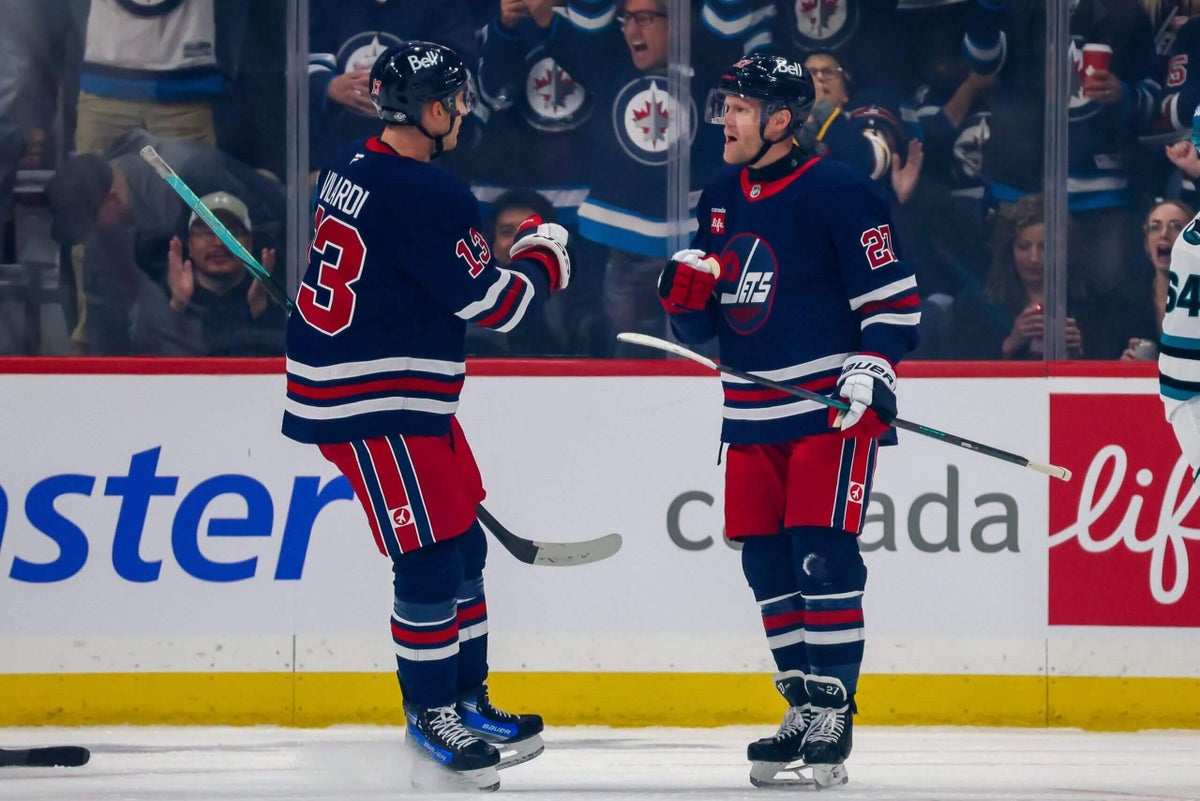
(Top photo of Gabriel Vilardi and Nikolaj Ehlers: Jonathan Kozub / NHLI via Getty Images)