
Barring a major surprise in the final days of a drama that has played out over two years, the Chicago Bears soon will become the “Chicago” Bears.
With either Hammond or Arlington Heights designated as its new home, the charter NFL franchise won’t really be Chicago anymore. The Bears will get a rent-to-own deal worked out in Indiana or build on land they already own in Arlington Heights, thanks to decades-long tax cuts that will take money away from the village and local three school districts.
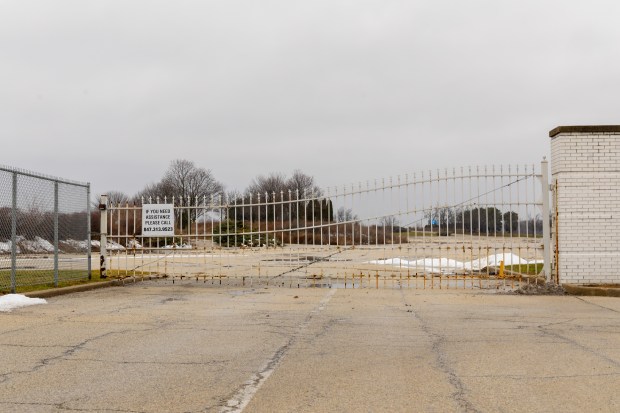 A gate remains at the former Arlington International Racecourse in Arlington Heights on Dec. 18, 2025. (Dominic Di Palermo/Chicago Tribune)
A new “mega-projects” bill aiming to give the Bears long-term tax certainty could benefit a new stadium near Chicago’s lakefront, too — on the outskirts of the Bronzeville neighborhood, which could use the new investment. But the McCaskey family that controls the Bears won’t even look there: The family owns 326 acres in Arlington Heights, and a new stadium there could anchor a multi-use development.
Whether in Hammond or Arlington Heights, the new stadium will be a loss to the city and state. If the team lands in Hammond, Illinois loses economic activity and prestige. If in Arlington Heights, that already prosperous suburb will benefit, but Illinois will suffer the missed opportunity of a Chicago investment that could have helped strengthen the economics of the city’s South Side.
It did not need to turn out this way.
And because the stakes are so high, it’s worth considering how we have come to this. What actions or lack of actions by elected officials are responsible for getting to this point and might there still be a better path forward than either Hammond or Arlington Heights?
Mayor Brandon Johnson comes to mind as a player who helped get us here. He has proved remarkably inactive when forceful city leadership could have made a difference. The Bears have publicly made their dalliance with Indiana known since at least December, and Johnson has not put up much of a fight in all that time.
It’s hard to imagine any of Johnson’s predecessors — Lori Lightfoot, Rahm Emanuel or Richard M. Daley — disappearing under similar circumstances. In fact, Daley threw a public tantrum when the Bears last flirted with Gary, in 1995, then went to work on a Soldier Field renovation that ultimately came to pass.
By contrast, Johnson’s singular contribution on the Bears’ stadium search to date was his cheerleading role at an ill-fated news conference at Soldier Field in April 2024. The vaporware nature of the Bears-city proposal for a new stadium just south of Soldier Field quickly came into evidence: Neither the team nor the mayor had cleared plans with Gov. JB Pritzker, whose support they wanted for a $2 billion state contribution toward building the stadium.
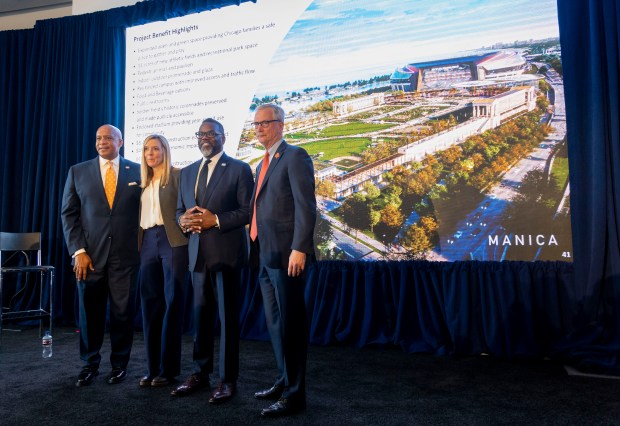 Bears President and CEO Kevin Warren; Karen Murphy, executive vice president of stadium development; Mayor Brandon Johnson; and Chairman George McCaskey stand in front of a rendering after the Bears announced their plans to build a new domed lakefront stadium April 24, 2024, at Soldier Field. (Brian Cassella/Chicago Tribune)
That was a nonstarter, and from that point forward, Pritzker kept an arms-length distance from the Bears stadium search. He scrambled into action only after Indiana emerged as a serious bidder, then timed statements of assurance as needed ever since. Thanks to work done by Pritzker and his team behind the scenes, Arlington Heights is a credible option today only because of expected state infrastructure support of around $855 million, along with the tax breaks being built into the mega-projects bill.
Even so, Pritzker’s unwillingness to push for construction in Bronzeville, on the site of the former Michael Reese Hospital, remains a baffling mystery. If public money is backing a new stadium development, the biggest return on taxpayer investment would come from a development in Bronzeville, where an economic multiplier effect is dearly needed and a group of serious investors is ready to help make the project happen — but can’t even get an audience with the McCaskey-run Bears.
The Bears have made it clear they won’t even consider the Bronzeville option. They have cited reasons that don’t stand up to scrutiny; they just state flatly that they think this move is in their own economic self-interest. Why that reluctance? Because taxpayers don’t like to be held hostage to such private interest.
Pritzker could have forced the issue by requiring a good-faith evaluation of the Bronzeville option. Instead, he is missing a chance for a visionary investment with the potential to transform the entire South Side.
With major private investment slated for the $750 million Chicago Fire stadium near Roosevelt Road, along with around $850 million in private money spent on the Obama Presidential Center in Hyde Park, which opens in June, the state could have seen a third concurrent project, located midway between the other two, enough to make the city’s southern lakeshore a new economic development zone.
This is where the Illinois legislature comes in. Lawmakers representing Chicago have astutely withheld support for the Arlington Heights move. They want the Bears to make good on around $84 million the team still owes on the lease for Soldier Field, and some say the price for a Bears exit package should include a large share of around $630 million of upgrades needed by the Chicago Park District, which owns the stadium.
This is another instance in which the no-show by Chicago’s mayor is having serious consequences. Testimony by Johnson’s interim chief financial officer, Steven Mahr, late last month was perfunctory, and the presence of an interim CFO not nearly enough to represent the city’s stake in all this.
In the absence of mayoral leadership, state Rep. Kam Buckner could make a key difference. He represents Bronzeville and also is a leader in legislative efforts to retain the Bears. There are ways to create state incentives that might tempt even the McCaskeys to take a look at Bronzeville: state financing tools that could be accessed only for a city project, for example.
One possible option: Consider allowing the Illinois Sports Facilities Authority to lend to nongovernmental owners of stadiums inside the city limits, such as the Bears could be. Currently, the IFSA is allowed to finance only government-owned facilities, such as Soldier Field and Rate Field.
As the situation stands, there aren’t enough Chicago votes to get the mega-projects bill through the legislature. If the bill stalls over the next two weeks, Hammond will inch yet closer to a sure thing. An effort to make a Chicago option viable, even for the reluctant Bears, would be both good policy — and good politics, too.
David Greising is president of the Better Government Association.
Submit a letter, of no more than 400 words, to the editor here or email letters@chicagotribune.com.