
March 13, 2026, 7:01 a.m. CT
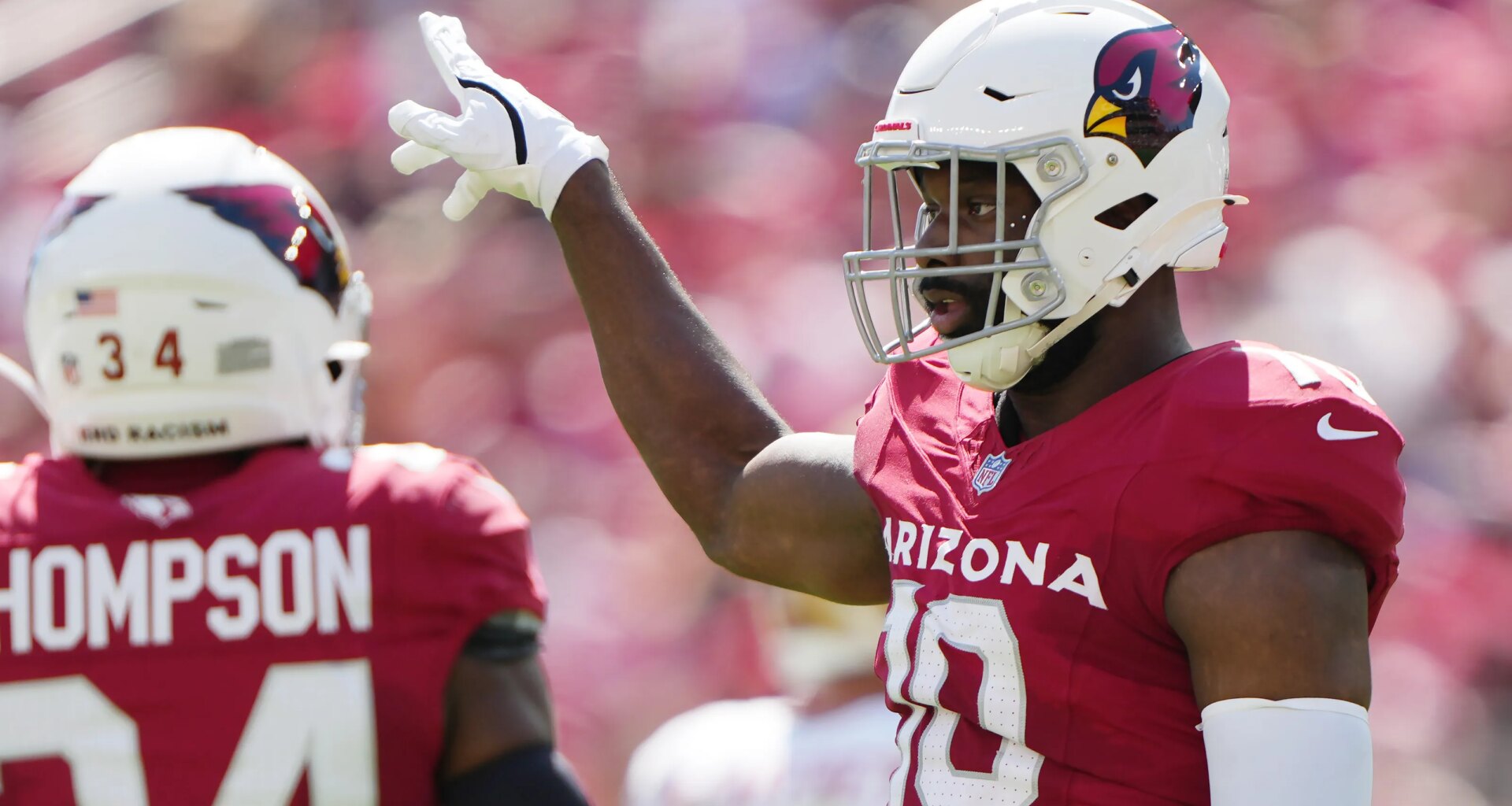
Buzz around Josh Sweat’s potential exit from Arizona has built throughout this week, following a report the pass rusher requested a trade at the end of the season.
Speaking on the PHNX Sports Arizona Cardinals podcast on Monday, Cardinals reporter Johnny Venerable claimed Sweat asked out of Arizona after Jonathan Gannon was fired as head coach.
Gannon is of course the new defensive coordinator in Green Bay. If Sweat were to get moved, the Packers would be a reasonable team to link him to.
Venerable said: “I think Josh Sweat will get traded. When Jonathan Gannon got fired, Josh Sweat asked to be traded.”
There is not much (if any) other information to indicate Sweat could actually get traded, or that it would be to the Packers, but let’s examine whether a trade makes sense for all parties.
Expert NFL picks: Exclusive betting insights only at USA TODAY.
Starting on Arizona’s side, why would they move on from a player they only signed to a four-year, $76.4 million contract last offseason, who is coming off a 12-sack season? The answer is a combination of their situation, and his contract.
Sweat turns 29 this month, and the Cardinals look like they’re in full rebuild mode after cutting Kyler Murray, seemingly set to go into the 2026 season with Jacoby Brissett and Gardner Minshew as their quarterbacks. Is Sweat realistically going to be part of their next competitive team?
Regarding his contract, Sweat has an option bonus which is due on 20th March that will pay him $7.2 million immediately, and for cap purposes be spread across the rest of his contract.
If they have any interest in trading him, that option bonus incentivizes them to do it in the next week, as it would pass over to the acquiring team. It would not make much sense to pay Sweat $7.2 million in cash and then end up trading him later anyway. Deadlines spur action, as they say.
Often when teams get out of contracts this early, it can come with bad optics in terms of how much they paid the player for just one year (see: the Packers paying Nate Hobbs $18 million for 11 games of forgettable football).
That is not the case here though. Were Arizona to trade Sweat in the next week, they would have paid him $22.1 million for one year, which is not much more than the $19.1 million average annual value of his contract.
When you consider Boye Mafe and Odafe Oweh, who are not as accomplished players, inked deals worth $20 million per year this week, one year of Sweat at $22.1 million would not be a tough pill to swallow or an inhibitor to a trade. They would save $52.5 million of the total deal if they got out early.
The option bonus creates a fulcrum for a decision, and it is notable how much friendlier the cap ramifications are for the Cardinals if they traded Sweat after just one year as opposed to cutting him.
If they cut him before June 1st, they would actually lose $15.4 million against the cap, but if they trade Sweat before then (or more pertinently before March 20th), they would save a small amount ($1.6 million) against the cap in 2026, with most of the significant savings coming in later years.
Frankly, this looks like a contract that was designed to be tradeable when it was drawn up.
What about from Sweat’s perspective? The reason for most of this buzz is the report that Sweat requested a trade after Gannon was fired, which would imply he would very much be open to a trade to the Packers.
For argument’s sake, let’s say he did not actually ask for a trade, and is happy in Arizona working under their new DC Nick Rallis, who like Gannon, coached Sweat with both the Eagles and Cardinals.
Unless he has a no-trade clause in his contract, Sweat would not have much say in the matter anyway.
But even if he is content with the Cardinals, one would think he would not be upset about reuniting with Gannon – under whom he broke out with the Eagles – and joining a contender in Green Bay. It would not impact him negatively financially either.
From the Packers’ side of things, they just traded away Rashan Gary, and although they have a ready-made replacement in former 1st round pick Lukas Van Ness, the team has usually held three significant investments at EDGE in each year since Brian Gutekunst took over as GM.
That means lucrative contracts or premium draft picks. Green Bay currently only has two in Micah Parsons and Van Ness.
Looking at whether the trade is worth doing for the player in question, Sweat had better pass rush numbers than Gary in 2025 and 2024. LVN’s numbers were actually stronger snap to snap in 2025, but the sample size for Sweat was almost double.
He is not a difference-making run defender, which is an area Gary excelled in, but Sweat is still solid in that regard, and Van Ness can help pick up the slack as he was very strong against the run last year.
As mentioned, Sweat is turning 29, so there is a bit of risk there, but he has only missed eight games with injury in eight seasons, which suggests he is durable. Five of those games were in his rookie year, two were in 2020 and one was in 2022.
The next question is whether the money would work for the Packers. They would take on $12.7 million in 2026, $19.9 million in 2027 and 2028, all including the prorated option bonus.
Green Bay has room on this year’s cap with currently $29.1 million in salary cap space per over the cap. Javon Hargrave’s contract is not yet factored in, but the year-one cap hit is probably low.
They should also have plenty of room next year as well, as the Packers currently have $84.6 million in projected cap space, and even factoring in potential extensions for Christian Watson, Tucker Kraft and Van Ness’s 5th year option, they should still have no problem finding room.
2028 could get interesting, as Love’s cap hit goes up to over $75 million and Parsons to over $42 million, but at least in Love’s case, and possibly both, Green Bay will likely extend their contracts again or restructure them to get those cap hits down.
The only dead cap they would be on the hook for in Sweat’s contract if they trade for him is the prorated option bonus, so they would be able to move off him at any time anyway.
Even if they can afford it, would the Packers have the appetite to spend so much cap space at one position?
Since Gutekunst took over, they have averaged 12.7% per year of their cap spent on their ‘top’ two/three investments at EDGE on active players. That rises to 13.9% if accounting for dead cap hits for jettisoned players over the years.
They are currently at just 8.2% spent on active players in 2026, which would be the lowest it’s ever been under Gutekunst. They are right at the 13.9% mark when factoring in Gary’s dead cap hit.
If they took on Sweat’s contract, the number for active players would go to 12.3%, in line with their average since 2018. The number would rise to 17.9% including dead cap, which is high, but still lower than the 18% they were at last year because of Preston Smith’s leftover dead cap.
In 2027 though, assuming they pick up Van Ness’s 5th year option, he, Parsons and Sweat would project to take up 19.1% of their cap, which would be higher than they’ve ever done in the Gutekunst era, unless they do something with one of the three contracts to lower the hit.
Green Bay could opt for an extension with LVN instead to make his cap hit lower in 2027. They could restructure Parsons, or re-do Sweat’s deal after a trade to get his number down. There is also a world where Van Ness is not on the team in 2027 at all, which would obviously lower the number.
The Packers are not flush with ammo to go after a trade like this in terms of 2026 draft picks, but they just picked up an extra 4th round pick in 2027 for Gary, and they are set to add four mid-round compensatory picks in next year’s draft due to the players Green Bay lost to free agency.
Figuring out the value of a player is always tricky, but a trade for Sweat could cost as much as a day-two pick. The Packers could also offer a younger player at a position of strength – perhaps a wide receiver – which could be attractive to the Cardinals if they are looking to 2027 and beyond.
The family connection between the two head coaches would surely not hurt in terms of communication and greasing the wheels of a trade, either.
There is very little to suggest a trade is close or even on the table right now. No one in the national media has covered the topic at all. Having spoken to someone who covers the Cardinals, they did not believe there is substance to the buzz, based on what they have heard.
They indicated the presence of Rallis would lessen Sweat’s eagerness to get out of town – which is something Venerable also brought up as a possibility when claiming Sweat asked for a trade – and pointed out the Cardinals’ pass rush would be anaemic if they shipped off Sweat.
In the spirit of simply analyzing whether it would make sense though, it does seem a logical trade for all parties involved. However, that argument does hinge on the Cardinals believing they need to look beyond 2026.
If Green Bay was interested, they would likely have competition, with Sweat’s former team Philadelphia another logical destination. Because of the option bonus, we should find out soon one way or another. If March 20th passes and Sweat is still a Cardinal, it probably stays that way.