
The Seattle Seahawks’ spending behavior during the first week of free agency should serve as a reminder that last year’s offseason was an aberration.
Between the contracts for quarterback Sam Darnold, edge rusher DeMarcus Lawrence and receiver Cooper Kupp, Seattle spent $178 million on three external free agents. All three moves were successful, but the team doesn’t want to make a habit of spending big on the open market.
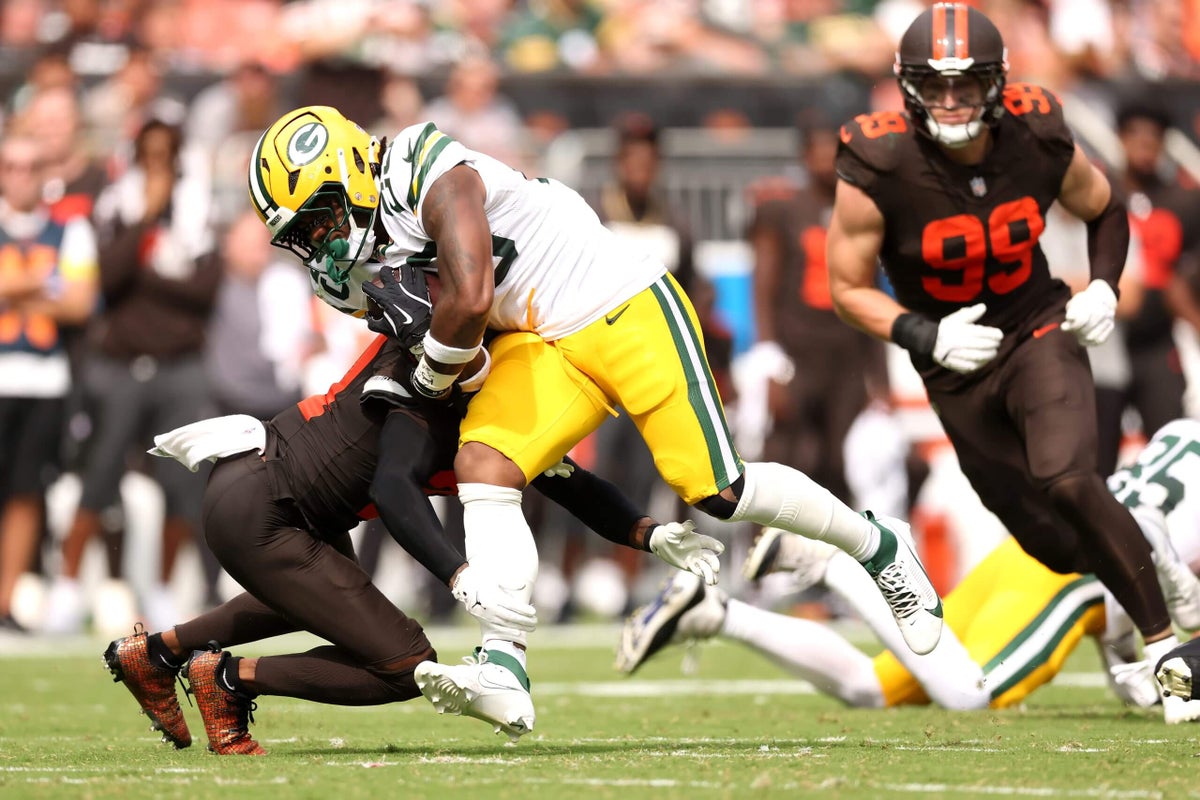
Thus far, Seattle has agreed to terms with a handful of external free agents, but nothing splashy like last year. The Seahawks agreed to a trio of one-year deals with safety Rodney Thomas II (formerly of the Indianapolis Colts), running back Emanuel Wilson (Green Bay Packers) and cornerback Noah Igbinoghene (Washington Commanders). Wilson signed Friday, and his deal is reportedly worth up to $2.1 million. I’d expect Thomas and Igbinoghene to be in the same price range.
All three free agents address the positions vacated by running back Ken Walker III (Kansas City Chiefs), cornerback Riq Woolen (Philadelphia Eagles) and safety Coby Bryant (Chicago Bears). Walker, Woolen and Bryant signed deals with base values of $95 million. As expected, Seattle chose to be economical about adding bodies to the depth chart, while shifting focus to the 2026 NFL Draft. The Seahawks also lost receiver Dareke Young (Las Vegas Raiders) and outside linebacker Boye Mafe, who signed a three-year, $60 million deal with the Cincinnati Bengals. It’d make sense for Seattle to add another low-cost veteran to the defensive line ahead of the draft.
“All these guys are really good players and you’d love to have everybody back,” general manager John Schneider said Thursday on Seattle Sports radio about the players who left in free agency. “We talked about that collective, our 90-(man) roster, our 70-(man) roster and the pieces of fitting everybody in. Sometimes you can be in range and sometimes you can’t. We’re building this thing throughout the whole year.”
Schneider has repeatedly mentioned the importance of the 70-man roster, which includes a 17-man practice squad during the regular season. The team’s actions in free agency match what he has said publicly. Seattle is bringing back receiver Jake Bobo, swing tackle Josh Jones, fullback and special teams captain Brady Russell, nose tackle Brandon Pili, safety AJ Finley, cornerback Shemar Jean-Charles, safety D’Anthony Bell and long snapper Chris Stoll. The team also re-signed running back George Holani ($1.07 million), safety Ty Okada ($1.1 million) and inside linebacker Drake Thomas (two years, $8 million) before free agency formally began. Once free agency kicked off, Seattle re-signed cornerback Josh Jobe on a three-year, $24 million deal and brought back receiver Rashid Shaheed on a three-year, $51 million contract.
Seattle also navigated free agency in 2026 with an eye on the 2027 draft. The Seahawks only have four picks in the 2026 draft — pick Nos. 32, 64, 96 and 188 — and Schneider has intimated that they view next year’s class to be stronger. Due to the average annual salaries of Walker, Woolen, Mafe and Bryant, the Seahawks are projected to receive one fourth-round pick and three fifth-round compensatory picks in next year’s draft, according to Nick Korte of Over the Cap. Seattle should also have Atlanta’s 2027 seventh-round pick from the August deal that sent offensive tackle Michael Jerrell to the Falcons.
The new guys
The mandate for all the outside additions is the same: Come in and compete.
At safety, Okada is in line to take over as the starter next to Julian Love. Okada started nine games in place of Love last year and two more in place of Bryant. Thomas, a 2022 seventh-round pick of the Colts, will join the mix along with Finley, who spent last year on injured reserve and Bell, a member of the rotation last year before the Carolina Panthers claimed him in December.
Thomas, who turns 28 in June, was a starter in 2022 and 2023, then fell out of the rotation and played just 240 defensive snaps over the last two seasons. Schneider credited assistant director of pro personnel Armani Perez with identifying Thomas as a potential fit in the defense and on special teams. Since shedding the high safety salaries of Quandre Diggs and Jamal Adams following the 2023 season, Seattle has taken low-risk swings on veteran safeties such as K’Von Wallace (2024) and Bell (2025). The Seahawks are likely hoping Thomas is more Bell, who cracked the lineup and played well in limited action, both on defense and special teams.
“Rodney is a very rangy, intelligent, instinctive player that loves our defense and had other opportunities and wanted to come here and compete in our safety room,” Schneider said.
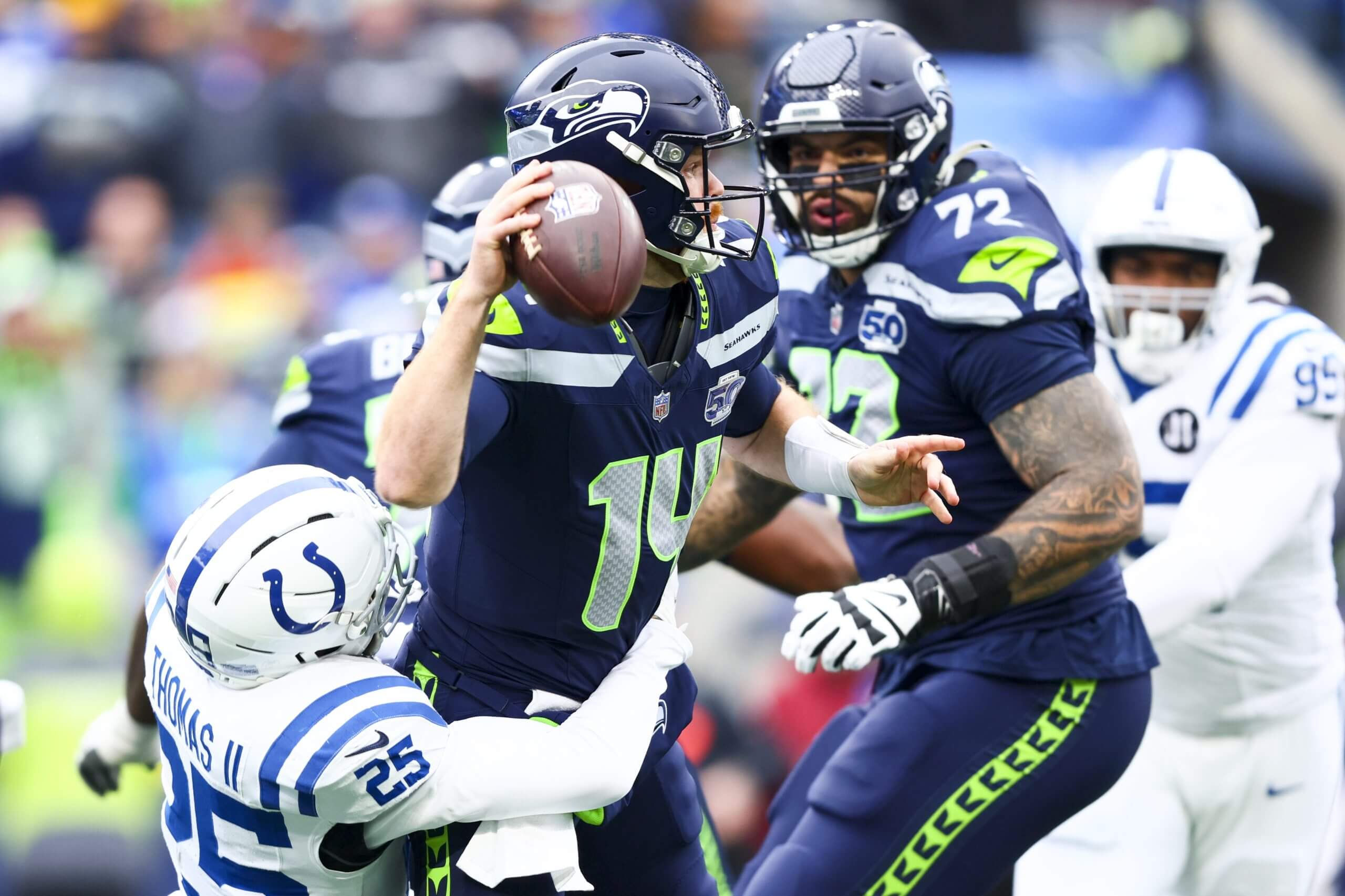
The Seahawks brought in safety Rodney Thomas — shown pressuring Sam Darnold last season — as a rangy, instinctive safety. (Kevin Ng / Imagn Images)
Igbinoghene, 26, was a first-round pick of the Miami Dolphins in 2020. He was traded to the Dallas Cowboys in 2023 and then spent the last two seasons with the Commanders, mostly as a backup. Seattle sees Igbinoghene as someone who can compete to play outside cornerback and nickel. Seattle also has 2024 fifth-round pick Nehemiah Pritchett as a backup behind Jobe, Devon Witherspoon and nickelback Nick Emmanwori.
The Packers did not tender Wilson as a restricted free agent despite the soon-to-be 27-year-old running back giving them decent reps as Josh Jacobs’ backup last season. Listed at 226 pounds, Wilson is the heaviest running back on Seattle’s roster and was signed in part because of his physical running style.
“Our pro staff did a great job evaluating and identifying Emanuel and just saying, ‘Here’s this 230-pound guy with great feet,’” Schneider said. “You sign a one-year deal like that, it’s like, ‘Come on in, come be part of our culture, come prove it, see what you can do and compete with the group.’ He gives us a little bit of something different — he’s a heavy runner. Excited about him.”
Seattle’s other running backs are Zach Charbonnet, Holani, Kenny McIntosh, Cam Akers, Velus Jones Jr. and Jacardia Wright. As Charbonnet recovers from the ACL surgery he had last month, the early favorite to be the lead back seems to be Holani, who Schneider said was “awesome” in the NFC title game and the Super Bowl as a receiver and provided “elite” pass protection. Holani, in those two games, had four catches for 34 yards and generated two first downs. He had five carries for 10 yards. In the regular season, Holani had 22 carries for 73 yards and a touchdown.
“Every time (Holani) goes in the game, he just performs,” Schneider said.
Remaining needs
The terms of all these deals are not yet available, but Seattle should have something in the realm of $35 million in effective salary-cap space when everything is official. The Seahawks technically only lost two starters from the Super Bowl squad: Walker and Bryant. That said, Woolen (917 defensive snaps) and Mafe (592) were on the field often as members of the defensive rotation, so their absences are notable as well. Otherwise, Seattle’s roster is still in good shape, though arguably not as talented as the roster that won a championship.
Walker’s absence will be felt primarily because he was one of the most dynamic offensive weapons on the team. Even after adding Wilson, Schneider said of the running back spot: “We’ll be continuing to look at that position.” In terms of skill set, Seattle will likely look to draft someone with game-changing speed to produce the sort of explosive plays the team could previously rely on Walker delivering.
The only other notable addition who would fit into Seattle’s roster-building plan would be a veteran edge rusher. The Athletic’s free-agent list features the following available players: Joey Bosa, Jadeveon Clowney, Cameron Jordan, Leonard Floyd and Von Miller, who considered signing with Seattle last season.