

The road to the Final Four starts now.
After months of grinding through the regular season and surviving the chaos of conference tournaments, 64 teams remain — with just three weeks separating them from a national title. But before dreams of cutting down the nets can take shape, there’s the most unforgiving round in sports: the Round of 64.
No series. No second chances. Just one game to survive and advance.
So who’s built for the moment? And who’s about to see their run end just as it begins? The Athletic has you covered with everything you need to know.
Here’s what to look for in the biggest games in Thursday’s slate:
No. 8 Ohio State vs. No. 9 TCU
12:15 p.m. ET on CBS
On paper, Ohio State has a lot offensively that TCU doesn’t. The Buckeyes have one of the best backcourts in the country. They have the 16th-rated offense, according to KenPom. They also have senior guard Bruce Thornton (20.2 points per game), who’s one of just 33 players in the country averaging more than 20 a night, and he’s fourth in the Big Ten. They also have junior guard John Mobley Jr., who adds 15.7 a night. Both are shooting 40 percent from deep or better.
TCU, on the other hand, doesn’t have a player averaging more than 15 a game.
But forecasting good guard play in March is always perilous. Ohio State isn’t a strong rebounding team, ranking 285th, so TCU will have an opportunity to dominate down low. Two of Ohio State’s three losses in its 4-3 stretch over the last seven games came against Michigan and Michigan State, which both rank in the top 30 nationally in rebounding.
Thornton averaged 26 points in those two contests, proving the Buckeyes can lose even if their star guard gets hot. Mobley didn’t play in the six-point loss to Michigan State, but he did in the team’s four-point loss in the Big Ten quarterfinals to Michigan, a No. 1 seed in the NCAA Tournament. The Buckeyes are in the ballpark of the nation’s elite.
TCU, however, is 2-1 against ranked opponents since the start of February, limiting Kansas, Texas Tech and Iowa State to an average of 64 points a game. The defensive rating is 23rd on KenPom, so the decider will be whichever gives first. Either Ohio State’s guards break open the Horned Frogs’ defense, or TCU muscles them out of the game. — Devon Henderson, staff writer
No. 4 Nebraska vs. No. 13 Troy
12:40 p.m. ET on truTV
Nebrasketball has existed for 130 years. And in that long and not-so-storied history, the Huskers have as many NCAA Tournament victories as their first-round opponent, the Troy Trojans of the Sun Belt. Which is to say, zero. So no matter what happens inside the Paycom Center on Thursday afternoon, history will be made.
This just might be Nebraska’s best chance yet to break through in the Big Dance. The Huskers (26-6) are a No. 4 seed in the South Region, their second-highest seed in program history behind the 1990-91 squad that was a No. 3 under Danny Nee. And they rose as high as No. 5 in the AP poll this winter en route to a second-place finish in the Big Ten (15-5).
Iowa transfer Pryce Sandfort and 6-foot-9 senior Rienk Mast lead an experienced cast under seventh-year coach Fred Hoiberg. This is the Huskers’ second NCAA Tournament appearance in three seasons. The coach’s son, 6-foot senior guard Sam Hoiberg, was also along for the ride the last time. That bid ended in a 98-83 loss to ninth-seeded Texas A&M. With the seventh-best defensive rating in the nation, per KenPom, these Huskers should at least avoid that fate.
Up next is a Trojan squad that is back in the NCAA Tournament for the second year in a row under coach Scott Cross. Troy has four players averaging double-figure scoring, and all four played on last year’s tourney team. That includes double-double machine Thomas Dowd. The 6-foot-8 junior shot 0-for-7 from the field in last year’s 76-57 loss to third-seeded Kentucky in the first round. A shot at redemption arrives. — Matt Schubert, staff editor
No. 6 Louisville vs. No. 11 USF
1:30 p.m. ET on TNT
In a time when “ethical scoring” is under the microscope, this matchup might not be for the faint of heart. Expect fireworks, as both Louisville and USF rank in the top 20 nationally in scoring.
The South Florida Bulls live at the free-throw line — no team in the country gets there more frequently — attempting 27.1 free throws per game and knocking down 20.2 of them. It starts with American Player of the Year Izaiyah Nelson, who anchors the attack with a near double-double, averaging 15.7 points and 9.6 rebounds per game. But it doesn’t stop there. The Bulls roll out four other double-figure scorers, including leading bucket-getter Wes Enis at 16.8 points per game.
Louisville can also fill it up, but the Cardinals will be without future lottery pick Mikel Brown Jr., who remains sidelined with a back injury. It’s a major loss, but the Cardinals have navigated 12 games without him, going 7-5.
For Louisville, the formula is simple: score early and often. The Cardinals are nearly unbeatable when topping 80 points (18-1), but far more vulnerable when held under 75 (3-7). Ball movement is their backbone — they rank 25th nationally in assists per game (17.1), a key reason they led the ACC in 3-pointers per game.
Still, this feels like upset territory. If Louisville wants to survive, it starts on the glass. USF ranks seventh in the nation in offensive rebounding percentage, and second-chance points could tilt everything. Limit those, knock down open 3s, and the Cardinals just might find a way through. — Tobias Bass, staff editor
No. 5 Wisconsin vs. No. 12 High Point
1:50 p.m. ET on TBS
This could easily become the classic 5-12 upset, especially given the teams’ high-octane playing styles.
High Point enters Thursday with a 30-4 record, is riding a 14-game winning streak and averages 90 points per contest.
Yet, if Wisconsin plays the way it has played throughout the season, quietly becoming one of the country’s top offenses with quick and efficient scoring while slowing some of the country’s top offenses, High Point could be in for a rude awakening.
The Badgers defeated Michigan — one of the four No. 1 seeds in this tournament — 91-88 in Ann Arbor in a high-scoring affair in which John Blackwell, Nick Boyd and Aleksas Bieliauskas combined to score 65 points. They also defeated then-eighth-ranked Illinois 92-90 on the road and followed that with a 21-point beatdown of Michigan State at home.
The Badgers score a lot of points in the halfcourt — their method for the longest time — and average 16 assists per game. So, if they can dictate the tempo and thwart High Point’s attempts to speed them up and force turnovers with full-court pressure, the Badgers should come out on top. The Badgers turn the ball over fewer than 10 times per game, so it should be a fun one. — Zach Powell, staff editor
No. 5 Vanderbilt vs. No. 12 McNeese State
3:15 p.m. ET on truTv
It’s a trend as old as March itself — offense can be slow to show up early in the NCAA Tournament. That plays directly into McNeese State’s identity. The Cowboys aren’t built on shooting, ranking 299th from 3-point range and 136th from two, but they dominate the glass and defend at an elite level.
Vanderbilt, on the other hand, brings one of the most efficient offenses in the country into this matchup. Per KenPom, the Commodores rank seventh nationally in offensive efficiency, sitting top 40 in two-point percentage, top 90 from 3, and an impressive fourth at the free-throw line.
The start early could tell the story late. Does Vandy come out making shots? Or will McNeese State’s defense overwhelm the Commodores?
If Vanderbilt grabs control, maintaining that pressure will be key, because McNeese thrives on relentless rim pressure, ranking top 70 in both free-throw attempts and makes. The Cowboys’ formula is simple: disrupt, pressure and force mistakes, leading the nation in defensive turnover percentage.
For Vanderbilt, the path is just as clear: execute, stay efficient and trust an offense that’s delivered all season. McNeese is dangerous, but unlike your typical Cinderella, it won’t beat you from deep. The Cowboys will try to drag you into the mud and win it their way. — Tobias Bass, staff editor
No. 6 North Carolina vs. No. 11 VCU
6:50 p.m. ET on TNT
This game could be a pressure test for UNC if it isn’t wise — even though VCU is seeded No. 11 — as the Rams are 27-7 and one of the hottest teams in this pod, having won 16 of their last 17 contests. The Atlantic 10 champs are defined by an aggressive style that could be described as organized chaos.
The Tar Heels certainly have an edge in various areas — size, rebounding and transition scoring — but VCU’s backcourt play will test UNC for 40 minutes. The Rams are +1.4 in turnover margin and force their opponents into 11.9 per game. They also average 7.4 steals per game.
UNC will need to do the simple things well: control the glass and protect the ball. VCU will pressure ball handlers, but the bigger question is, will the Tar Heels’ talent be enough to overcome a scrappy opponent or will VCU claw its way to an upset? — Zach Powell, staff editor
No. 7 Saint Mary’s vs. No. 10 Texas A&M
7:35 p.m. ET on truTV
What happens when an unstoppable force of chaotic, nonstop pressure and movement meets two 7-foot immovable objects — plus a 6-foot-8 one? We’re going to find out. Texas A&M’s famous “Bucky Ball,” the name of coach Bucky McMillan’s high-chaos, high-pressure style, vaulted the Aggies to an 8-1 start to SEC play this season. In that stretch, they averaged 84.5 points per game and scored 90 or more three times.
The Aggies are known for their full-court pressure, high-tempo offense and rapid 3-point shooting. This season, they’re 11th in the country in pace with 76.0 possessions per game, 14th in 3s attempted per game at just under 30, and 43rd in steals per game at 8.1. Six players average double-digit scoring for Texas A&M.
The problem is, chaos isn’t always controllable.
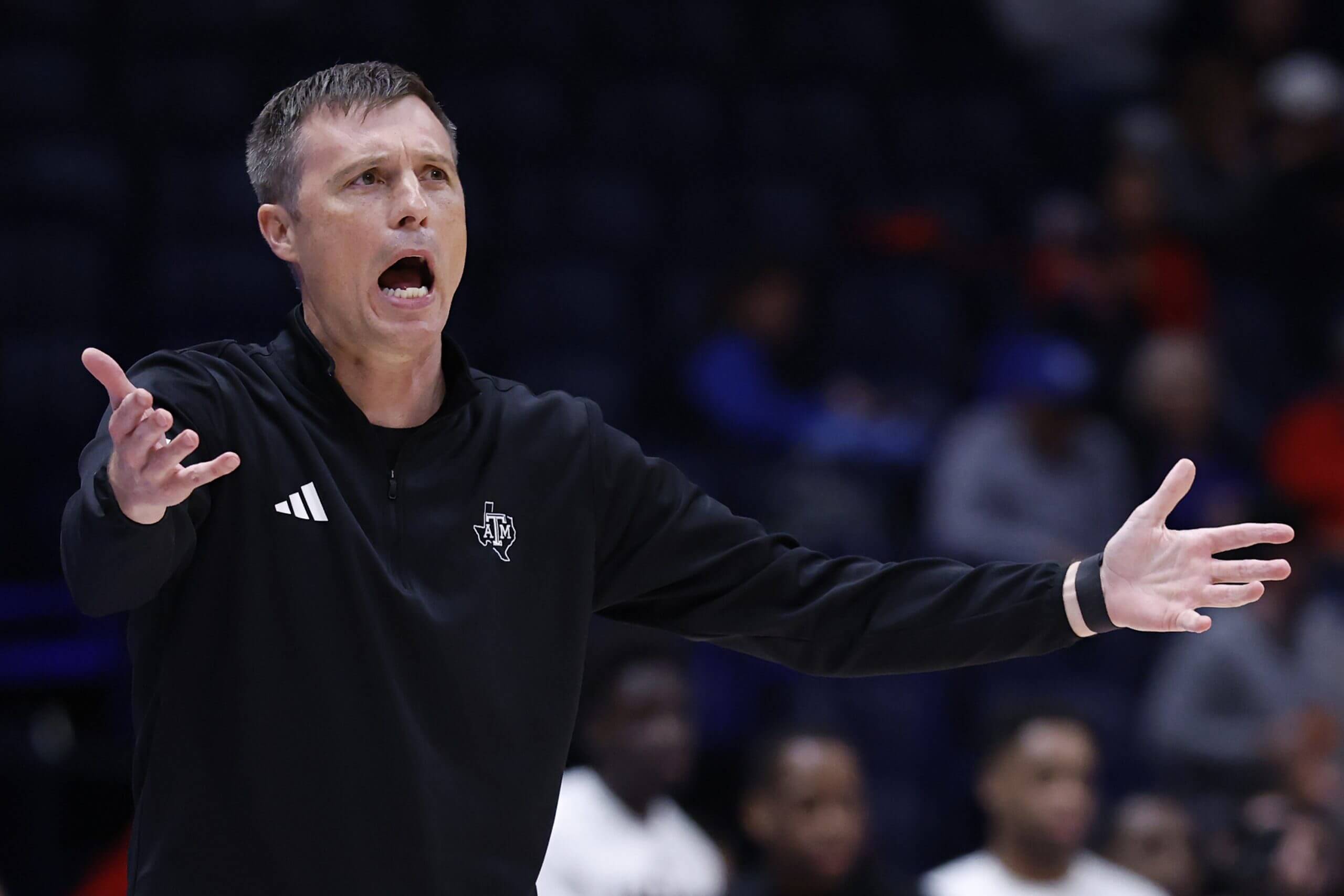
Bucky McMillan’s Texas A&M squad loves to play fast, ranking 11th in the country in pace with 76.0 possessions per game. (Johnnie Izquierdo / Getty Images)
After the fast start to conference play, Texas A&M went 4-7 in its last 11 games. A lack of effective defense caught up to it, as the Aggies finished the year with the fourth-worst scoring defense (79.6 points allowed per game) in the SEC.
On the flip side, Saint Mary’s deploys three gargantuans in Andrew McKeever (7-foot-2, 285 pounds), Harry Wessels (7-foot-1, 280 pounds) and Paulius Murauskas (6-foot-8, 235 pounds). They’ll control the glass and make the runaway train that is Bucky Ball navigate through oak trees.
In Mikey Lewis and Joshua Dent, the Gaels, who knocked off three-seed Gonzaga in their regular-season finale, have talented guards. Against Texas A&M, the question will be whether Saint Mary’s can wade through the full-court press. On the flip side, the Aggies will be forced to bomb away from outside.
If styles make fights, this should be a good one. — Devon Henderson, staff writer
No. 8 Georgia vs. No. 9 St. Louis
9:45 p.m. ET on CBS
One of the biggest challenges for a team in March is sustaining its playing style no matter the circumstances. Yet, if a team such as Saint Louis — which relies on halfcourt execution, scoring by committee and generating high-percentage looks — can slow the game down to its pace, it can beat the Bulldogs.
The Bulldogs, meanwhile, lean on athleticism. Silas Demary Jr. is Georgia’s primary scorer. He fuels creativity in the offense and can be hard to contain if a defense doesn’t work to slow him down. His drive-and-dish ability, coupled with Jabri Abdur-Rahim’s talent for spacing the floor, could give Georgia room to play more of its style.
Conversely, Saint Louis guards Gibson Jimerson and Yuri Collins dictate the Billikens’ offense from the backcourt. Collins, who averages 10 assists per game, will look to control the tempo. Georgia might try to force the ball out of his hands. Yet that could open the floor for Jimerson, who is one of the best shooters in the country when on the move. He makes shots, but he can drive-and-kick to find open shooters, which fuels the Billikens’ 40 percent mark from long range.
St. Louis’ hope is to score in the halfcourt, and if it can slow the pace, an upset is possible. But if the Bulldogs can find a way to disrupt the Billikens’ rhythm and get out in transition, the game could quickly get out of reach. — Zach Powell, staff editor