
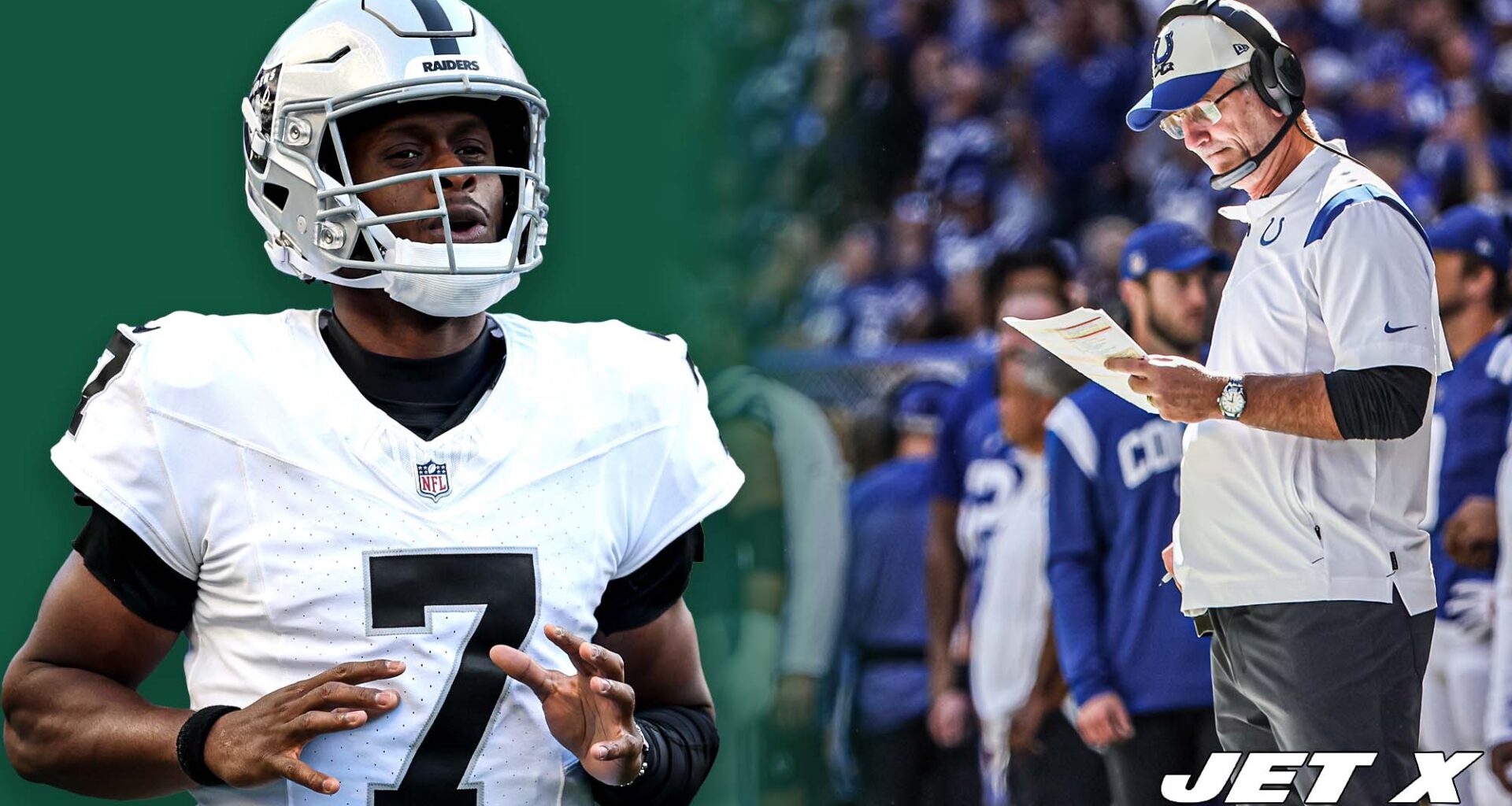
A select few NFL quarterbacks are scheme-transcendent. No matter the coach, they will find a way to move the football.
In today’s league, only players like Patrick Mahomes, Joe Burrow, Josh Allen, and perhaps Lamar Jackson have proven they belong in this category.
If you’re not one of those players, you’re in the other tier of NFL quarterbacks: Those who rely on their surroundings to be successful.
From Jalen Hurts to Sam Darnold to the Jets’ newest quarterback, Geno Smith, just about every other NFL quarterback can range from elite to unwatchable on any given Sunday, depending on how their team supports them.
It wasn’t long ago that Smith was a bona fide above-average starter in the NFL. As the Seattle Seahawks’ starter from 2022-24, Smith had the fourth-most passing yards of any quarterback, while his 95.5 passer rating placed 14th among 42 qualified signal-callers. Seattle had a 27-22 record under his lead.
Suddenly, Smith looked like a backup quarterback again. In 2025, Smith led the NFL in interceptions (17) and had the worst QBR (34.1) among non-rookie quarterbacks. The Raiders went 2-13 in Smith’s starts.
The Jets are hoping to get the Seattle version of Smith. If it’s going to happen, they need to give him the quality support that he had in Seattle but sorely lacked in Las Vegas.
A big part of that quality support has to be a scheme that suits Smith’s strengths. In Seattle, Smith’s comfort level was so strong that he emerged as a Pro Bowl-level quarterback in his 30s despite never being anywhere close to a league-average quarterback over his first nine NFL seasons.
In Las Vegas, Smith played under a scraped-together staff that saw its head coach and offensive coordinator go one-and-done. Nothing about the Raiders organization, on or off the field, was functional. It translated to a passing game that never appeared to be on the same page.
That’s not to say the Jets organization is any more functional until proven otherwise. But if Jets offensive coordinator Frank Reich implements a system that matches the strengths and weaknesses of his starting quarterback, New York could win more games than most people expect.
It brings us to the question of the day: Does Geno Smith fit Frank Reich’s scheme?
Let’s analyze Smith and Reich’s historical tendencies to estimate the answer.
What type of routes does Frank Reich like to call?
Using data from FTN Fantasy, we can analyze the frequency at which Reich’s recent offenses targeted each route type.
The chart below shows how often Reich’s teams targeted each route type (as a percentage of pass attempts) across his last three NFL seasons (2021-23), compared to the 2025 league average. The route types are sorted from top to bottom based on how often Reich targeted them compared to the average NFL team in 2025.
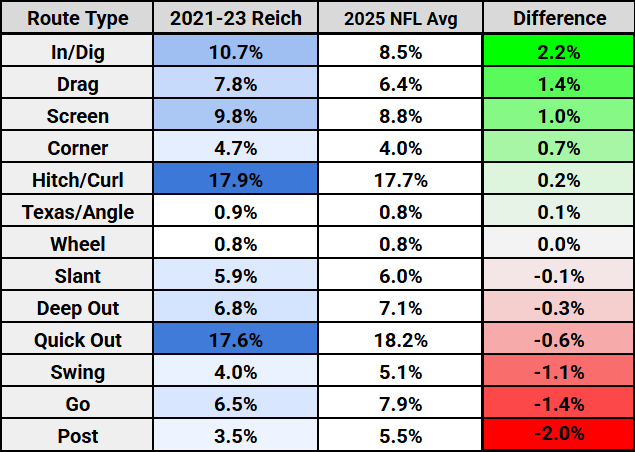
Relative to other teams, Reich’s two favorite routes were both in-breakers: in/dig routes and drag routes. He also liked to call a healthy dosage of screens.
On the other end of the spectrum, Reich’s two least-favorite routes were both vertical deep shots: post routes and go routes.
How does Smith fit into this type of offense?
Geno Smith’s best route types
Now that we know Reich’s route tendencies, we can learn a lot by analyzing Smith’s efficiency at targeting each route type.
In an ideal world, Smith would thrive at Reich’s preferred routes and struggle at Reich’s least favorite routes. This would make Reich’s offense the perfect system to emphasize Smith’s strengths and minimize his weaknesses.
In a less-than-ideal world, Smith would struggle at Reich’s preferred routes, while his strongest routes would be among Reich’s least favorite.
Let’s find out which world we live in.
First, we need an ideal way to understand how proficient Smith is at each route type. We can’t just look at stats like completion percentage or yards per attempt, because these numbers will obviously look very different for screens than for go routes, for instance.
So, we’re going to use our good friend, EPA, which stands for Expected Points Added. This metric accounts for the down, distance, and field position of each play to quantify how “valuable” the final result is. It tells us a lot more about a player’s true impact on winning than rudimentary stats like yards and touchdowns.
I pulled Smith’s EPA per attempt on each route type and compared it to the 2025 NFL average. This helps us identify the best and worst throws in Smith’s game.
For this exercise, I focused solely on Smith’s 2022-24 seasons as the Seahawks’ quarterback. I figured it made sense to exclude the messy 2025 season in Las Vegas, as the Jets’ goal is to help Smith replicate what he did in Seattle, while throwing everything from Chip Kelly’s putrid Vegas offense in the garbage.
Seen below is the same table we saw above, featuring Reich’s route type frequencies relative to the 2025 NFL average, except this time, the table also includes Smith’s EPA per attempt on each route type compared to the 2025 NFL average.
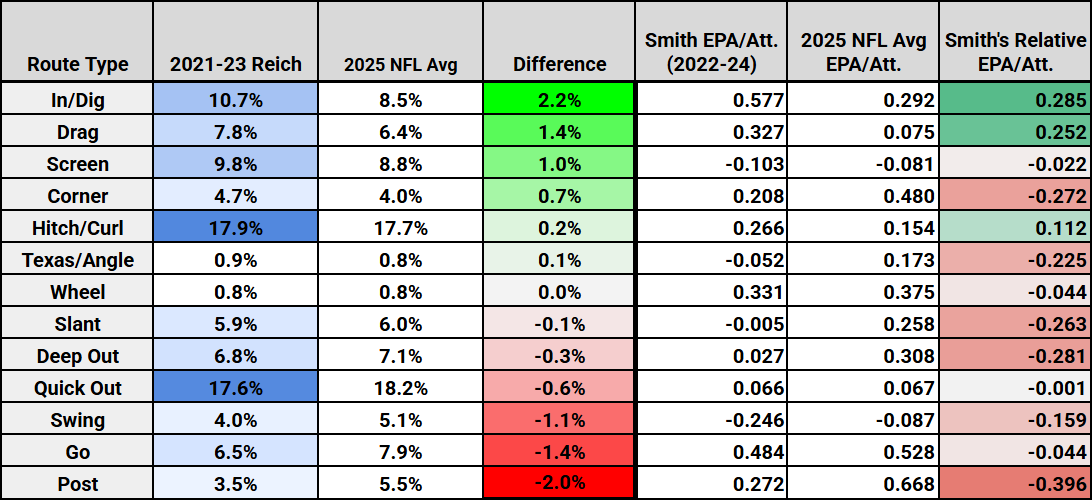
This table, right here, could explain precisely why the Jets preferred Smith among their realistic quarterback options on the 2026 veteran market.
Reich’s two favorite routes relative to the NFL average, the in/dig route and the drag route, also happen to be Smith’s two best routes based on EPA per attempt relative to the NFL average—by a longshot, too. Smith was nothing short of elite on those two route types in Seattle.
To boot, Smith’s third-best route, the hitch/curl route, is Reich’s most commonly used route overall, and his fifth-favorite compared to league average.
Meanwhile, on the other end of the spectrum, Smith’s worst route by a country mile, the post route, is also the route type that Reich targets the least frequently compared to league average.
This is precisely the combability you want to see between a coach and his quarterback.
Smith is at his best throwing digs and drags, and those are the routes Reich loves more than any other. Smith is at his worst throwing posts, and that’s just fine, because Reich avoids them more than any other.
Perhaps the most tantalizing aspect is that Reich should allow Smith to use his best route types even more frequently than the Seahawks did.
Here is a look at Smith’s 2022-24 route tendencies compared to Reich’s. The table is sorted from top to bottom by the target percentages of Reich’s teams from 2021-23.
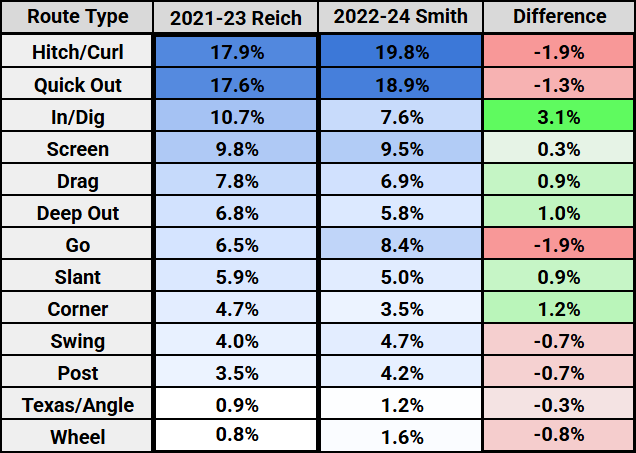
In terms of target frequency, the in/dig route is by far the biggest separator between Reich’s offenses and the 2022-23 Seahawks offense. Whereas Reich targeted it 2.2% more often than the 2025 league average (8.5%), Smith targeted it 0.9% less often, culminating in a relatively massive 3.1% gap in target frequency.
That means, if Reich plans on calling his offense the same way in New York, Smith will throw far more in/dig routes than he did in Seattle. Given that the in/dig route is Smith’s best route (0.285 EPA per attempt above the league average), Smith would benefit greatly from that change.
good old y-cross.
field quarter safety doesn’t stand a chance in robbing Smith-Njigba’s dig, Geno feels the rush and delivers a strike over the middle in rhythm pic.twitter.com/HSIL8haCiM
— under zone x (@cmikesspinmove) December 16, 2024
Reich’s teams also targeted drag routes nearly 1% more frequently than Smith, another area where Smith’s usage would be optimized, as the drag route (0.252 EPA per attempt above the league average) closely trails the in/dig route as Smith’s second-best route.
An optimistic spin on the Jets’ Reich-Smith pairing
As Jets fans search for reasons to be optimistic about the team’s chances of winning games in 2026, this is one of the best signs they could possibly ask for. Despite fair concerns about Reich and Smith as individuals, they seem to complement one another quite nicely.
It is important to recognize that we do not know whether Reich plans to replicate the route tendencies that we saw from him when he last coached in the NFL. If he does, though, his offense will be tailor-made to emphasize Smith’s strengths and hide his weaknesses.
Of course, this does not guarantee any sort of success. Those throws still have to be executed, and it is uncertain whether Smith can be trusted to execute them at this point of his career.
In 2025, it appeared that Smith may have hit the mid-30s wall athletically, reducing him to one of the league’s least mobile starters. This is a concern he will have to squash in 2026 if he wants to return to his Seattle peaks. If he cannot prove it to be nothing more than a byproduct of the Raiders’ rough environment, then his days as a quality NFL starter may simply be over, no matter how well the offense suits his strengths.
At the very least, though, Jets fans can take some solace in knowing that cohesion existed between the coaching staff and the front office when it came to evaluating the quarterback position in March. Should Smith ultimately be the team’s Week 1 starter, they would not be trying to fit a square peg into a round hole.
That counts for something after years of offensive dysfunction.
All that Geno and the Jets have to do now is achieve the only part of the equation that actually matters—completing those dig routes and drag routes for touchdowns.