
At first glance, the Green Bay Packers’ decision to sign Skyy Moore in 2026 looks like a rerun of last offseason’s Mecole Hardman addition.
Moore and Hardman share similar profiles. They are undersized, speedy receivers with return ability. Both are former second-round picks and have spent time with the Kansas City Chiefs. To the casual observer, this appears to be the Packers recycling a failed roster experiment.
But a deeper look reveals that these two signings are not the same. More importantly, adding Moore reflects a more intentional and informed approach from Green Bay.
The most immediate and telling difference lies in how the Packers structured the deals.
Moore’s contract includes a significantly higher financial commitment than Hardman’s deal the previous year. Reports indicate Moore received a larger signing bonus and overall guaranteed money in the $1 million range. Moore can make up to $4.5 million with his contract. That suggests the Packers are more confident that he’ll make next year’s roster.
By contrast, Hardman’s deal in 2025 was minimal – essentially a flier. It was a low-risk, low-investment signing that allowed the team to evaluate him in camp without any real obligation.
That distinction matters. The only guaranteed money in Hardman’s deal was a $150,000 signing bonus. The total value of his deal was just up to $1.5 million. Teams often signal their expectations through contract structure. In this case, Green Bay is clearly more invested in Moore than they ever were in Hardman.
That isn’t just semantics; it’s roster philosophy. Hardman was a “see if it works” player. The Packers have brought Moore in with a defined role in mind.
Another major difference is where each player was in their career at the time of signing.
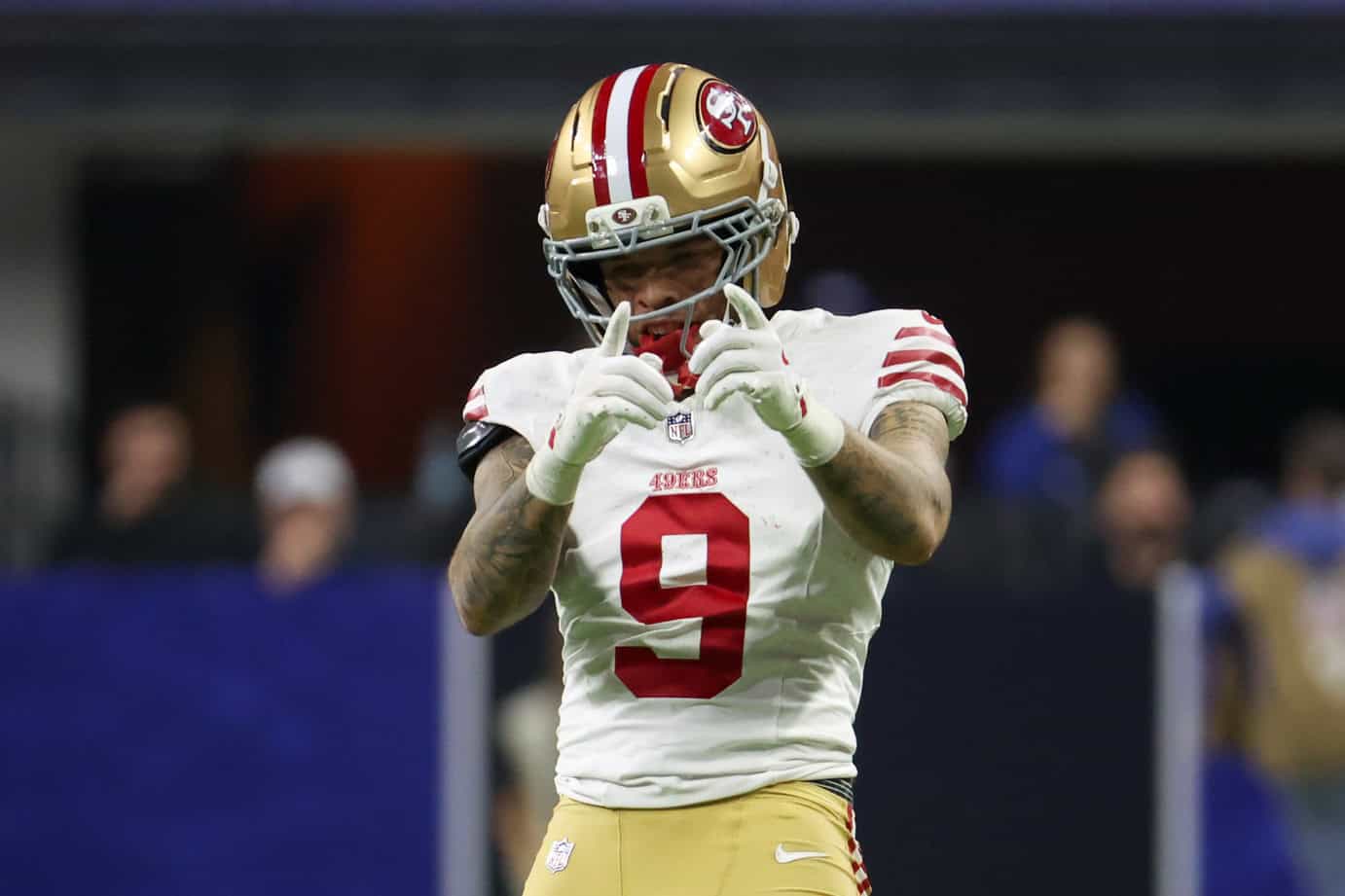
Moore is coming off a season where he carved out a legitimate role as a return specialist. After flaming out in Kansas City as a second-round pick in the 2022 draft, he went on to the San Francisco 49ers and revived his career as a return specialist. He posted strong numbers last year, including over 900 kick-return yards and solid punt-return production, proving he can be an effective special-teams contributor.
Hardman, on the other hand, was trending in the opposite direction when he signed with the Packers last year. Injuries and inconsistent usage had limited his effectiveness, and his offensive production had declined significantly in recent seasons.
The result? Hardman never made the 53-man roster and didn’t play a single regular-season snap for the Packers.
Moore, by comparison, arrives with a clearly defined and recently proven skill set and purpose on this team. He may not be a breakout receiver, but he has demonstrated value in the exact role Green Bay needs. He can improve field position and special teams consistency.
While both players were once viewed as similar prospects, their timelines have diverged.
Moore is still in his mid-20s and retains some developmental upside. As a former second-round pick in 2022, he’s only a few years removed from being a highly regarded prospect with strong hands, high-end speed, and route-running ability.
Meanwhile, Hardman was already a more established — and arguably more defined — player when he signed with Green Bay. By 2025, teams largely knew he was a gadget player and returner whose peak impact had likely already passed.
In other words, Moore still offers some “what if” potential. Hardman did not.
That difference matters for a team like the Packers, who have consistently prioritized player development and upside at the back end of the roster.
Perhaps the most important distinction is role clarity.
When the Packers signed Hardman, the move felt somewhat ambiguous. Was he competing for a receiver spot? A return job? A gadget role?
Hardman didn’t have a clearly defined pathway to making the roster, and that ambiguity ultimately worked against him. The Packers had just drafted Matthew Golden in the first round and Savion Williams in the third. Both came to Green Bay with experience returning in college, and the Packers wanted to explore every avenue to get them on the field early in their careers.
With Moore, the role is far more obvious.
Green Bay signed him specifically to address ongoing issues in the return game – a problem that has persisted for years. Moore’s recent success as both a kickoff and punt returner aligns directly with that need. Golden and Williams proved last year that they are not the answer the team was seeking as returners. With Doubs now out of the picture, both will be asked to contribute on offense in major ways. Moore has a clear path to a much more defined role than anything Hardman had.
That clarity increases his chances of sticking. Coaches value players who fill a defined role, especially on special teams, and Moore checks that box immediately.
Skyy Moore on the run! pic.twitter.com/2uGt9Pv4pF
— NFL UK & Ireland (@NFLUKIRE) November 30, 2025
It’s also important to recognize that the Moore signing doesn’t exist in a vacuum – it’s a direct response to what happened with Hardman.
Coming over from the Kyle Shannan offense last year in San Francisco, it wouldn’t be surprising to see Matt LaFleur draw up a package or two for Moore on the offensive side of the ball, either. The Packers love creating mismatches, and getting Moore on a jet sweep or lined up on a linebacker out of the backfield could be a fun wrinkle. They really haven’t had that type of player since their Tyler Ervin days in 2020.
The Packers tried the “cheap veteran returner” approach in 2025, and it failed. Hardman didn’t make the team, and the return game remained inconsistent. Golden, Williams, Doubs, and Melton all took their turns back there, and the Packers were the worst team in the league with 5.6 yards per punt return.
Now, they’ve adjusted their approach and seem to finally be taking this critical position seriously.
Moore represents a refined version of that same idea: a similar player archetype, but younger, more productive recently, and more financially backed. As one analysis put it, Moore is essentially a “younger version” of the type of player the Packers attempted to add with Hardman.
That’s not redundancy. It’s iteration and a shift in Green Bay’s roster-building approach.