
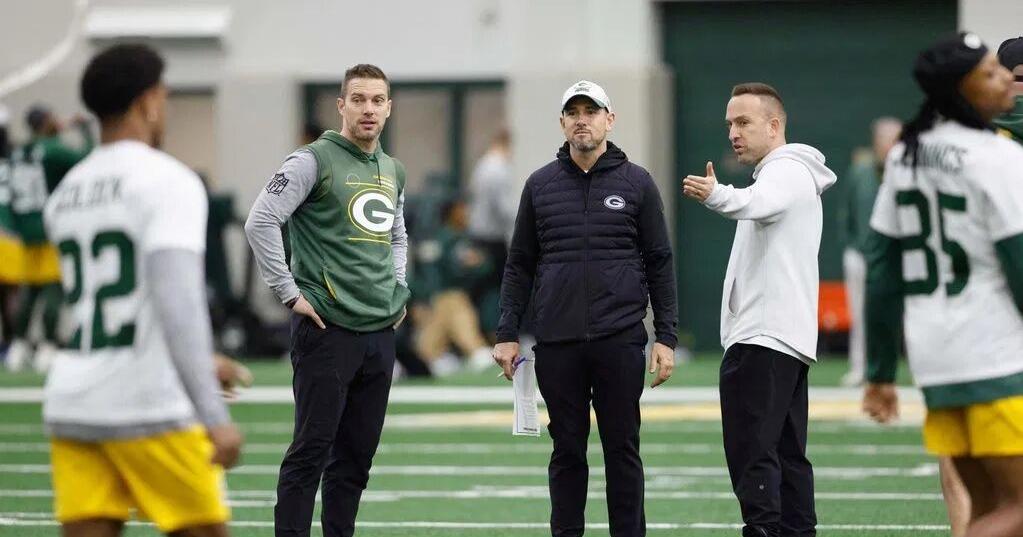
GREEN BAY — Matt LaFleur has made it very clear, both privately to his players and publicly to reporters: When it comes to the Green Bay Packers’ offseason program, time is of the essence.
The Packers head coach had his team spend the first week of the program in the virtual realm, not wanting the players to have to deal with the logistical challenges of getting to and from Lambeau Field as Green Bay played host to the 2025 NFL Draft.
And with the NFL kicking off its regular season on Sept. 4 with the defending Super Bowl-champion Philadelphia Eagles facing the rival Dallas Cowboys — with the Packers opening their season at home against the Detroit Lions on Sept. 7 — training camp will likely begin early again, as it did last year (July 22) when the Packers played the Eagles in São Paulo, Brazil, last Sept. 6.
Thus, in an effort to give his guys ample time to recharge their batteries, LaFleur will wrap up the offseason program with a mandatory minicamp June 10-12.
Before that, he has six organized team activity practices — three fewer than usual — to get them ready: Tuesday, Wednesday and Friday of this week, and June 2, 3 and 5 next week.
“We’re kind of cutting [the offseason program] a little short, which I think about 28 of the 32 teams from what I saw are doing the same,” LaFleur explained. “It’s about our time and what we do when we’re in the building — just being urgent.
“To me, if you want more and you want to go further [in the playoffs], you’ve got to be willing to give more. That’s what we’ve got to do. It’s going to be a collective effort. We need everybody to have that mindset, to come in with that mindset, and get to work.”
Asked what his reasoning was for limiting the length of the offseason program, LaFleur replied, “I think if you look at where the calendar fell, you’re going into late June [if you don’t shorten it]. We all know the rigors of an NFL season and how long it is. You’ve got to decide the value [of time off] from the end of the offseason to the start of training camp. How much time do you want to give these guys? We’re going to have plenty of time to be together.”
And during that time, the Packers must get started on answering some of the questions that will determine if they do, in fact, advance further in the NFC playoffs than in 2023 (when they lost to the San Francisco 49ers in the divisional round after taking a seven-point lead into the fourth quarter) and 2024 (when they lost to the Eagles in the wild card round, their third straight loss to end the year).
Here are five such questions that LaFleur & Co. will be efforting on, starting with Tuesday’s first OTA session:
1. What kind of quarterback is Jordan Love going to be? | LaFleur challenged Love after the season to become more vocal in his leadership, so it will be interesting to see if there’s any discernible difference in how Love approaches that responsibility.
But that’s only one aspect of the job where Love must elevate his game. After finishing his first year as the starter in 2023 on an Aaron Rodgers-esque heater, Love was unable to sustain that level of play in Year 2. Even Love himself described his (and the offense’s) season as “inconsistent.”
To be sure, early season knee and groin injuries hampered his mobility, and his would-be pass-catchers dropping 33 passes certainly did not help his 61.3% completion rate. Nonetheless, he finished the year having thrown 25 touchdown passes against 11 interceptions (96.7 quarterback rating) and threw three more INTs in the playoff loss to the Eagles.
Now, entering Year 3 as a starter and having signed a four-year, $220 million contract extension 10 months ago, it’s time for him to raise his game.
“He’s a great talent. He’s a great person. And he has great habits. I think when you combine those three things, really the sky is the limit,” said new quarterbacks coach Sean Mannion, a longtime NFL backup who retired after the 2023 season and is replacing 71-year-old consigliere Tom Clements.
“For him, what we’re really trying to focus on [are] the fundamentals and the footwork. [Because] that’ll help you be your most consistent accuracy wise, decision making wise and timing wise. So that’s really our main area of focus with him.”
2. Who will be among the proverbial “best five” to start on the offensive line come the Sept. 7 opener against the Detroit Lions? | Offensive coordinator Adam Stenavich hath proclaimed three of the five spots to be open competitions — left tackle, right guard and right tackle, which just so happen to have incumbent starters who are all in the final years of their rookie contracts.
Meanwhile, although left guard-turned-center Elgton Jenkins is not in a direct competition for his starting gig, he did not take part in Phase I or Phase II of the offseason program — all of which is technically voluntary, of course — because he’d like his existing contract to be altered to give him a measure of security in the final two years of the deal.
So, at this point, only $77 million free-agent pick-up Aaron Banks, who has never taken an in-game snap as a Packer, is settled into his starting spot at left guard.
Perhaps left tackle Rasheed Walker, right guard Sean Rhyan and right tackle Zach Tom will all hold serve and keep their job against challengers who figure to include 2024 first-rounder Jordan Morgan and 2025 second-rounder Anthony Belton, among others. But as OTAs begin, 60% of the line jobs are up for grabs and Jenkins’ plans are unclear.
3. What will be the pecking order at wide receiver after the draft-day additions of Matthew Golden and Savion Williams? | Although he’d suffered a season-ending torn ACL in his right knee in the regular-season finale a week earlier, Christian Watson was not put on injured reserve right away.
Instead, he was a game-day inactive for the Packers’ season-ending NFC playoff loss to the Philadelphia Eagles. The other five wideouts on the roster were all active and divvied up playing time. Of the offense’s 66 snaps, Dontayvion Wicks (51) played the most, followed by Romeo Doubs (37, before suffering a concussion), Jayden Reed (36, before dislocating his shoulder), Bo Melton (32) and Malik Heath (26).
Make no mistake, all six of those men have a lot at stake this season, including Watson, who is not expected to be cleared for game action until November.
Although Golden’s first-round draft status and Williams’ versatility don’t guarantee them immediate and extensive playing time, it’s hard to imagine either of them taking anything remotely resembling a redshirt year.
And so, Watson and Doubs in the final years of their rookie deals and Wicks and Reed eligible for extensions at season’s end, let the competition commence.
“I tell all our guys, ‘I want all you guys to get your second contract, whether it’s here or somewhere [else],’” Packers offensive passing-game coordinator Jason Vrable said earlier this month. “I want them to have 10-year careers where they’re both financially and numerically successful.
“I’ve always said, ‘You get what you earn. No more, no less.’ Just [with] the laws of compensation of what you’re going to get, it usually works out that way in this league.”
4. When Jaire Alexander’s fate is — at long last — decided, what will the Packers’ cornerback rotation be? | There hasn’t been a single indication that the two-time second-team All-Pro cover man’s in-limbo status is close to being resolved.
As recently as last week, LaFleur appeared on Kay Adams’ podcast and trotted out the organization’s party line: “That’s just something that we’re working through, and hopefully we’ll have some resolution sooner than later.”
What the Packers and Alexander are working through is threefold: Is Alexander willing to stay on an adjusted contract that protects the Packers financially after Alexander missed 20 games over the past two seasons? Will a team come to general manager Brian Gutekunst with an out-of-the-blue trade offer? Or, without a restructured contract and without trade interest, will Gutekunst ultimately give up and release Alexander outright?
All parties involved seem to agree that when healthy, Alexander is still a top-flight player. If something can be worked out, the Packers secondary is far better off with him on the field.
If not, the top three cornerback options are Keisean Nixon, who declared himself ready to be CB1 after the season; free-agent signee Nate Hobbs, whose inside-outside versatility landed him a $48 million, four-year deal; and rising 2023 seventh-round pick Carrington Valentine, who could be poised for a breakout year.
5. After fielding a top-10 unit in his first year as the defensive coordinator, can Jeff Hafley’s group develop into one of the NFL’s best? | For Hafley, who’d spent four years as Boston College’s head coach but had never been an NFL coordinator before, the numbers were the numbers: The Packers ranked sixth in scoring defense (19.9 points per game) and fifth in total defense (314.5 yards per game).
But Hafley made it clear earlier this month that he has no intention of simply running it back with the same playbook and same approach, and given how malleable he was with his fit-the-scheme-to-the-talent mentality, this group just might be good enough to lead the league in defense—especially if the dormant four-man pass rush awakens under new defensive line coach DeMarcus Covington.
“Expectations? In a perfect world, you want to get back to where you left off as fast as possible and build from there. So, how fast can we do that?” Hafley said. “We have guys who have played in the system, we have some new pieces we need to add.
“We need to evolve. We can’t just do the same thing and say, ‘Here’s the playbook, and this is what we’re running.’ No. We’re a different team. It’s a different year. Offenses are going to have evolved; we have to evolve.”
COPYRIGHT 2025 BY CHANNEL 3000. ALL RIGHTS RESERVED. THIS MATERIAL MAY NOT BE PUBLISHED, BROADCAST, REWRITTEN OR REDISTRIBUTED.