
Are the Miami Dolphins tanking? That question has been circulating for weeks, especially after the new regime of general manager Jon-Eric Sullivan and head coach Jeff Hafley took over. The speculation only intensified when the team traded star wide receiver Jaylen Waddle to the Denver Broncos after releasing Tyreek Hill. That narrative, however, is now starting to shift again, at least according to Mike Florio.
“For those who believe the Dolphins are tanking in 2026, one trend contradicts that conclusion: They’re kicking as much cap space as they can into future years,” Florio wrote.
Advertisement
The Dolphins restructured the contracts of running back De’Von Achane and center Aaron Brewer, a move reported by Barry Jackson of the Miami Herald that lowered their current cap charges by nearly $8 million.
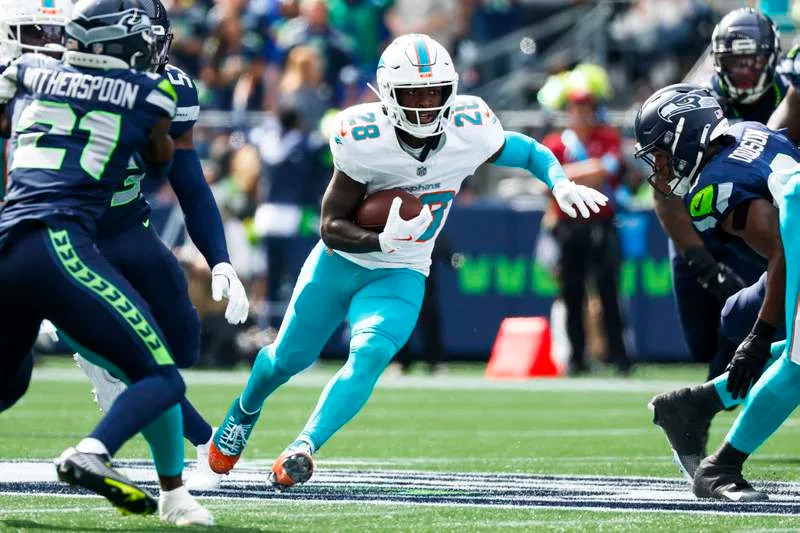
NFL, American Football Herren, USA Miami Dolphins at Seattle Seahawks Sep 22, 2024 Seattle, Washington, USA Miami Dolphins running back DeVon Achane 28 rushes against the Seattle Seahawks during the first quarter at Lumen Field. Seattle Lumen Field Washington USA, EDITORIAL USE ONLY PUBLICATIONxINxGERxSUIxAUTxONLY Copyright: xJoexNicholsonx 20240922_jmn_sn8_013
Looking deeper into those moves adds more context. Achane, who was entering the final year of his rookie contract, had four void years added. The team converted $4.6 million of his salary into a signing bonus and pushed $3.7 million into future years.
Brewer’s deal followed a similar structure. The Dolphins converted $5.25 million into a signing bonus, added a void year, and created $4.2 million in cap space.
Advertisement
Taken together, these are not random moves. They suggest a front office that is actively managing its cap and planning. That is why Florio believes these restructures push back against the idea that Miami is tanking. Still, the speculation did not come out of nowhere. The Dolphins’ offseason moves have been aggressive enough to raise eyebrows.
Are the Dolphins in tanking mode under the new regime?
The Dolphins find themselves in one of the worst cap situations in the league heading into 2026. Reports suggest the team is dealing with well over $100 million in dead money, with a significant portion tied to the release of Tua Tagovailoa. Miami designated Tua as a post–June 1 cut, resulting in $99.2 million in dead cap, with $67.2 million hitting the 2026 season and the rest rolling into 2027.
That alone put the team in a difficult spot. But the roster decisions that followed only added fuel to the tanking narrative.
Advertisement
Miami brought in Malik Willis as a replacement option, a move that raised questions given his inconsistent track record as a starting quarterback. Then came the Waddle trade. The Broncos, fresh off an AFC title game appearance, acquired Waddle along with a 2026 fourth-round pick in exchange for their 2026 first-round pick (30th overall), third-round pick (94th), and fourth-round pick (130th).
Once that deal went through, the financial picture became even clearer. The Dolphins are now projected to carry over $175 million in dead cap for the season, spread across multiple former players:
Tua Tagovailoa: $99.2 million ($67.4 million in 2026)
Jaylen Waddle: $26.3 million
Tyreek Hill: $28.2 million
Jalen Ramsey: $20.9 million
Minkah Fitzpatrick: $13 million
Bradley Chubb: $10.9 million
Terron Armstead: $10.7 million
James Daniels: $4.8 million
Zach Wilson: $3.8 million
Jonnu Smith: $1.7 million
Nick Westbrook-Ikhine: $1.6 million
Matthew Judon: $1.4 million
Looking at those numbers, it is easy to understand why the tanking narrative gained traction. Moving on from star players, taking on massive dead money, and lowering short-term expectations are all classic signs of a team stepping back.
The recent restructures suggest something different. Miami is not simply tearing things down and accepting losses. Instead, it is actively managing its cap, spreading out financial pressure, and keeping future flexibility intact.
Advertisement
That does not completely shut down the tanking conversation, but it complicates it. The roster moves may look like a reset, but the financial strategy points toward a controlled rebuild rather than an intentional collapse.