

Just one month out from the NFL Draft, the San Francisco 49ers are poised to take on their next phase of roster revamping ahead of the 2026 season. After what only the hopelessly out-of-touch would refuse to admit was perhaps the team’s best off-season free agency period in more than a few years, the 49ers are now ready to bring in another wave of youngsters to shore up and solidify their already upgraded squad.
With the signings of future Hall-of-Fame wide receiver Mike Evans (formerly with the Tampa Bay Buccaneers), interior pass rushing standout Osa Odighizuwa (Dallas Cowboys), defensive back Nate Hobbs (Green Bay Packers), veteran receiver Christian Kirk (Houston Texans), and offensive linemen Vederian Lowe (New England Patriots) and Brett Toth (Philadelphia Eagles), the 49ers have added significant roster strength over the past two weeks.
Of course, being the 49ers, no good deeds go unpunished. 49ers General Manager John Lynch and Head Coach Kyle Shanahan have since been taking some random shots from both fans and the internet media about the team’s aging offensive roster, where most of the 49ers’ key starters are at the upper end of their careers.
“The 49ers are a retirement home! They’re falling behind the Rams and Seahawks! They’re going in the wrong direction!” The more extreme takes of this sort whip up entertaining debate, but there’s little actual substance behind the ranting. Certainly, the team has aging stars, especially on offense. Those players are aging because they’ve been so highly productive that the team has been unwilling to move off them. And it would be ridiculous to blame Lynch and Shanahan for not taking action, given the situation.
In the 49ers’ first dynasty days of the 1980s, head coach Bill Walsh had a practice of offloading players as they approached the edge of their prime. Walsh’s reasoning was, “It’s better to lose a player one year too early than to have him on the roster one year too late.” It’s hard to argue with the philosophy of a Hall of Fame coach, but the NFL today is not the same as it was back then. Players are moved faster and more often in today’s league, and playbooks, schemes, and systems have gotten significantly more complex since Walsh’s time.
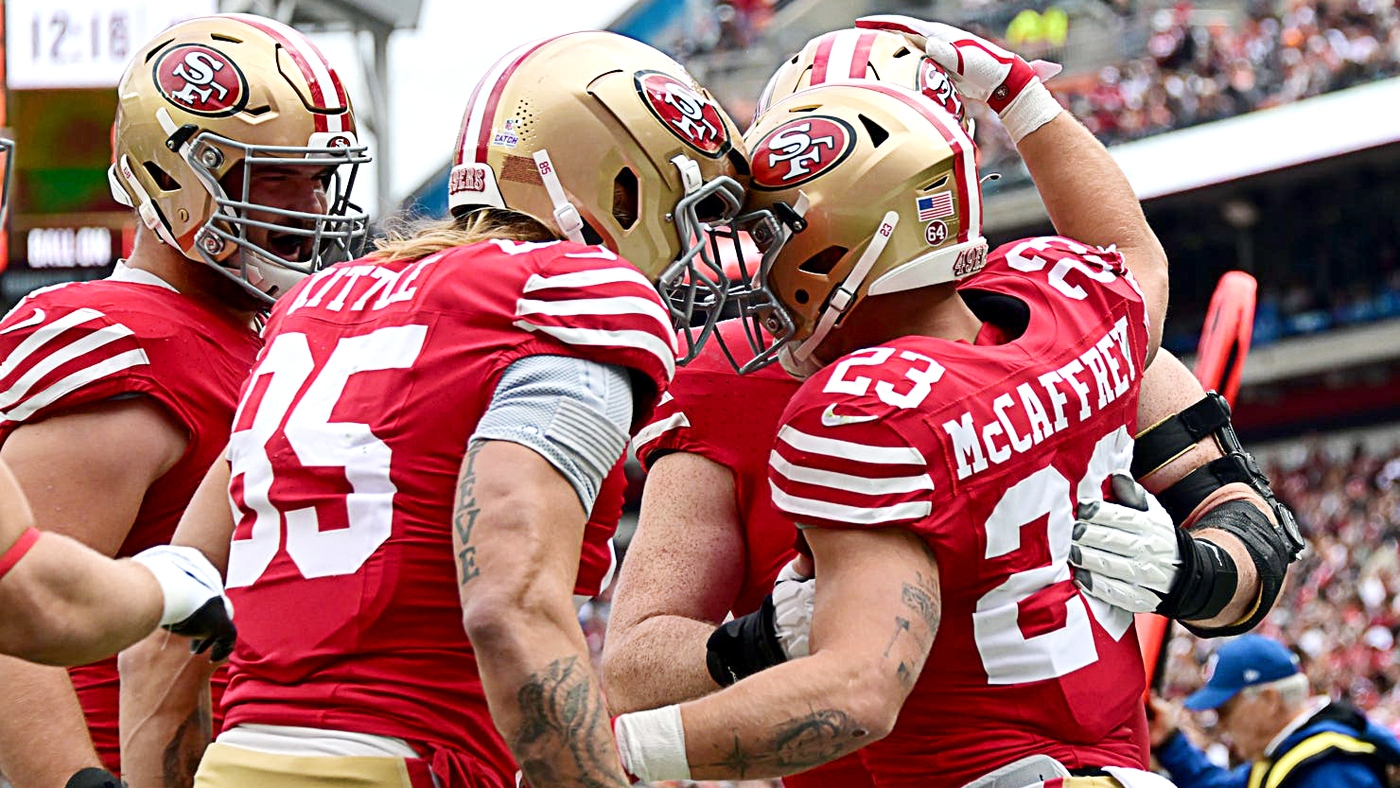
That’s created a landscape (made worse by the clearly declining player development in college football) where replacing long-standing, elite players on the roster is a much more difficult and riskier undertaking. Of course, it would be nice to have enough cold roster confidence that sending players like Christian McCaffrey, Trent Williams, or George Kittle on their way and handing over their positions to younger, cheaper, talented replacements was not worrisome. But that is not the reality we live in, and the players labeled outside the building and within the fanbase as being “too old” are still playing at the very top of their game. The argument then comes down to the mantra of “they can’t stay healthy.”
Without a doubt, that health factor is a legitimate concern. With Williams pushing 38, Kittle at 32, and McCaffrey reaching 30 (and now welcoming in the 32-year-old Evans), the 49ers’ offensive stars are looking like the elder statesmen of the NFL. And all of them have had periodic stretches of missing games due to injury. That point cannot be denied, but a closer look at the injury reports over the past years shows that the 49ers aren’t a team plagued by age problems; they are haunted by injuries across the board, regardless of player age.
Mykel Williams, Ricky Pearsall, and Brock Purdy were all key starters last season, and all of them missed a significant amount of time due to injuries. Other young players (Dee Winters, Tatum Bethune, Jacob Cowing, and Malik Mustapha, among them) also struggled to stay on the field. This is evidence that it’s not necessarily age alone that has been holding the team back; it’s the injuries themselves. The superficial optics may scream “old,” but the reality is more than a few clicks back from there. Denying the fact that most of the 49ers’ best offensive players are exiting their prime would be dumb. But equally ignorant is the idea that, by virtue of their age alone, it’s a good time to pull the plug on an offense that has been operating at a very high level for over three years.
On his show, The Herd, sports commentator Colin Cowherd recently dismissed the moves Lynch and Shanahan made in free agency as wasted ones, saying, “Their roster creaks louder than the trolley cars rattling down Market Street.” He offered that the plan in San Francisco, bringing in more experienced vets instead of going all in on the draft, is a mistake, contrasting the 49ers’ signings to what is happening in Seattle and Los Angeles. “Seattle is the fifth-youngest team in the league,” Cowherd continued. “The Rams are loading up with athletic freaks on defense. The narrative writes itself: the 49ers’ Super Bowl window isn’t just closing—it’s nailed shut by a bunch of graybeards who can’t keep up anymore.”
Indulging reality for just a moment, it’s not hard to drag this narrative, kicking and screaming, out into the sunlight and expose it for what it mostly is: convenient but mostly mindless silage intended for people who love a hot take more than actual roster analysis. Cowherd’s monologue was colorful, but as far as being genuinely relevant, it landed about forty yards out into the back pasture. And his words were consumed and digested by those who already live in the rage-space of hating anything that Lynch and Shanahan do.
The age situation in San Francisco isn’t as dramatic as Cowherd or others want you to believe, and the talent on the 49ers’ roster still sits among the league’s absolute best. The real conversation shouldn’t be about dumping All-Pro vets. It should be about sticking to a coherent succession planning—infusing youth without setting fire to elite production too soon. That’s the path forward for Lynch and Shanahan, and it’s principally what they’ve been doing for the past two or three years. For some fans and a lot of podcasters, “burn it all down” seems tantalizing, especially when fueled by the false panic that the 49ers are suddenly falling hopelessly behind their division rivals. It’s a popular narrative, but it’s largely manure.
The best course of action isn’t tearing down the team’s offense to the studs. It never was. Roster demolition is the way out for teams in disarray, teams mired in poor coaching and bad management, and teams without any true pipeline of talent. That’s not the 49ers this year, and it hasn’t been them for a very long time. The team has continued to make solid post-season runs for nearly a decade, and only widespread injuries (to both older and younger players) have kept them out of the playoffs.
Age naturally will have some impact on injury recovery—that’s simply a physiological fact. But on the data alone, the 49ers’ “retirement home” claim collapses under its own weight. Average age on the 49ers’ roster heading into 2026 sits at 26.30 years, just eight months older than the Seattle Seahawks’ (25.77). That’s not exactly a generational chasm. The Los Angeles Rams check in at 26.38, ironically older than San Francisco. And as for the number of players 30 and up, the 49ers had just nine entering this offseason, wedged between the Rams at 11 and the Seahawks at seven. Snap-weighted age—the stat that matters because it accounts for who’s playing real snaps—tells a similar story.
There is no doubt the 49ers will need to keep pace with both the Seahawks and Rams moving forward. Seattle’s team is young, athletic, and built for the modern NFL, with speed to burn. Their offense and defense both sit among the league’s youngest by snap-weighted metrics. And they play fast in a way that exposes slower, older lines. Add in the Rams’ defensive youth movement, and you’ve got an NFC West where the 49ers suddenly look ancient in key spots. It’s a circumstance that is built to create overreaction.
The argument against Lynch and Shanahan’s plan doesn’t overcome reality. The 49ers have already proven that they understand the age factor, and they are doing something about it. The defense has flipped from what it was two or three seasons ago, and the influx of young players into key roles is obvious. The fact that a similar transformation hasn’t yet happened on offense doesn’t mean it won’t. It has, in fact, already begun, starting with the move to make Purdy their franchise quarterback three years ago. Lynch and Shanahan have already taken great steps toward making the roster significantly better this season. And they’ve done it by adding both younger vets with years of prime play in front of them, and older players who, despite their age, are still elite on the field. That’s slick work, and they aren’t done yet. Youngsters will be added in the draft, and the roster thereafter should start to look like a championship-caliber team the 49ers can saddle up in 2026.
It’s understandable to want the team to stay ahead of the age game by bringing in young talent. And it’s equally reasonable to lean into your premier players while you do that, because football isn’t just about what’s down the road; it’s also about the games looming in front of you. Both things are true. And Lynch and Shanahan are implementing a plan that does just that. All the age-centered mooing from the back pasture doesn’t make that fact disappear.