
Join the huddle. Sign up here for Ravens updates in your inbox.
Ravens general manager Eric DeCosta and his deputies have been hard at work restructuring, negotiating and cutting contracts, and the team is in a good place with its salary cap.
For now, that is.
Restructuring quarterback Lamar Jackson’s contract cleared about $40 million in cap space. The Ravens used some of that to continue adding free agents after offensive lineman John Simpson, quarterback Tyler Huntley and pass rusher Trey Hendrickson, all of whom signed before the restructure.
They have since added safety Jaylinn Hawkins, tight end Durham Smythe, guard Jovaughn Gwyn and center Danny Pinter, while bringing back cornerback Chidobe Awuzie.
Here’s a look at the Ravens’ cap.
The 2026 cap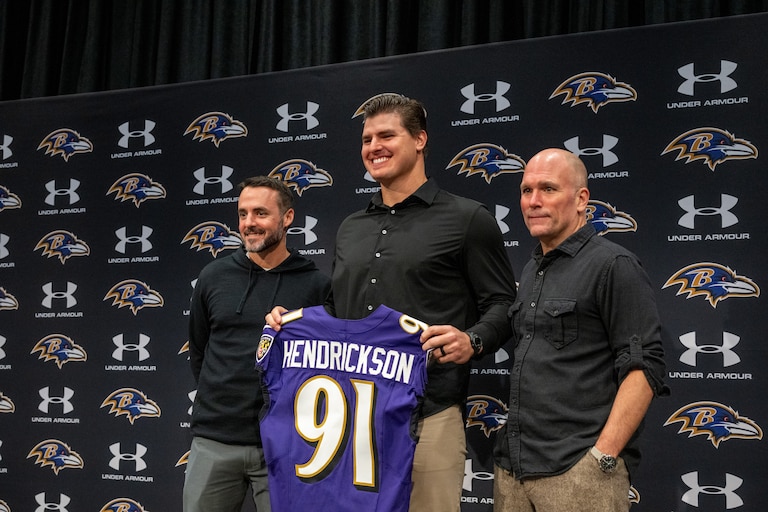 Pass rusher Trey Hendrickson is introduced by Ravens coach Jesse Minter, left, and general manager Eric DeCosta last week. (Jerry Jackson/The Banner)
As of Thursday night, the Ravens had $29,589,010 in cap space by the rule of 51, according to Over The Cap.
That calculation includes all the free-agent additions except Pinter. It does not include any unreported restructures.
In addition to restructuring Jackson’s contract, the Ravens kept this year’s number down by putting $20 million of Hendrickson’s contract in an option bonus. That means it won’t kick in until next season, unlike a signing bonus that is prorated over five years starting with the first year of the contract. Hendrickson’s 2026 cap hit is $15 million, but it increases each of the next three seasons.
The Ravens also cut backup quarterback Cooper Rush, which brought back $453,000. They received a $3,287,000 increase to their cap as a reconciliation of incentives, grievances and insurance from the season before.
What they need to account for
The Ravens have addressed several areas of need since clearing this space, adding offensive line depth, secondary depth and a blocking tight end. However, they have a way to go if they want game changers and not just depth.
Before they decide on taking a big swing in free agency, they have several areas they need to put money aside for.
According to Russell Street Report, the Ravens will need about $15.8 million by the start of the season to accommodate their draft class. While the Rule of 51 is in place, they will need only $10.455 million (the other contracts wouldn’t rank among the top 51 on the team).
Once the season arrives, and the Rule of 51 ends, they will need a minimum of $1.77 million to account for the final two active contracts, according to Russell Street Report’s calculations. They will also need about $4.7 million for practice squad salaries, $1.2 million for practice squad elevations and $6 million for injury replacements.
That leaves $9,461,068 in cap space.
The Ravens also need to set aside money for the contract extension they say they’re working on with Jackson. They reduced his salary as much as they could and converted it into a signing bonus that will be spread over his next two seasons under contract and three void years.
When he signs an extension, he will presumably get another signing bonus that will be prorated and tacked on to his cap hit for this season. It’s hard to predict how much that will be because he can also get money through an option bonus or incentives that will kick in later.
How to make more space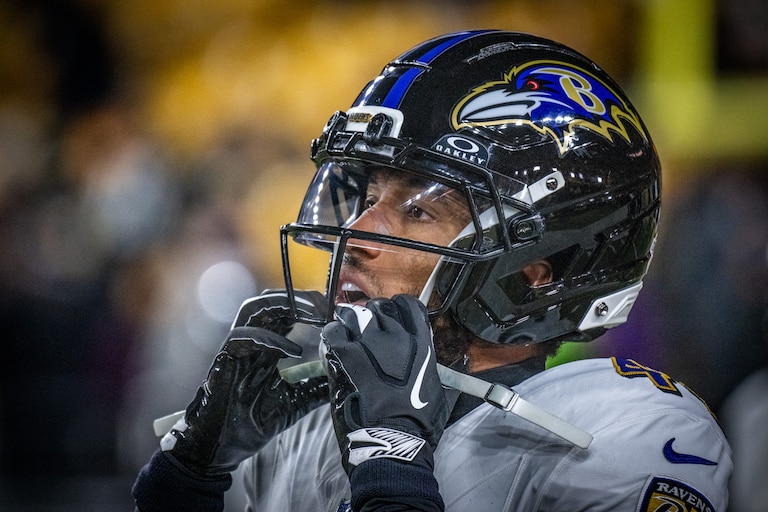 Cornerback Marlon Humphrey is a candidate to rework his contract. (Jerry Jackson/The Banner)
The Ravens have several candidates for a contract restructure, including linebacker Roquan Smith’s and defensive lineman Nnamdi Madubuike. They have the second- and third-biggest cap hits, respectively.
The team can also negotiate reworked contracts with players who have struggled, such as cornerback Marlon Humphrey, and convert some of their salaries into incentives. Ronnie Stanley is an example of a player who bet on himself by restructuring his contract.
Another option is to cut players. However, the Ravens need to consider how much dead money (guaranteed money the team has paid or committed to pay) is left to see if they’d be saving money by cutting the salary or wasting cap space on a player no longer on the team.
Preparing for the future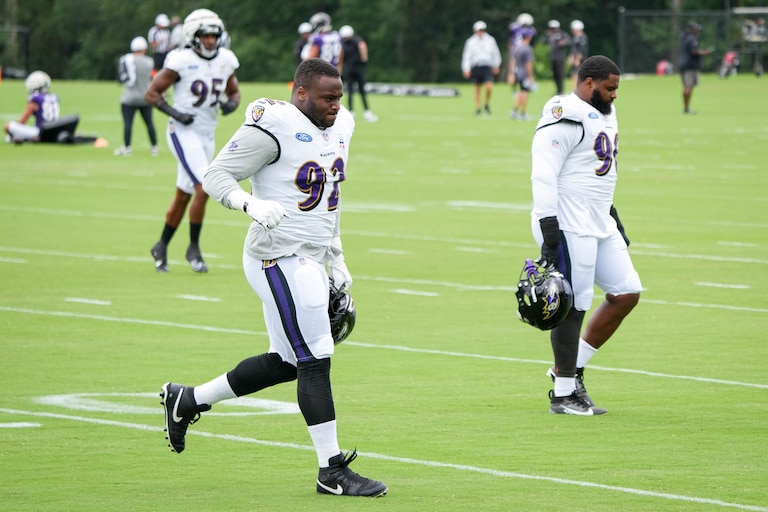 Nnamdi Madubuike, foreground, had his season ended by a neck injury in 2025, and his status remains unclear. (Ulysses Muñoz/The Banner)
If you thought the Ravens’ 2026 salary cap had hefty numbers on it, wait until you see 2027.
Two of the top three contracts remain just as high. Smith’s cap hit stays steady at $32.7 million, while Madubuike’s makes a small jump from $30.975 million to $31.475 million. Hendrickson’s also only goes up $3 million to $18 million, with a bigger jump happening from 2027 to 2028.
It’s unclear if Madubuike will return this season after suffering a season-ending neck injury early in 2025.
Meanwhile, safety Kyle Hamilton’s cap hit more than doubles, from about $10.7 million to $26 million. Stanley’s goes from about $9.8 million to over $24 million. Tight end Mark Andrews’ goes from just under $7 million to about $14.7 million.
Running back Derrick Henry’s and defensive lineman Travis Jones’ cap hits will also jump more than $10 million in 2027.
But all of those are nothing compared to the cap hit Jackson will have if he and the Ravens don’t work out an extension. By restructuring Jackson’s contract, the Ravens bought themselves time this season while overloading next season. His cap hit would jump to $84 million.
Being tight against the cap is the price to pay for stars, but DeCosta has even more work ahead of the 2027 season if he wants to back up his statements that he think the Ravens’ Super Bowl window is closing.