
With the NFL draft just 32 days away, the New York Jets are taking stock of their roster to identify their top needs. After the opening wave of free agency, those needs have become much clearer.
Here are the offensive and defensive position groups on the Jets’ roster ranked from worst to best.
10. Quarterback
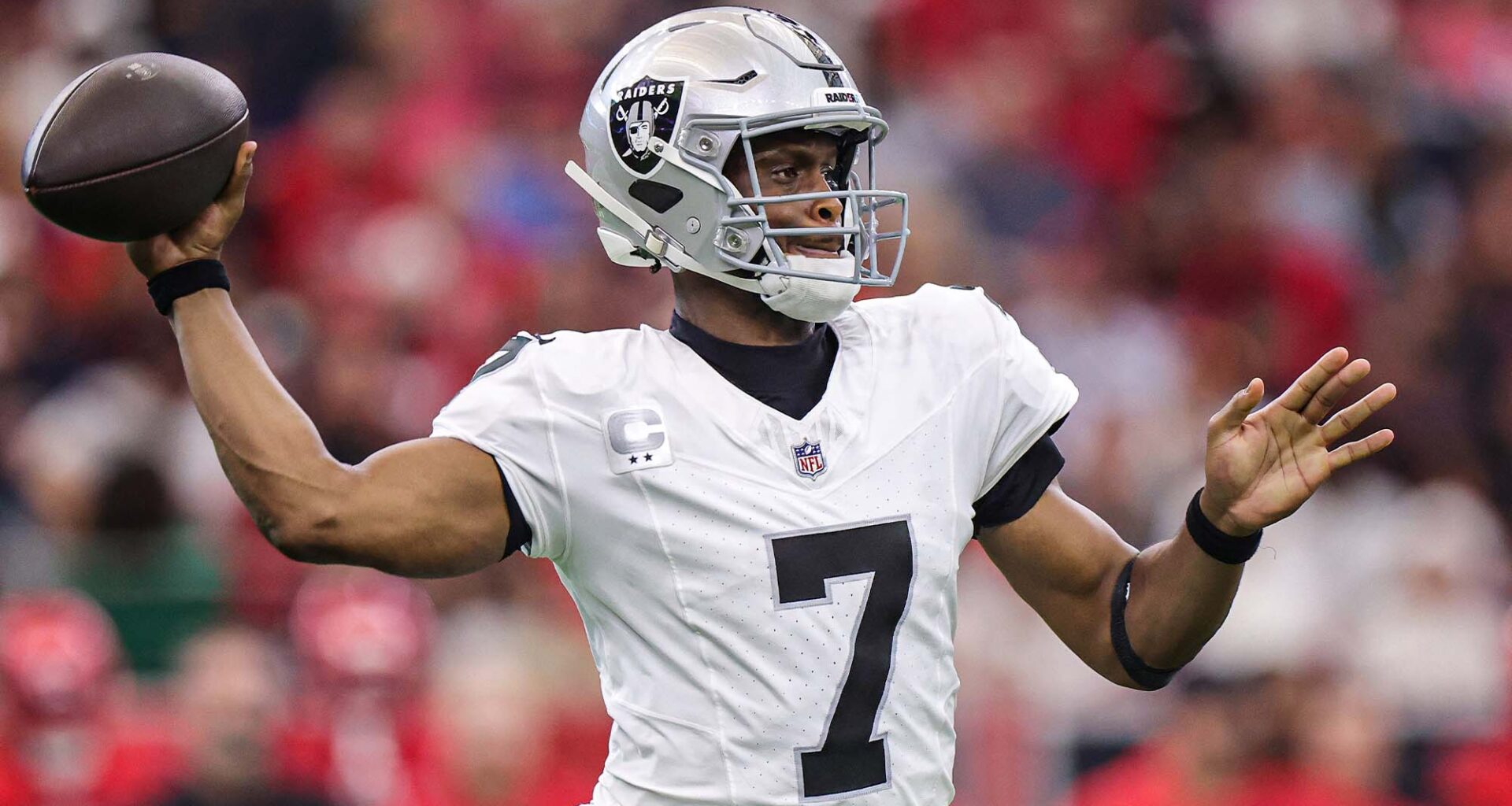
Geno Smith, Brady Cook, Bailey Zappe
The Jets’ penciled-in starter is coming off a season in which he ranked 29th out of 30 qualified quarterbacks in adjusted EPA per play (-0.066) and 29th in QBR (34.1). Both of the other two quarterbacks on the roster have thrown more interceptions than touchdowns in the NFL.
This is the worst unit on the roster, bar none. Given that it is also the most important position in football, it will be difficult for the Jets to win games unless this unit vastly exceeds expectations.
New York is hoping that Geno Smith’s snug fit in Frank Reich’s offense can make that happen.
9. Edge defender
Joseph Ossai, Will McDonald, Kingsley Enagbare, Braiden McGregor, Tyler Baron, Eric Watts, Kingsley Jonathan, Ochaun Mathis, Paschal Ekeji
While the Jets strengthened this unit’s depth in free agency, they lack an elite difference-maker, which is critical at a position many consider the second-most valuable after quarterback.
Will McDonald has the potential to be that type of player, but he failed to record the necessary production in 2025. His weak run defense also places a firm cap on his overall ceiling.
Luckily, this unit will likely get the potential superstar that it lacks in less than five weeks.
8. Cornerback
Brandon Stephens, Azareye’h Thomas, Jarvis Brownlee Jr. (SCB), Nahshon Wright, Qwan’tez Stiggers, Samuel Womack III
This position is poised for some heated competitions in the summer. The depth looks solid after adding Jarvis Brownlee Jr. during the regular season and Nahshon Wright in free agency.
Similar to the edge defenders, the cornerback unit lacks a star. They need someone who can be counted on to go toe-to-toe with the opponent’s WR1; Brandon Stephens isn’t an ideal option.
Azareye’h Thomas has the best chance of becoming that kind of player, but we need to see more after the third-round rookie only spent a brief time on the field.
7. Tight end
Mason Taylor, Jeremy Ruckert, Jelani Woods, Andrew Beck (FB/TE)
Mason Taylor showed promise as a receiver and blocker in his rookie year, but he still needs to put it all together before he can be considered a legitimate plus starter. If Taylor takes a step forward this season, the tight end unit will rank much higher on the season-end list.
The depth after Taylor is uninspiring. While Jeremy Ruckert improved to an average blocker in 2025, it would be a stretch to call his blocking much better than that, and he offers very little in the passing game.
New York shouldn’t consider this position off-limits with their four top-45 draft picks.
6. Wide receiver
Garrett Wilson, Adonai Mitchell, Isaiah Williams, Arian Smith, Irvin Charles, Jamaal Pritchett, Quentin Skinner, Mac Dalena
It would be fair to rank this unit anywhere from 7-10.
However, the logic in having it at No. 6 is that Garrett Wilson is valuable enough on his own to carry this group past the quarterbacks, edge defenders, tight ends, and cornerbacks. All of those units lack a player anywhere close to as impactful as Wilson, even if they might have better depth.
Past the WR1, this might be the weakest wide receiver unit in football. Many teams don’t have a top option with as high a ceiling as Wilson, though. With that in mind, the Jets only need one more quality starter to make this unit look like one of the league’s best.
For now, they’re one Wilson injury away from having an untenable lineup out wide, and that makes this unit a weakness for the time being.
5. Linebacker
Jamien Sherwood, Demario Davis, Kiko Mauigoa, Mykal Walker, Marcelino McCrary-Ball, Kobe King
It’s pretty easy to split the bottom five positions on this roster from the top five. The gap between No. 6 and No. 5 is larger than the gap between No. 5 and No. 1. It would be fair to rank these top five positions in any order.
The Jets’ linebacker unit could claim the No. 1 spot by season’s end. Demario Davis has been playing at a high-end level annually since 2017, while Jamien Sherwood is only two years removed from an excellent season.
For now, though, the lingering questions around Sherwood force this unit into a lower spot than position groups that offer a little more reliability. Sherwood had a highly concerning 2025 season in coverage, yielding the seventh-most yards (578) and seventh-most touchdowns (4) among linebackers.
4. Running back
Breece Hall, Braelon Allen, Isaiah Davis, Kene Nwangwu
Breece Hall was certainly a top 10 running back in 2025, although his mediocre 2024 season makes him an unpredictable player moving forward. Still, his elite upside makes him a player who can easily be considered a high-quality RB1.
The depth is solid, albeit unproven. Braelon Allen and Isaiah Davis have shown potential in spurts, but neither has accrued a large enough sample size to be trusted if called upon as the starter. If everyone is healthy, though, Allen and Davis are solid in their roles.
3. Defensive tackle
T’Vondre Sweat, Jowon Briggs, David Onyemata, Harrison Phillips, Payton Page, Mazi Smith, Jack Heflin
This is arguably the deepest position on the Jets’ roster.
Few NFL teams have an interior quartet as strong as the Jets. Darren Mougey crafted this lineup with three trades and one free agent signing in a span of seven months.
What holds this unit back from the two ranked above it is the lack of a star. The Jets don’t quite have that one defensive tackle who will consistently demand double teams and make life easier for his teammates, which places a cap on the unit’s ceiling. But the floor is very high.
2. Safety
Minkah Fitzpatrick, Dane Belton, Malachi Moore, Andre Cisco, Dean Clark, Jarius Monroe, Keidron Smith, Chris Smith II
Safety has been an annual candidate for the Jets’ worst non-quarterback position in each of the past few seasons. Suddenly, it is a candidate for their best position.
Minkah Fitzpatrick has an All-Pro pedigree, and while he hasn’t earned accolades or put up flashy interception numbers in a few years, he quietly still performed like a star safety in 2025. It is fair to be concerned about whether he can sustain it into his 30s, but until proven otherwise, he remains among the cream of the crop.
Andre Cisco went from the Jets’ projected best safety in 2025 to a likely backup (or a competitor for a starting spot, at best). Malachi Moore is an intriguing second-year player after a productive rookie season. Dane Belton is still only 25 after logging starting experience for the Giants and showcasing an impressive knack for takeaways.
Star power, young upside, and solid veteran depth—this unit’s got it all. There are some minor concerns, particularly Fitzpatrick’s age and the development of Moore (who is only a fourth-round talent), but the Jets have to feel great overall.
1. Offensive line
OT: Olu Fashanu (LT), Armand Membou (RT), Chukwuma Okorafor, Max Mitchell
IOL: Dylan Parham (LG), Josh Myers (C), Joe Tippmann (RG), Xavier Newman, Liam Fornadel, Marquis Hayes, Gus Hartwig, Kohl Levao
Cases could be made that any of the previous four units deserve this spot. What separates the offensive line is a critical element that strengthens its trustworthiness: continuity.
The Jets are counting on new additions to anchor positions like linebacker, defensive tackle, and safety. As for the offensive line, we already saw this unit do a nice job together in 2025.
Four of the five starters are back (although Josh Myers is a weak link who should be upgraded upon), and the starter who left has been replaced with a potential upgrade in Dylan Parham.
To boot, the Jets expect further development from the young trio of Olu Fashanu, Joe Tippmann, and Armand Membou, three top-50 draft picks who have still yet to reach their high ceilings.
The depth could be better; adding a center to boot Myers to the second-string unit would go a long way. Still, the starting five is in a great spot. Building off the foundation it set in 2025, it is on a trajectory to become one of the NFL’s best starting units in 2026.