
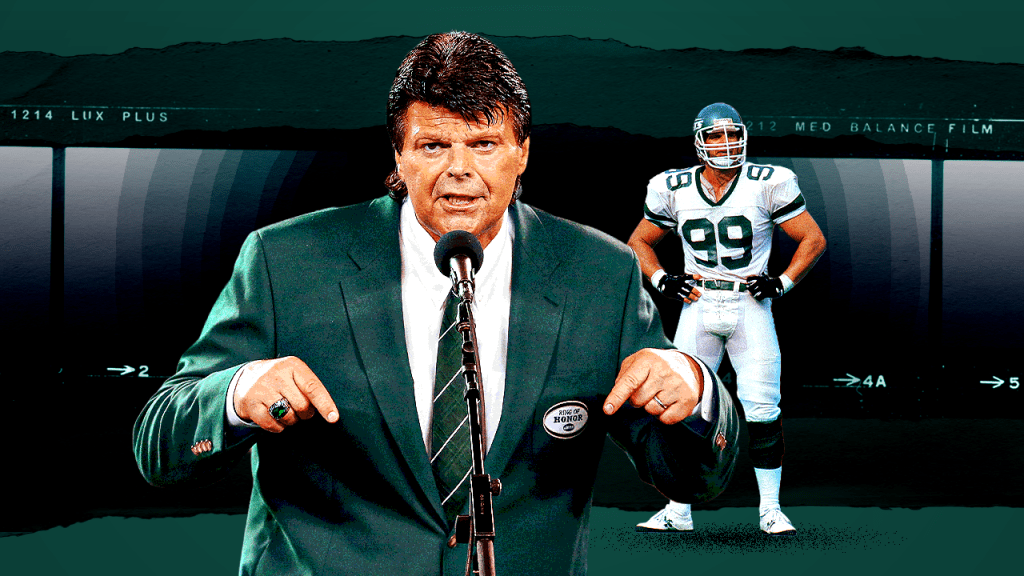
Retired New York Jets defensive end Mark Gastineau’s $100 million lawsuit against ESPN, the NFL and others who produced the “New York Sack Exchange” 30 for 30 episode has been dismissed.
One key to the dismissal: Gastineau’s public confrontation with retired Hall of Fame quarterback Brett Favre—“although seemingly puerile,” U.S. District Judge Paul A. Engelmayer bluntly wrote in his March 16 order—“clears” the “low bar” of what counts as newsworthiness in law and thus trumps Gastineau’s NIL rights.
This reasoning underscores that for athletes and celebrities, even conduct that appears trivial or immature can satisfy the low threshold for “newsworthiness,” and can therefore override their NIL rights when weighed against First Amendment protections.
Engelmayer rejected Gastineau’s case, which centers on ESPN including a video of the mullet-maned former lineman emotionally calling out Favre at a Chicago sports memorabilia show in 2023. Gastineau accused Favre of taking a dive during a game in 2001 so that New York Giants defensive end Michael Strahan could sack him and break Gastineau’s single-season record.
Gastineau raises several claims, including breach of contract and misappropriation of his NIL. Gastineau was paid $10,000 for a sit-down interview in Philadelphia and a filming session at the New York Stock Exchange. He insists he never granted ESPN permission to use the Favre video, but as Engelmayer’s ruling indicates, ESPN didn’t need his blessing.
ESPN aired the 30 for 30 on Dec. 13, 2024. As summarized by Engelmayer, the documentary film chronicled Gastineau, Joe Klecko, Marty Lyons and Abdul Salaam forming a dominant Jets defensive line, dubbed the New York Sack Exchange, in the early 1980s. Gastineau recorded 22 sacks in 1984, an NFL record. At the end of the film, Gastineau says “the NFL should have stopped” Strahan from breaking his record since, Gastineau asserts, it was borne through fraud (that is, Favre allegedly taking a dive).
Strahan, Gastineau told 30 for 30, “took my record away from me. Anybody will tell you that Brett Favre took a dive. And you know it, she knows it, he knows it, and everybody knows.”
The film showed a clip of Gastineau awkwardly confronting Favre. Gastineau told Favre: “You hurt me. You hurt me. You hear me? You really hurt me. You hurt me, Brett.”
Viewers then watched Lyons reflect on the incident.
“For [Gastineau] to do that to Brett Favre, that was my last straw,” Lyons said. “I tried to defend him [Gastineau]. I’m done defending him.”
Engelmayer found two major problems in Gastineau’s case.
The first is that Gastineau lacked contractual power to stop 30 for 30 from using the Favre video.
The judge stressed how Gastineau’s contract to appear on the 30 for 30 didn’t grant him veto power over content and, in fact, gave NFL Productions the right to modify the film to suit production needs. While Gastineau insists that he didn’t authorize 30 for 30 to use his NIL from what he terms a “private encounter” with Favre, the contract also didn’t block 30 for 30 from using content acquired, be it the Favre video or other material.
Further, as Engelmayer stressed, the contract gave 30 for 30 an “unlimited right” to use Gastineau’s “name, voice, portrayal, performance, appearance, actions, likeness, and/or biographical information” in connection with the film. This right included the inclusion of the Favre video.
The second problem for Gastineau is that his incident with Favre was newsworthy.
In the context of the right of publicity—which makes it illegal to use a person’s NIL and other identifying traits for commercial purposes without that person’s consent—newsworthiness is a well-established and liberally applied exception grounded in the First Amendment. Newsworthiness reflects material that concerns matters of public interest, and it can apply even when the material’s use generates revenue and contributes to profit.
For example, media coverage of the men’s basketball NCAA Tournament relies on the NIL of college athletes and coaches and is intended to generate money for media companies. Those companies don’t need the permission of players or coaches, because the coverage reflects reporting on basketball games that are of public interest.
Engelmayer explained that although the Gastineau-Favre incident was hardly hard-hitting news and seemed overly dramatic, it’s still newsworthy, because “the participants were nationally recognized football players.” The exchange between the two men also concerned “a venerated NFL record.”
The judge also defended the newsworthiness of the incident given that it played a prominent role in the 30 for 30 and the film’s subject matter.
“Gastineau’s aggressive conduct,” the judge wrote, “appears to have driven a wedge within the Sack Exchange quartet that was the subject of the film.”
For athletes, the ruling against Gastineau is a reminder that fame cuts both ways.
The same renown that drives endorsement deals and NIL opportunities can also work against athletes when they object to documentaries and news coverage. Emotional outbursts in public settings and social media temper tantrums can be deemed matters of public interest—especially, as with the Gastineau—Favre incident, when they involve issues fans care about.
For all the industry talk about “building a brand” through NIL, athletes should remember that once they step into the spotlight—whether on a football field or at a memorabilia show—they expand the range of material that media companies can lawfully use to tell stories about them.