
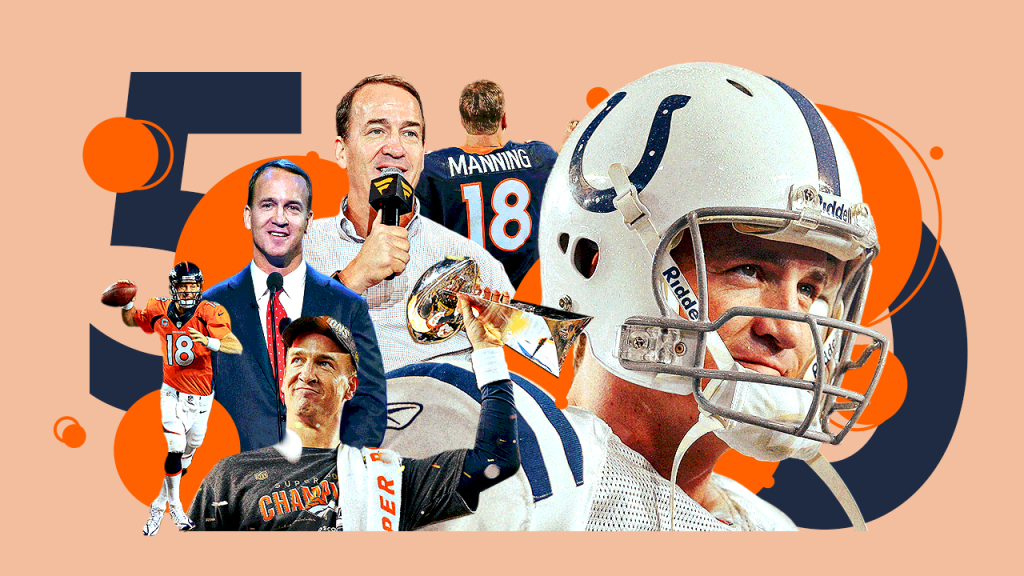
Peyton Manning retired from the NFL a decade ago as the NFL’s all-time leader in passing yards, passing touchdowns and quarterback wins, but he had no plans to walk off into the sunset.
“I’m totally convinced that the end of my football career is just the beginning of something I haven’t even discovered yet,” Manning said at his March 2016 retirement press conference, fresh off a win in Super Bowl 50 with the Denver Broncos. “Life is not shrinking for me; it’s morphing into a whole new world of possibilities.”
Manning turned 50 on Tuesday, and the five-time MVP remains a ubiquitous presence in the NFL, from commercials to commentary to coaching Pro Bowls. His continued off-field wins have pushed his career earnings to an estimated $575 million since he was selected first overall by the Indianapolis Colts in the 1998 NFL Draft.
Manning’s first NFL contract was a six-year deal worth $46.3 million, including an $11.6 million signing bonus. His next deal was the biggest of his career, worth $99.2 million over seven years with a then-record $34.5 million signing bonus.
He retired after the 2015 season with $249 million in playing salaries and bonuses during his 18-year career with the Colts and Broncos. At the time, it was a record for NFL players, $61 million ahead of his brother Eli at $188 million, according to salary tracker Spotrac. Fellow QBs Tom Brady ($163 million), Philip Rivers ($152 million) and Drew Brees ($150 million) rounded out the top five a decade ago. Matthew Stafford now leads at $408 million, and Peyton has dropped to No. 12.
Manning padded his on-field earnings with an unmatched endorsement portfolio as the NFL’s most marketable player for more than a decade. During his peak, he made $15 million a year from sponsors, totaling roughly $150 million during his playing career.
Papa Johns was one of Manning’s biggest sponsors, and he owned 31 franchises in the Denver area. In 2018, he sold his stake in the franchises ahead of the pizza chain relinquishing its role as the official pizza of the NFL.
Manning remains one of the most marketable NFL athletes despite hanging up his cleats a decade ago. His current endorsement partners include Nationwide, Nestle and Anheuser-Busch. “Peyton Manning is as strong as ever,” Q Scores Company executive Henry Schafer said in a phone interview. “The man is like gold.”
Q Scores data supports Schafer’s claim. The company’s recent polling had Manning’s public awareness level at 63%, second highest behind Tom Brady (73%) among current or former NFL players. Next up was Travis Kelce (61%), Eli Manning (59%) and Patrick Mahomes (56%). Peyton’s likability score of 19 was the highest in the NFL, with Mahomes a tick behind at 18; Brady was at 12 and below the average sports personality score of 13.
Last year, Manning joined the ownership group of the NWSL’s Denver Summit ahead of its first season that kicked off this month. Rob Cohen is the Summit’s control owner, and the group also includes Ariel Investments co-CEO Mellody Hobson, beverage executive Molly Coors and skier Mikaela Shiffrin. The team’s first home game, scheduled for Saturday, will set an NWSL record with 50,000 tickets sold for the match at Empower Field at Mile High.
Manning’s biggest project in retirement is Omaha Productions, which he launched in 2020 with former ESPN executive Jamie Horowitz. The firm is behind the Manningcast (officially known as Monday Night Football With Peyton and Eli), and it also produces alternate live presentations of NBA, golf and UFC events. Other credits include docuseries Receiver and Starting 5 on Netflix, as well as Hulu’s Chad Powers series. The latest addition: Omaha Productions started producing LOVB matches in 2026 as part of a multiyear tie-up with the women’s volleyball league.
Omaha’s success has attracted investors who want to be in the Peyton Manning business. In 2023, Peter Chernin’s North Road Company acquired a minority stake in Omaha. Last year, Omaha was valued at $750 million when WTSL, the Silver Lake-backed investment firm led by Patrick Whitesell, according to CNBC.