
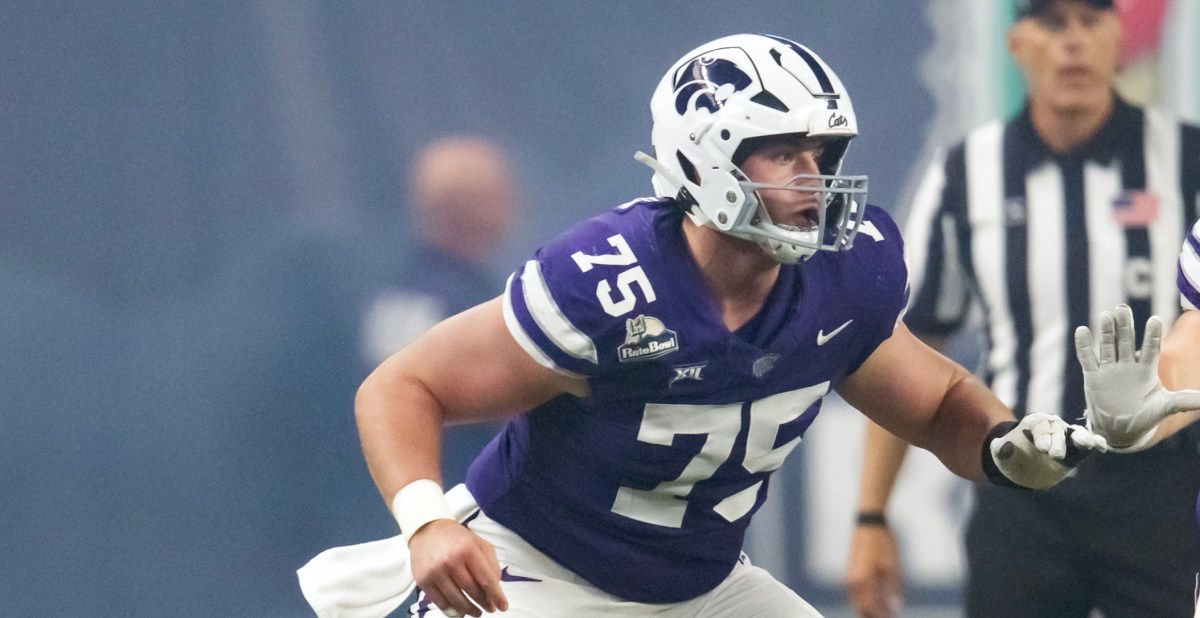
One of the last offensive lineman to be highlighted in this series, Hecht came onto the scene after an elite set of Senior Bowl practices where he rarely lost a rep.
Two years of starting experience with zero sacks allowed is as robust a stat line as possible. He’s a pure center with zero snaps at either guard position, but presents an extremely specific yet alluring combination of size, athleticism, and technique.
Hecht presents a long and lean frame for a center, and will need to add raw mass to better protect at the NFL level.
This center class presents an intriguing case study. There are four to six starting-quality centers. How teams rank them will completely depend on what skillset they prioritize. For teams who desire an agile, zone-oriented center with extremely high-quality pass blocking acumen, Hecht will be their target on Day Two of the draft.
Size: 6’4”, 300 poundsPosition: CenterYear/Age: Senior, 23 years oldMeasurements: 31 5/8” arms (23%), 9 7/8” hands (54%)Expected draft range: late second to early third round
Games watched: Texas Tech (2025), Iowa State (2025), Senior Bowl (2025), Utah, (2025)
The goal of this film study was to identify how Hecht played against the Big 12’s best defensive tackles. That includes Tech’s Lee Hunter and Skyler Gill-Howard, Iowa State’s Domonique Orange, and the Senior Bowl.
When watching Hecht at the Senior Bowl, which presented my first exposure to Hecht, I was concerned about his size as I presumed he was 6’1”. Turns out, he’s 6’4” but possesses elite bend, especially through his hips. He’s athletic, lean, aggressive in space, well-proportioned.
Kasnas State offense bordered on gimmicky. The lack of quality QB play and downfield weapons necessitated their offensive line be the focal point of the entire offense. Because of that, Hecht was utilized as pulling center, something you don’t see everyday when offensive center watching film. In that wide zone concept, Hecht sometimes crossed his feet and became upright, which allowed defenders with better leverage work their way into the backfield.
In pass blocking reps, he knows how to use hands as a deterrent and delayer in pass protection. His footwork is where he shined the most. He displayed a balanced and wide base without compromising power. When being bull rushed, he didn’t lock out his legs and instead remained bent and balanced, which better absorbs the pressure from larger DTs.
His run game technique is all about dictating the rep. When defensive tackles engaged and attempted to shift their body to find the running back, he used their momentum to pin them and turn their shoulders away from the play. This lead to multiple long runs in the Utah game.
In power schemes, Hecht reliably works with his guard to pair their shoulders together and push defensive tackles as one. He was significantly more refined in this than Connor Lew.
When engaging three techniques – that is defensive tackles who are over the guard – Hecht keeps his hands inside and low to scoop up and through the exposed chest of the DT. This provides Hecht the power and leverage to mobilize shorter and heavier DTs.
Hecht’s ideal NFL landing spot would have been in Mike McDaniels’ 2024 Miami Dolphins. Expect the Chargers to select him early on day two with McDaniels as their new offensive coordinator.
When comparing my film review to other site’s, I disagreed fervently with The Draft Buzz’s opinion that “Hecht doesn’t have the movement skills to thrive in a heavy outside-zone scheme that asks its center to consistently reach and climb”. That is most poignantly what makes Hecht shine on the tape. K-State’s wide zone scheme hinged on his ability to wrestle and turn the shoulder of defensive tackles in a three-technique.
They also suggest he’ll be “most effective in a system that features gap and inside-zone concepts”, but he did not illustrate the power and earth-moving capability to be leveraged in those schemes. Don’t trust everything you read folks (unless it’s on Battle Red Blog, of course).
If Draft Buzz’s analysis is correct, he’ll fit in Houston’s inside zone and power offensive blocking scheme which unlocked the run game later in the season. However, K-State’s wide-zone scheme won’t be a match for the offensive line Nick Caserio is cobbling together for Nick Caley. Can Hecht play in a gap scheme and succeed? Absolutely, but he’ll need to add legitimate mass and strength to compliment the style of running attack Houston wants to employ. With all of the pulling, Hecht could shift out to guard with some serious coaching and time in the weight room.
I rate Hecht as the number two center in this class behind Jake Slaughter and in front of Connor Lew. Hecht isn’t for every team, but for the teams he does work for he is an unquestionable asset and cog in their system. Expect a team who values his speed, athleticism and movement skills to over draft him relative to his value.
For Houston, he’s worth a mid-third round pick. Though as mentioned earlier, I suspect a team who prioritizes Hecht’s strengths more will shell out a mid-second round pick for his labor.