
No sport demands more context when analyzing players than football.
And it can be argued that no position in football requires more context to be fairly analyzed than quarterback.
While the quarterback is widely viewed as the most important player on the field, his success is often dictated by numerous factors beyond his control. Whether it’s play-calling, pass protection, route-running, or pass-catching, the quarterback can only do so much to will a group of 11 players and one play-caller into the end zone.
We always need to take these factors into account when analyzing a quarterback. This is doubly true when analyzing NFL draft prospects.
Quarterback prospects are often stacked against one another as if it is an apples-to-apples comparison. We put their statistics, measurables, and film head-to-head in a quest to determine which prospect should be ranked higher.
However, without accounting for the quality of the quarterback’s supporting cast, all of those comparisons are irrelevant.
Two plays that yield the same result might be far different in quality because one quarterback had to overcome more obstacles than the other.
This extends from the play-by-play level to the course of an entire year, or even an entire career. Two players who had similarly successful careers on paper might appear drastically different after accounting for the fact that one player carried his team while the other was merely along for the ride.
Today, our goal is to identify the best and worst supported quarterback prospects in the 2026 NFL draft. We will break down a plethora of metrics that are intended to reveal how well the quarterback was supported in areas beyond his control.
The results
Fernando Mendoza’s system at Indiana is often touted as a juggernaut. Ty Simpson’s situation at Alabama is often described as a hellscape, at least in comparison to what Mendoza enjoyed.
Are those narratives true?
Let’s marvel at a color-coded chart, shall we?
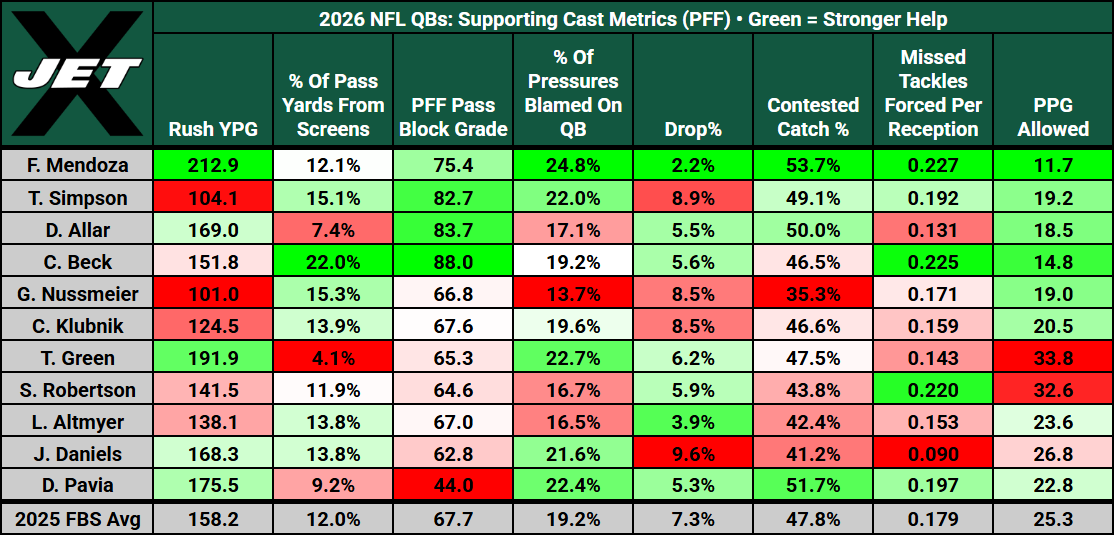
It appears that Mendoza, indeed, enjoyed the strongest support of the 2026 quarterback class. Not only that, but his support was about as close to perfect as you could realistically get. He had the friendliest number of the 11-man group in six of the eight categories, and enjoyed better support than the FBS average in every category.
You name it, Mendoza got it. Just 2.2% of his passes were dropped, and nearly 54% of his contested throws were hauled in. His receivers broke tackles regularly. His run game gave him well over 200 yards per week. His defense only required him to score 12 points to win the average game.
Mendoza’s offensive line wasn’t the highest-graded in college football, but it is alarming that, per PFF’s tracking, Mendoza was at fault for nearly one quarter of the pressures he took, the highest rate among the 11 prospects listed above.
Indiana head coach Curt Cignetti is practically worshipped by the football community for the downright unfathomable job he did with the Hoosiers, and rightfully so. The chart above proves just how much of Indiana’s offensive success is owed to Cignetti rather than Mendoza. He put everything on a silver platter for his quarterback.
Does this mean Mendoza will be a bad NFL player? Not necessarily. But it should drastically alter the perception of him as a prospect.
The first overall pick of the NFL draft is expected to have so much raw talent that he can single-handedly turn around a fledgling franchise. Mendoza has yet to prove he can do that. His impeccable support at Indiana suggests he was more of a game manager than a driving force.
Mendoza might go on to be successful in the NFL, especially as the league gradually shifts away from the necessity for “alien” quarterbacks and toward a world where coaches lead the way, and all you really need is someone good enough to do their job (i.e., Sam Darnold).
Still, Mendoza’s supporting-cast metrics show that he is much more likely to be the type of NFL quarterback who will only go as far as his team takes him, rather than the franchise-lifter teams expect to get with the first pick.
Was Ty Simpson’s support really that bad?
While Ty Simpson certainly did not enjoy the utopian environment that Mendoza did, his supporting-cast metrics suggest he was helped out far more than his most fervent defenders claim.
I’ll drop the chart here again so you don’t have to scroll back up.
The big issues around Simpson were the run game and the receivers’ dropsies. These were undoubtedly major problems for the Crimson Tide.
Alabama ranked 125th out of 136 FBS teams with just 104.1 rushing yards per game, while their 3.4 yards per carry was even worse, placing 126th. This put a lot of extra pressure on Simpson’s shoulders in competitive games.
The drops were back-breaking, too. Alabama dropped 32 passes in 2025, per PFF, and it was a chronic issue, as 13 different players dropped at least one pass. The main culprit, though, was easily five-star sophomore Ryan Coleman-Williams, who dropped a Power Four-leading 10 passes in a wildly disappointing campaign.
These factors are extremely important to mention when discussing Simpson, especially relative to Mendoza. However, in just about every other area, Alabama did a good-to-great job around Simpson.
The first-year starter enjoyed highly graded pass protection (82.7 pass-blocking grade, 7th in the nation), a relatively high percentage of his yards off screens (15.1%), and above-average efficiency at contested catches (49.1%) and elusiveness after the catch (0.192 missed tackles forced per reception). Similar to Mendoza, he was also blamed for a high percentage of the pressures he took (22%).
Compared to Mendoza, it’s no contest—Indiana had the better supporting cast by an enormous margin.
Compared to the rest of the class, though, Simpson’s support wasn’t too shabby. There were a couple of major problems, but there were some strengths, too, and those cannot be tossed aside in the Simpson conversation for the sake of a black-or-white narrative that paints Simpson’s situation as a hopeless wasteland. That is an exaggeration.
Other takeaways
Among the rest of the quarterback class, the biggest standout has to be Miami’s Carson Beck, who is currently the No. 121 overall prospect (QB5) on the consensus big board.
Once again, here is another glimpse at the chart for your viewing pleasure.
Outside of Mendoza, Beck may have enjoyed the second-best support. A mind-boggling 22% of his passing yards came off screen passes, nearly double the national average (12%).
That kind of number makes a quarterback prospect challenging to project to the NFL. It means that pro-style throws are scarce on his film. There is nothing to learn about a quarterback’s pro-readiness from screen passes, so the more he relied on them to be successful, the less there is to learn from his film, making his projection unreliable.
Beck also enjoyed playing in a Miami offense that earned the No. 1 pass-blocking grade in the country (88.0). Playing with the fifth-best scoring defense (14.8 points per game) was nice, too, along with a skill-position unit that racked up 0.225 missed tackles forced per reception.
All things considered, Beck is an extremely risky prospect due to the immense help he received this past season, even at the minimal cost of an early Day 3 pick.
When it comes to poorly supported quarterbacks, the cake goes to LSU’s Garrett Nussmeier (No. 81 overall on consensus big board, QB3).
The Tigers ran for just 101 yards per game in Nussmeier’s starts, an incredibly low number at the college level. The pass catchers were abysmal, dropping 8.5% of his passes and securing a ghastly 35.3% of his contested throws.
While LSU gave Nussmeier a solid chunk of screen yardage, his pass protection was mediocre at best. Making the offensive line look even worse is that only 13.7% of the pressures Nussmeier took were charted as his fault, a very low number. This reflects positively on Nussmeier, especially in comparison to quarterbacks like Mendoza and Simpson, who were blamed for a significantly higher percentage of their own pressure.
If you’re looking for one quarterback in the class who deserves the 2026 draft class’s “Sam Darnold-to-Terrelle Pryor Award”, it’s Nussmeier.
Takeaways?
What else can we take away from these numbers?
Well, that’s up to you, reader.
Some people place all of their stock in the numbers. Some place all of their faith in the eye test while shunning ghastly color-coded charts; those folks probably didn’t even make it this far in the article. (If you are one of those folks, please know how much your courage is appreciated.)
The best method is to combine both worlds. The numbers can never tell us everything. But neither can the film. There is value to quantifying what happens on the field. Nobody has the time, nor the memory, to watch every rep of every prospect and equally weigh each of those reps in their evaluation.
Sometimes, the numbers reveal trends that you wouldn’t realize from the film—the eye test can play tricks on us, as our brains tend to primarily remember only the best and worst parts of something, while leaving out the all-important minutiae.
Sometimes, the film debunks silly narratives that arise from the spreadsheet warriors. It happens every year: Someone runs a slower 40 time than we expected based on their film, they fall in the draft because of it, then, lo and behold, they are just as fast on the football field as they looked in college.
There is no tried-and-true formula for scouting the draft. All teams can do is glean as much information as possible to make the most informed decision they can, and that’s why it will always be paramount to find a happy medium between the film and the data.
So, take today’s data with a grain of salt, or dump the whole shaker on it—that’s up to you.