
If the New York Jets need a history lesson to understand what not to do in the 2026 NFL draft, they’re in luck.
All they need to do is sift through the franchise’s long track record of draft blunders.
Here are three Jets draft mistakes that can inform the team’s preparation for the 2026 draft, teaching them valuable lessons that can reduce the odds of a similar failure.
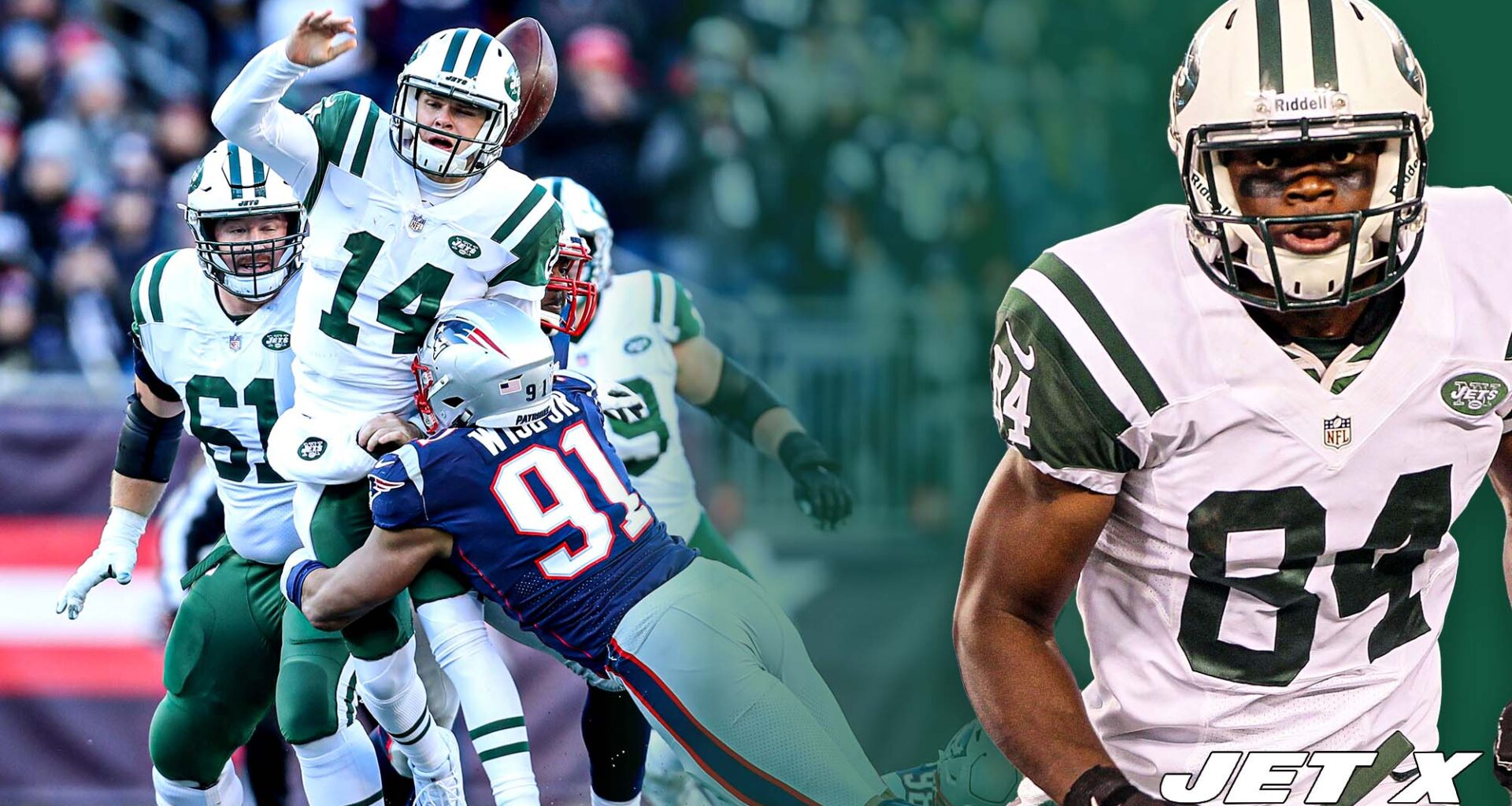
1. Stephen Hill, Devin Smith, Denzel Mims, Elijah Moore
The Jets had a decade-long run of stunning futility when attempting to identify offensive building blocks in the second round.
From 2012-21, these were their seven offensive choices in Round 2:
2012: WR Stephen Hill
2013: QB Geno Smith
2014: TE Jace Amaro
2015: WR Devin Smith
2016: QB Christian Hackenberg
2020: WR Denzel Mims
2021: WR Elijah Moore
Thankfully for the Jets, they have rectified this issue in recent years. Breece Hall (2022), Joe Tippmann (2023), and Mason Taylor (2025) appear to have the Jets on a three-pick winning streak when it comes to offensive second-round picks.
However, that seven-pick losing streak demands a thorough examination to ensure it is not replicated.
The most notable aspect is that five of the seven players were pass-catchers, including four wide receivers: Stephen Hill, Devin Smith, Denzel Mims, and Elijah Moore.
There is an easy lesson to be learned from these four players: Be wary of valuing tools over skills.
All four of these players were outstanding prospects from a physical standpoint. The average 40-yard dash time among them was 4.37, and even the slowest of the bunch, Devin Smith, ranks in the 80th percentile among wide receivers with his 4.42 time.
Hill (6-foot-4, 215 pounds) and Mims (6-foot-3, 207 pounds) offered incredible combinations of size and speed.
Smith didn’t have the size, but as a track star in both high school and college, his straight-line speed was special despite the slightly underwhelming 40 time.
Moore was small (5-foot-9, 178 pounds) but had athleticism in droves, as he also lit up the 3-cone (6.67, 91st percentile) and the 20-yard shuttle (4.00, 93rd percentile).
Despite all of these incredible tools, all four players were busts relative to their draft position.
It would be an exaggeration to say that the lesson here is to ignore physical traits and focus solely on fundamentals. However, perhaps these picks serve as a bright-red flag that warns of the dangers of overvaluing physical traits.
If you can’t play football, none of the measurables matter. Period.
Now, could the Jets have envisioned that any of those four prospects would be poor football players at the NFL level? Not necessarily. They were all chosen in the second round for a reason; sometimes, winning the NFL draft comes down to luck. Moore, especially, was incredibly productive and technically sound at Ole Miss. Mims was also a standout at Baylor, securing 2,925 yards and 28 touchdowns at Baylor.
Perhaps, though, the Jets could have saved themselves from the Hill and Smith whiffs if they put more of an emphasis on skill than athleticism.
Hill only had 49 receptions and nine touchdowns across three years at Georgia Tech. He racked up 1,248 yards by way of his ability to win deep, but it’s a lot easier to win jump balls against college corners than it is against NFL corners. The lack of production from Hill was a red flag that could have been heeded.
Smith had far better college production, racking up 121 receptions for 2,503 yards and 30 touchdowns. However, he was heavily reliant on the deep ball; in his last season, Smith only caught 33 passes in 15 games. Those turned into 931 yards and 12 touchdowns (28.2 yards per reception), but there wasn’t much production to be found outside the deep shots.
In fairness, Smith’s NFL career was derailed by injuries. Still, he was a non-factor whenever healthy, and it was because he couldn’t do anything besides running go routes.
As for Mims and Moore, they were great college players, but perhaps the Jets could have foreseen their poor NFL careers if they realized that neither player had the right stuff between the ears.
Moore turned out to be a malcontent in New York, demanding a trade mid-winning streak. Could the Jets have sniffed this out pre-draft? Absolutely—we all saw the immature celebration that cost his team a game.
Mims never won over the coaching staff in New York. He was consistently buried on the depth chart after Robert Saleh’s staff took over, suggesting he was unimpressive at grasping the offense during practice and meetings. The fact that he constantly committed pre-snap penalties whenever he did get a chance to play only further supported the notion that he was probably lost in practice.
There are no hard rules in the NFL draft. Many teams are rewarded for gambling on high-risk, high-reward prospects who have tools in droves but limited production and/or off-field concerns.
With that being said, the Jets’ 2012-21 run of second-round picks at wide receiver serves as a reminder that it is always imperative to weigh a prospect’s skills, fundamentals, and mental makeup just as heavily as their measurables.
2. The Idzik 12
John Idzik’s 2014 draft class remains one of the most infamous classes in Jets history. The second-year GM accumulated 12 selections, but by Week 1 of the 2015 season, only one of them was a starter for the team, first-round safety Calvin Pryor, who was ultimately a bust.
The lesson yielded by the Idzik 12 is simple: Quantity over quality is not always a recipe for success.
While the Jets had 12 picks in that draft, they only had three within the first 100 picks. The gaudy pick total stemmed from two extra fourth-round picks and three extra sixth-round picks.
It’s always nice to have more rolls of the dice on Day 3, which is basically a mildly educated crapshoot. However, if a draft class is going to truly shift the direction of an organization—which is precisely what Idzik was trying to do in 2014, smack-dab in the middle of a transitional period for the Jets—you need more premium selections. Those are the picks that yield a high chance of landing real building blocks who can be the faces of an organization.
Of course, the Idzik 12 is hampered by the fact that Idzik didn’t even hit on the earlier picks, so the class probably would have been just as infamous if Idzik had accumulated more picks on Days 1-2.
Nonetheless, the lesson stands: Just because you stockpile a boatload of late-round picks, it doesn’t guarantee that at least one of those players is bound to work out. The odds of a late-round pick hitting are too low for a quantity of extra shots to improve your chances that much. Think about buying five Powerball tickets instead of one. Sure, your odds are five times better, but it’s still a negligible difference.
Extra picks from Days 1-2 are what really give a class the potential to shift a franchise’s fortunes. The 2026 and 2027 Jets will have that. They don’t have the most picks in the NFL this season, but they have the most valuable collection of picks, and that is what rebuilding teams should be after.
General manager Darren Mougey deserves credit for having the boldness to trade players who would yield premium assets, rather than settling for middling trades that yield a plethora of relatively useless Day 3 picks and pretending it is enough to rebuild a roster.
3. Sam Darnold
It remains unclear if the Jets will take a quarterback in the first round this year. However, the possibility is on the table.
The team recently hosted Alabama quarterback Ty Simpson for a private workout. This doesn’t necessarily indicate that the team plans to draft him, but if Simpson wins them over, the Jets have the ammunition to angle themselves into the perfect position to take him.
If the Jets do end up taking a quarterback in the first round, they must learn from the Sam Darnold era.
It took him a while, but Darnold ultimately proved that he did, indeed, have the Super Bowl-winning potential that the Jets saw in him coming out of USC, prompting them to trade two second-round picks for the right to take him third overall.
We’ll never know how things would have transpired in this alternate universe, but perhaps if the Jets surrounded Darnold with an adequate supporting cast, he would have reached that Super Bowl ceiling in New York.
The “work” that the Jets did to support Darnold in the 2018 draft is grounds for a criminal investigation. After selecting him, this is what the remainder of their draft class looked like:
R3: DT Nathan Shepherd
R4: TE Chris Herndon
R6: CB Parry Nickerson
R6: DT Folorunso Fatukasi
R6: RB Trenton Cannon
Not one wide receiver. Not one offensive lineman. And not a single offensive player within the first three rounds of the draft.
This occurred in part because the Jets chose to dump two second-rounders to secure Darnold. However, the Jets should have made a greater effort to surround Darnold with a legitimate offensive building block to grow alongside. Whether it was trading a veteran player or packaging multiple picks to move up, the Jets could have gotten back into the second round to give him a wide receiver to develop with or an offensive lineman to protect him.
Even if that endeavor failed, it should have been considered a necessity to use the next two picks on a receiver and a lineman.
The Jets were coming off a 2017 season in which they ranked 29th in offensive DVOA and had the 28th-ranked pass-blocking unit, per PFF. Their 2018 free agency haul focused mostly on defense, highlighted by cornerback Trumaine Johnson and linebacker Avery Williamson, with the biggest offensive addition being a mediocre center in Spencer Long.
Yet, the Jets let the draft pass by without adding a single premium-position offensive player to support their new franchise quarterback.
The “Best Player Available” mentality is considered gospel by many NFL front offices. While it is generally a wise adage to live by, there are certain situations where it makes sense to ditch the draft board and target specific positions.
When a team without a strong offensive ecosystem commits a first-round pick to a quarterback, adding more young offensive talent alongside him is a requirement. It is malpractice not to do so for the purpose of drafting a defensive player who is slightly higher on the overall board than the top wide receiver or offensive tackle.
Today, the Jets have a much better offensive depth chart on paper than they did going into the 2018 draft, but let’s stare reality in the face: the team still ranked 30th in offensive DVOA last year, and the depth chart has barely changed since the conclusion of the season. For that reason, if they feel so inclined to draft Ty Simpson in the first round, they must commit at least two of their other three top-45 picks to offensive players.
Missing a first-round pick is always painful, but missing on a quarterback is the ultimate way to doom an organization for the next five years—the Jets know this well. That’s why “BPA” should be tossed aside in favor of drafting players who can maximize the quarterback’s odds of success.