
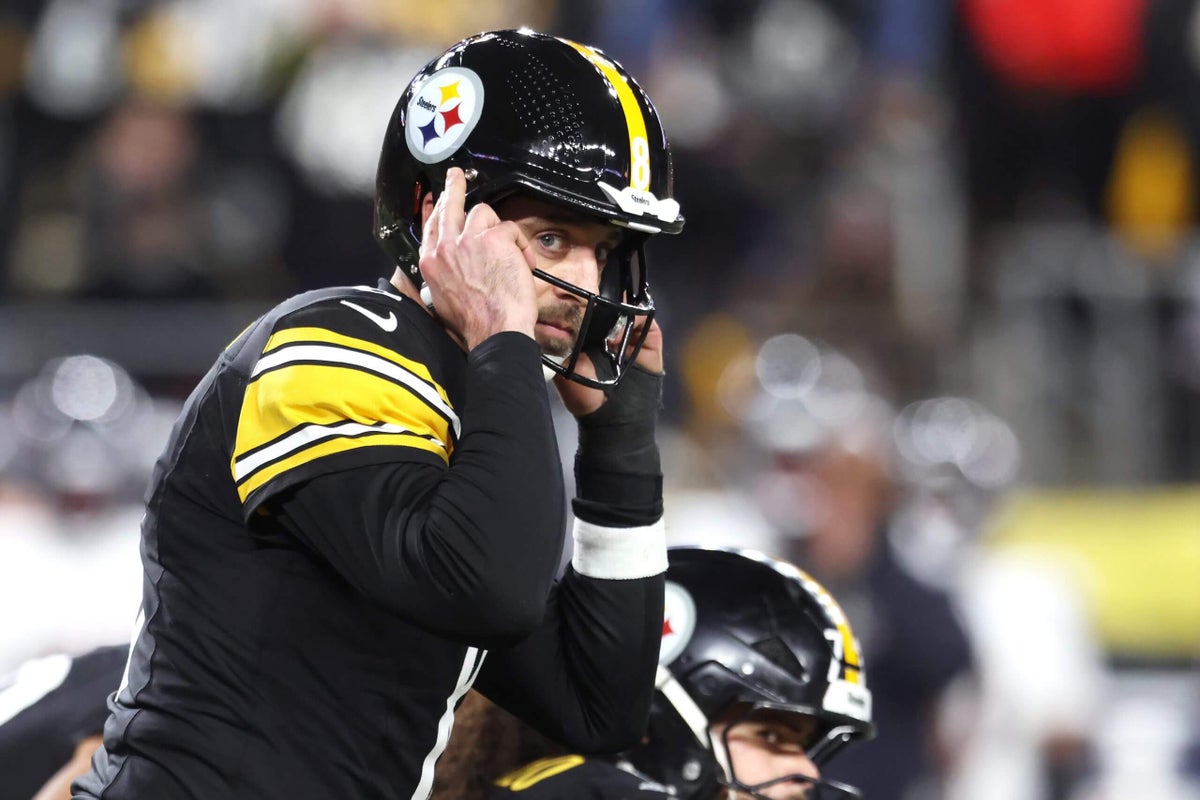
Who could forget the rented Chevy Malibu? In the first few weeks of Aaron Rodgers’ long, drawn-out courtship with the Pittsburgh Steelers last offseason, the future Hall of Fame quarterback flew from California into a still unknown airport, evading the public eye. Wearing a baseball cap and dark aviator sunglasses, he drove through the back gate of the Steelers’ facility for what was intended to be a secret recruiting trip. When word got out that Rodgers was in Pittsburgh, that meeting prompted one of several false alarms — no contract was signed. It took about 12 more weeks for Rodgers to finally commit, just ahead of mandatory minicamp.
Fast-forward one year. “I don’t foresee this going like it did last year,” Steelers general manager Omar Khan assured the fan base during the NFL Scouting Combine in February. “…It just isn’t going to go like it did last year.”
Yet, here we are: Three weeks into free agency, and the Steelers still don’t have an answer.
Another offseason of indecision feels unnecessary. It’s created undue drama and risks turning off at least some portion of a fan base that Rodgers won over with his performance last year. More than anything else, it’s the perfect metaphor for the current state of the Steelers.
In the NFL there are two types of teams. There are those that have a legitimate answer at the most important position — the ones with a quarterback capable of leading a team deep into the postseason and competing for a Super Bowl. And then there are the teams that don’t. For about the last half-dozen years (maybe longer), the Steelers have fallen squarely in that second category, as Ben Roethlisberger’s play declined with age, and then as the franchise tried — and repeatedly failed — to find a successor.
The first warning sign came in January of 2017, when Roethlisberger indulged in a game of “guess what I’ll do next?” that aging quarterbacks love to play. Shortly after the Steelers lost their first of six consecutive playoff games, Roethlisberger publicly suggested the end could be coming sooner than later.
“I’m going to take this offseason to evaluate, to consider all options,” he said on his Pittsburgh-area radio show. “To consider health, and family and things like that and just kind of take some time away to evaluate next season, if there’s going to be a next season.”
Despite this early flirtation with retirement, the Steelers never seriously invested in a succession plan the way the Green Bay Packers and other franchises have. The one and only time they even attempted to go down that path by drafting Mason Rudolph in the third round — a completely reasonable way to spend a mid-round pick— Roethlisberger openly criticized it. Rather than planning ahead, Pittsburgh doubled down on defense, spending nine of 10 first-round picks on that side of the ball from 2011 to 2020 with the goal of building up the roster enough to support an aging quarterback.
Even when Roethlisberger tore three elbow tendons in 2019, giving the Steelers an opportunity to use a top pick in a QB-rich draft, Mike Tomlin and company refused to accept a losing season. Instead, the same day the team announced Roethlisberger would undergo season-ending surgery, they traded a 2020 first-round pick for safety Minkah Fitzpatrick. As a result, the Steelers found the last missing piece to complete a nearly dominant defense. However, the prime years of T.J. Watt, Cameron Heyward and Fitzpatrick were mostly wasted due to subpar quarterback play.
In the years since Roethlisberger’s 2021 retirement, the Steelers’ misses at quarterback have spanned a wide spectrum of possibilities. First, they tried the draft-and-develop approach. In 2022, even though there wasn’t a quarterback with first-round talent, the Steelers spent the 20th pick on Kenny Pickett anyway. The feel-good story of the former Pitt passer playing in the same same stadium where he broke Dan Marino’s records transformed into a cautionary tale. After two seasons and 24 starts, Pickett was essentially declared a bust and traded to the Eagles in a pick swap. That swing and miss scarred the Steelers, who learned that just because a team needs a quarterback doesn’t mean the answer is there in the draft, making them reluctant (right or wrong) to take a similar chance again.
In 2024, the team pivoted by bringing in a pair of castoff QBs in Justin Fields and Russell Wilson. A training-camp hamstring injury for Wilson gave the Steelers a chance to try the first-round reclamation project route. However, even though then-offensive coordinator Arthur Smith got the best out of Fields during a 4-2 start, the Steelers only made a half-hearted attempt to see if they could unlock Fields’ first-round upside. Instead of pursuing that option more seriously, they turned the job over to Wilson.
Backed by the NFL’s highest-paid defense, Wilson threw enough moon balls to George Pickens to lead the Steelers to a wild-card berth. But after the season ended with five consecutive losses, including another first-round flameout in the playoffs, they realized too late it was time to move on.
That brings us to Rodgers. When he finally agreed to a deal last offseason, both parties involved saw it as a one-and-done fling that would get them both to their next chapter. For Rodgers, who had just endured two tumultuous seasons with the Jets, it would be an opportunity to finish his career with a stable franchise and a head coach who never had a losing season. He could pass Brett Favre in all-time passing touchdowns and see if he could maximize what appeared to be a loaded, if aging, defense. For the Steelers, who were underwhelmed by the 2025 QB class, Rodgers could provide the bridge to what was supposed to be a much stronger 2026 crop of passers. But here they are, again waiting on Rodgers.
If you gave the team truth serum, they’d probably admit they’re going down this path again, not because of what the QB did in 2025 but because of what the incoming rookie class failed to do. A 2026 QB class that was once seen as booming with first-round talent has almost entirely collapsed. Aside from Indiana QB Fernando Mendoza, the presumptive first overall pick, many of the top contenders have either decided to return to school (Texas’ Arch Manning and Oregon’s Dante Moore), failed to meet preseason hype (LSU’s Garrett Nussmeier and Penn State’s Drew Allar) or both (South Carolina’s LaNorris Sellers).
For that reason, you could make a pretty convincing argument that Rodgers is the best of the bad options. But that doesn’t necessarily mean it’s a good one — and it’s certainly not the one to break this cycle.
Last year, Rodgers showed he still has his fastball and the experience to get the offense into the best play. He was well-received by teammates, a willing mentor to Will Howard and a high-level tactician. However, the mobility that was once a strength has noticeably declined with age, and his deep ball was inconsistent throughout the year. That forced the Steelers into a simple game plan: Get the ball out of Rodgers’ hand faster than anyone else and rely on yards after the catch. With that formula in place, Rodgers finished the season 26th in EPA per dropback (0.01) and 14th in passer rating (94.8). He played some excellent games — like against the Ravens in Weeks 14 and 18. He also experienced some of the worst games of his career, including against the Los Angeles Chargers in Week 10.
How Rodgers looked hinged largely upon the competition. Against average to below-average defenses he was typically good — sometimes even showing flashes of his old brilliance. Against top-tier defenses, particularly ones with elite pass rushers, the limitations were illuminated.
The Steelers played eight games last year against defenses that finished top 10 in fewest yards allowed — Texans, Vikings, Browns (twice), Chargers, Seahawks, Bills and Patriots. In those games, Rodgers had as many turnovers (seven) as touchdown passes, including a fumble returned for a touchdown in the wild-card game. He also took a sack for a safety against the Chargers. Overall, he posted an EPA per dropback in those eight games of negative-0.25, according to TruMedia, and a passer rating of 75.2. That was good enough to get the Steelers into the playoffs (thanks in part to Tyler Loop’s missed field goal) but not nearly enough to get the franchise’s first playoff win in nearly a decade. While every quarterback will face struggles against better defenses, Rodgers’ play dropped off more precipitously than his peers’.
By going the Rodgers route again — an all-time great showing signs of decline — the hope is that the Steelers have done enough around the quarterback to elevate the team. After the Michael Pittman Jr. trade, the offense finally has a real WR2 for the first time in years. With additions at corner (Jamel Dean), safety (Jaquan Brisker) and the defensive front (Sebastian Joseph-Day), new defensive coordinator Patrick Graham might help this highly compensated unit play closer to its collective paycheck.
Still, it’s a gamble. Quarterbacks 40 or older have won 12 playoff games. Tom Brady has 10 of those wins. Drew Brees has one and Brett Favre have one each.
Even if the best-case scenario unfolds, this is still another Band-Aid disguised as a bridge. It’s a one-year answer for a team that needs a long-term solution.
In that way, no matter what Rodgers decides (and when he decides it), the Steelers will still, almost certainly, be in this same place next year at this time: Waiting for a quarterback to bail them out of this tiresome cycle.