
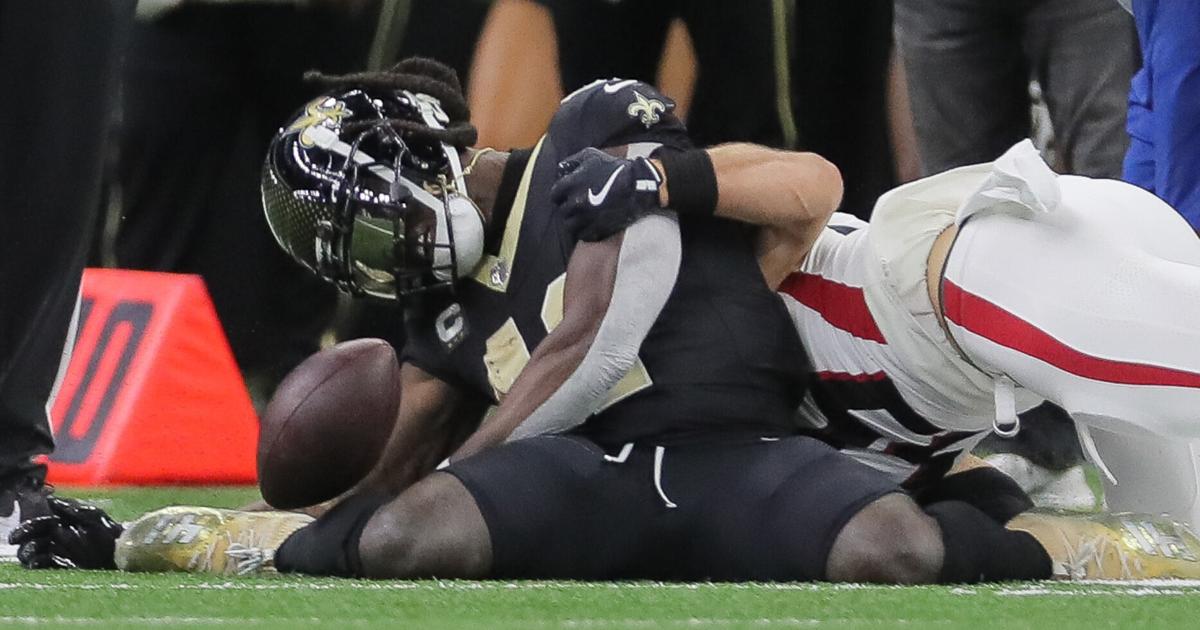
PHOENIX — On the surface, Kellen Moore sounded more optimistic Monday about Alvin Kamara playing for the New Orleans Saints in 2026 than he did two weeks ago.
The Saints coach, speaking to reporters at the NFL owners’ meetings, said he could find ways for Kamara and Travis Etienne to share a backfield. And he answered affirmatively when asked whether Moore was planning for Kamara to be on the roster next season. He reiterated that the Saints “love” Kamara and that he means “the world to us.”
But in those sentences, there was enough vagueness and caveats to leave an out that makes Kamara’s return far from a guarantee.
Moore said there is a full “process” to go through this offseason, without providing any clarity on what that process entails. And though he mentioned that Kamara was on the roster, he said it in a way that left open the possibility that it could change.
Moore was even asked whether anything had changed with the running back since the coach last spoke to reporters two weeks ago, when he was far more vague about the situation.
“No,” Moore said. “No, we haven’t (talked).”
The end result added a new layer of confusion, one the Saints seem content to string along. The team, to be fair, doesn’t have to make a decision now. Mandatory minicamp is months away — let alone training camp and the start of the season. Kamara also could have a big say in his future if he decides to retire.
But Tuesday was not Moore doing a 180 in the way he once did with Derek Carr.
For those that don’t recall, Moore was equally noncommittal about the quarterback’s future when Moore was hired by the Saints in February 2025. Then, weeks later at the combine, Moore was seemingly on board with Carr.
“We feel fortunate to have Derek here,” he said back then. (The Saints’ plans obviously changed when Carr later retired that offseason.)
Kamara’s future remains up in the air. The saga continues even after the Saints took measures to address the 30-year-old’s contract. Earlier this month, New Orleans used a creative accounting trick and a little-known salary-cap rule to alter Kamara’s cap hit rather than a conventional restructure. The move lowered Kamara’s cap hit to $10.4 million and cleared $8 million in cap space.
But then the Saints signed Etienne and new questions emerged. ESPN, for instance, reported that teams wondered whether the Saints would be open to trading Kamara, while the NFL Network reported others wondered whether Kamara could retire.
As of now, the Saints have the most salary-cap dollars and overall cash committed to their running backs across the NFL in 2026.
New Orleans structured Etienne’s four-year, $52 million contract in a way that makes the first year of his cap hit ($5 million) palatable. Would having Etienne and Kamara be manageable if they were both on the books for $16 million — $2 million less than Kamara’s original cap hit for 2026?
Even then, Kamara is coming off the worst season of his career, and it’s worth wondering whether he can bounce back. He had career lows in several categories — including rushing yards (472) and yards per attempt (3.6) — and missed the final six games because of knee and ankle injuries.
It’s also fair to wonder about how Kamara will co-exist with Etienne. Kamara, to his credit, has been at his best when he’s had another legitimate threat to manage the workload. But Etienne and Kamara share similar skills, particularly in how they can factor in the passing game.
On that front, Moore was willing to acknowledge that he already had envisioned how the two could complement each other.
“Both of them obviously have the explosive, elusive ability to play in all three phases, which is beneficial,” Moore said. “I feel like our running back room is a really healthy room right now, with just the depth and the experience and all the guys that are in there.”
Pick apart Moore’s words close enough, and even that might have contained a caveat. Right now? Does that mean the room is subject to change?
The lack of concrete answers just widens the guessing game.