
 Raise the Flags: 50 Years of Buccaneers Football © Prime Video
When I was presented with the opportunity to review Raise the Flags: 50 Years of Buccaneers Football, a ten-episode docuseries focusing on the Tampa Bay Buccaneers, I’ll admit I was hesitant. For over a decade, I’ve had the privilege of covering the San Francisco 49ers. I’ve worked closely with the organization and its players—some of whom have become great friends. To make it even more special, they’ve been my hometown team for most of my life.
Over the years, I’ve been warned a few times: “Don’t cover the team you love.” After interviewing Trent Cooper, the director of Raise the Flags, I finally understand what that means. But before that interview, I had to ask myself an honest question: ‘Can I leave my bias at the door and genuinely enjoy ten episodes about a team I don’t follow?’
The answer, it turns out, is a resounding yes. After decades of being immersed in football, my love for the game supersedes my allegiance to one team. I can look beyond the jersey and respect the athletes—these modern-day gladiators at the pinnacle of their sport, craftsmen building their legacies brick by brick. Raise The Flags: 50 Years of Buccaneers Football is an absolute cinematic docuseries that kept me engaged throughout every episode.
I’m not accustomed to interviewing people outside the 49ers’ orbit, but I thoroughly enjoyed my conversation with Trent. Despite our limited time, I hope my questions were thought-provoking enough to do justice to the incredible work he put into this Prime Video docuseries.
Nexus Point News: I’ve read and I’ve heard that you are a long-life devoted Tampa Bay Buccaneers fan. How did you balance the personal connection to the team and their passion and love for the team? When you were creating Raise the Flags, what was your objective there, and how did you balance all that out?
Trent Cooper: Listen, you got to check that stuff at the door. I use it as fuel to, first of all, make sure I’m really prepared for every shoot and every interview. Because I really love this story and I love these characters. I might pull an all-nighter to make sure I’m extra prepared for the Tom Brady interview, because I know how precious it is to my lifelong favorite team. So, I think it motivated me in incredible ways. I also think it helps to have lived through a lot of the story. I remember the emotional beats that fans felt. I remember the kick in the stomach. And just as much, I remember the goosebumps and the tears and the moments you leap out of your chair. Like, this was my childhood. Having that emotional rollercoaster in the back of my mind is very helpful as a storyteller, because that’s all we’re trying to do. We’re trying to take you on that journey and get you to those spots where you have the goosebumps and tears and all those things. It inspired me. It motivated me to work harder. But when you’re sitting in a room with people that you’ve loved as a kid, you’ve got to very quickly get over that, and be a pro, and earn their trust and their respect. And, okay, Doug Williams, I know you were my first ever hero, and the first jersey I ever owned was yours. But right now, I need to tell a really good story. So, let me put seven-year-old Trent Cooper out of the room for a second, and let me get back to being a storyteller, because I have exactly this amount of time with this guy and we need to kick some ass here.
Nexus Point News: I know working with NFL players, they’re naturally really grounded or really guarded around cameras and just letting people in. Who was the first player or coach who initially hesitated to possibly let you in or get closer, but eventually became the emotional core of your series?
Trent Cooper: Probably [Jon] Gruden. And, again, I mean, listen, Jon Gruden is fantastic on camera. He is constantly creating content now in new ways than he did when he was on Monday Night Football. He’s really great at this. But at the same time, Jon’s been through a lot of stuff, and this is emotional for him. Starting with what he went through with the Raiders, and the overnight trade to Tampa, which felt very personal to him. Then his time in Tampa, which we all watched from a distance. But, man, there is some real human emotion underneath everything he went through. I think it took a second for him to understand what I was trying to do and why I was doing it. There was a point where we really connected, and I left that interview feeling like it might be the best interview of my career. It was about three and a half hours long, and I think we were both exhausted emotionally when it was over. But what I’m most proud of is that he completely let his guard down, and he went on the ride, and he took us to all the very private places and emotional places. Then every now and then he’d just be Chucky and he’d let it fly, and he’d have all that energy and passion and the stuff that you, the fans, pay to see. Then sometimes he’d just be really human and really vulnerable, and I just thought it was fantastic. I think it elevates the series tremendously.
Nexus Point News: You captured hundreds and hours of footage for this project. Was there something that was painful to possibly leave out of the series? I know it was a pretty long series. Was there anything that you left on the cutting room floor that pained you that you really wanted in there?
Trent Cooper: You know, there’s a lot. I mean – listen. You know, Ricky Bell is a character that I remember from a kid. As a kid that’s just such an incredible story about his very tragic death and what he meant to so many people. Because that kind of happened after the Bucs, we didn’t really have a chance to go there. Hardy Nickerson is a character that was instrumental in changing the culture in Tampa. But when you’re telling a story, you can’t have too many turning points at the exact same time or you have nothing. So, you have to make certain choices. I come from the narrative film world where I was a screenwriter for 15 years of my career. So, I’m literally building documentaries the way screenwriters build movies. I know the turning points, and I know when you have too many beats and you have to simplify things. So that was something that drove me crazy that we couldn’t quite give him the credit at the right time, that I knew. It just didn’t work for the story as much. So, he ended up being more of a supporting character and I love him. I think he’s great. There’re funny stories, quirky things about Brad Johnson that we thought were hysterical and amazing but didn’t quite fit into what we were doing because it isn’t the time to be funny. It’s the time to be tense and dramatic. Gruden had some great stories about his childhood because he was the son of a Bucs coach, a Bucs running backs’ coach and a personnel guy. And so, Gruden has incredible memories of being 15, 16, 17 years old and his dad doing things and him being around. There’s just so much, man. There’s great stuff that we weren’t able to do, and we still have 10 episodes of just wall-to-wall killer shit. This is the business we’re in, man. You don’t have room for everything. You hope that you have a lot of great story that didn’t make it and you’re packed with wall-to-wall story that did.
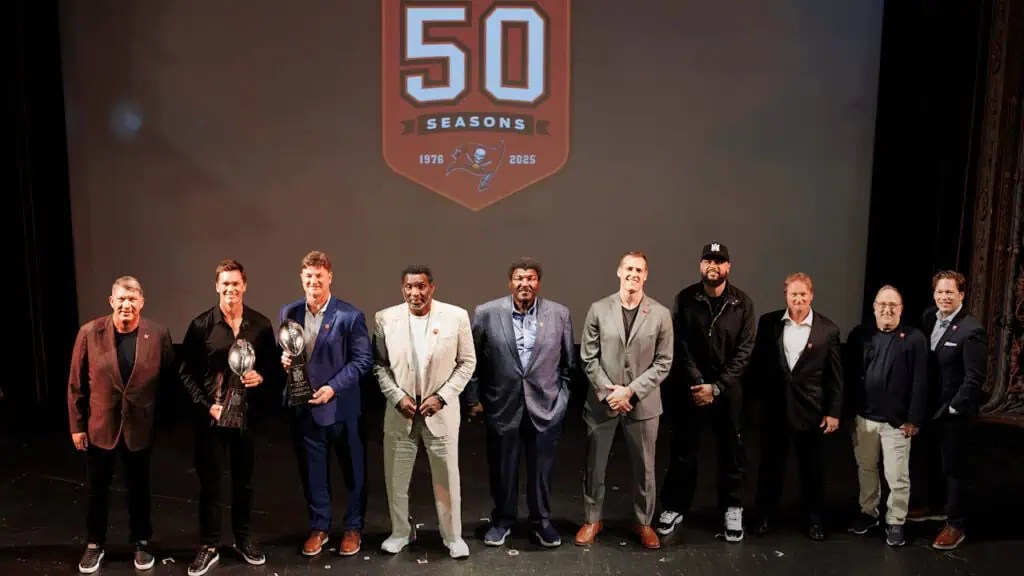 Celebrating half a century with Raise the Flags: 50 Years of Buccaneers Football. © Tampa Bay Buccaneers
Nexus Point News: I come from covering 49ers for the past 10 years. John Lynch has become a pivotal figure in our franchise, and he was such a revered figure in Tampa Bay history. Do you see any of his likeness in the way he’s building the 49ers right now, and what are your thoughts?
Trent Cooper: I think you have an excellent GM. Among the very best in football. I can’t believe you guys were smart enough to hire him with almost no experience, but I think he’s a home run choice. There were things that he experienced in Tampa that he brought to that in terms of how he built that defense. I think he might have even seen certain traits in certain players that he recognizes that are, “This guy has the Hall of Fame DNA that I saw when I was a player.” I think character is a big deal to him because those that know him understand you’ll never meet anyone with a higher character. And I think some of that comes straight through his DNA with Tony Dungy and Herm Edwards and Mike Tomlin and some of the great guys that helped mold John Lynch. I could talk about this for two hours. I think Lynch is amazing. He’s a great dude. And as long as he is working, doing that job in San Francisco, I think you guys are going to have a very stable franchise.
Nexus Point News: With the ever-changing landscape of how people view the game and social media, how important is a docuseries such as Raise the Flags to fans, old and new people coming into the sport, people that know nothing about the sport? How important is the docuseries for things such as this to you as far as relaying the story, the message, and just everything in between?
Trent Cooper: I think story is everything. It’s why I do what I do for a living. And I think football is a really cool game that we love watching on Sundays, but when we get to take these helmets off of players and really understand who they are as human beings and what they’ve gone through to get where they are, the first thing we notice is we start to see ourselves in some of their stories. We have this connection. “Oh, my God, I never knew that you’ve gone through some of the same stuff I’ve gone through.” You’ve lost a child, you’ve struggled to pay the bills, you’ve been laid off and fired and overlooked and marginalized, and all those things that we as human beings struggle with in our worlds, they’re going through too. When you start to relate in those ways and connect, things really come to life. So I think what’s cool about this series is you didn’t have to be a fan of this team to love this story. It’s an incredible underdog story of a team that got their asses kicked and they got humiliated in ways that sports rarely have. They’ve gone to lows that people haven’t really felt in sports, and they clawed their way out of it. They built a community of people that fought through stuff, and a lot of it was built on high-character people that just did some extraordinary things and pulled this franchise to the absolute top of the mountaintop, only to lose it all again in an even more painful way, and then restart that journey and climb all the way back again. Seeing that is so compelling, and it doesn’t matter if you’re a Bucs fan or a 49ers fan. If you’re a fan of human beings working together to get something done that’s bigger than themselves, you will love this story because it is the essence of that. That’s great. That’s really great.
Nexus Point News: If Prime Video were to hand you the keys to a 49ers docuseries tomorrow, let’s say, who would be the very first person you’re putting a microphone on and why?
Trent Cooper: [AMC’s Rise of the 49ers] , the one that just came out, a lot of my friends worked on, and I thought it was quite good. For me, I want to awaken the spirit of Bill Walsh, I think he’s the greatest thing ever. I think he’s a fascinating character, and so I would be getting into the heart and soul of Bill through the people that were there with him day one and that learned from him and embody his legacy. I think of people like Holmgren and I think about even a young Jon Gruden and just people that are part of that legacy, obviously Montana and Rice and just everybody who got to taste a little of the magic of Bill Walsh. I am here for it, man. I could never get enough of that, dude.
Nexus Point News: When you were shooting Raise the Flags, were you shooting for more of a kind of telling the story, or was it more for you going for giving viewers a fly-on-the-wall type of experience? How did you pivot?
Trent Cooper: When I was younger, documentaries were boring. You would put a documentary on and you’d fall asleep. It was what your driver’s ed teacher would do, or your substitute teacher would do when they had nothing better. They’d put on a documentary, and we’d all take a nap in high school. Now, this is entertainment and you have to honor the story and be absolutely correct. There’s no bullshitting your way through a story, but you have to understand how to tell a story in a really cinematic, emotional, compelling way. That means understanding the turning points and, and the emotional highs and the emotional lows and when, how to craft those turns and when to land those punches. You also have to learn how to do it with visuals. When I was first getting into sports docs 10 years ago, they weren’t very innovative. There was a lot of talking heads and football highlights. I wanted to help change that, and I got to work with some really great visual storytellers and cinematographers and people that understood the narrative film and the things that we want to see as entertainment. We kind of took narrative film principles and applied them to documentaries. What was born out of that is this really high art, really new way to see the sports doc world. I think if you watch this series, you’re going to hear sound design you’d never heard before, and you’re going to see some really interesting visuals and you’re going to go on an emotional ride that you weren’t expecting from this team that you don’t even know that much about, but it’s storytelling. I think entertainment is a huge part of documentaries right now. If you’re not making documentaries with an eye towards that, you will lose your audience in about five seconds. We are here to entertain. And if we’re bold enough to say we have 10 episodes, by God, all 10 of them better entertain you wall to wall with no chance to escape. I think that was the goal, and the feedback we’ve been getting is that a lot of people are watching all 10 episodes and are riveted by it and blown away by the storytelling. So to me, that’s the highest compliment and that that’s the whole reason we do it.
Raise The Flags: 50 Years of Buccaneers Football is now streaming on Prime Video.
This article has been edited for clarity.