
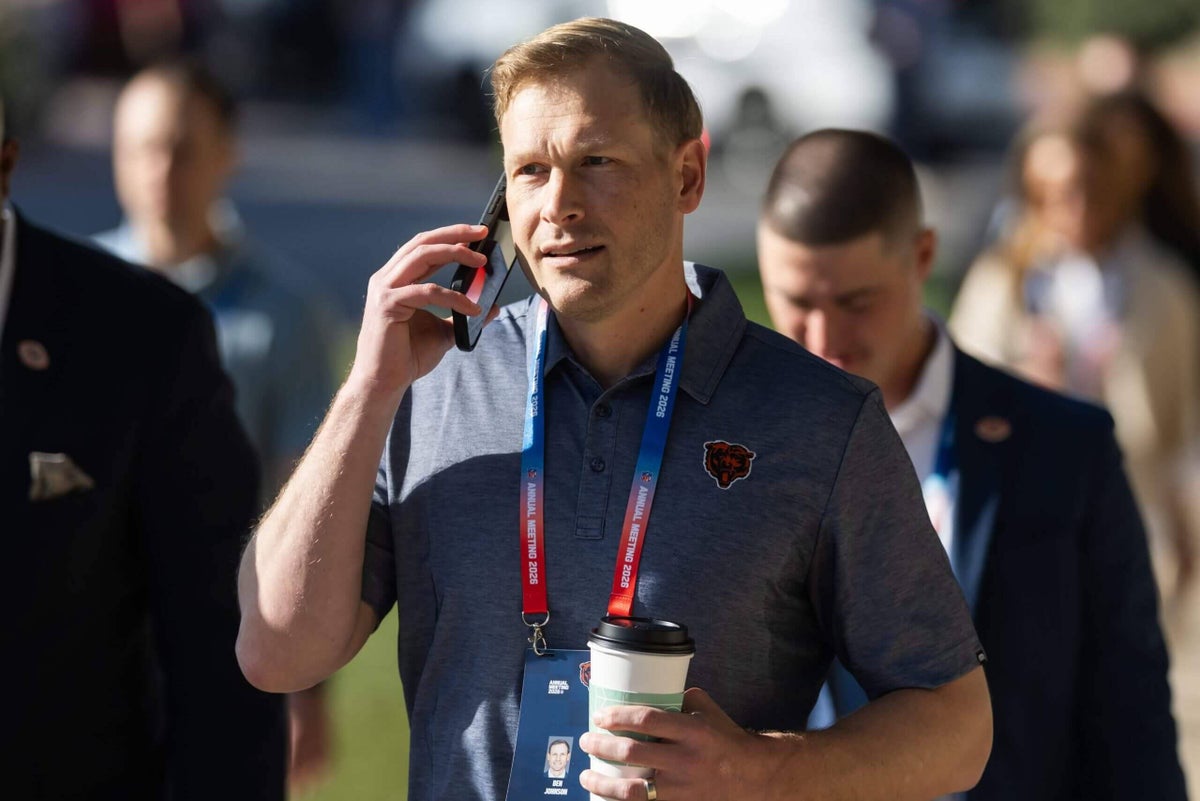
PHOENIX — A few weeks back, as Chicago Bears coaches continued combing through their 2025 offensive video library as part of their offseason self-scouting process, Ben Johnson conducted what he called “a fun little exercise,” calling up the files from Aug. 3 of last season. Family Fest at Soldier Field.
That footage, to put it nicely, was far from impressive. Clunky. Discombobulated. Evidence of a newly installed system being run by a young quarterback and needing serious repetition and refinement to create positive results.
At that stage of Johnson’s first preseason in Chicago, there were few signs offensively that a magical Bears season was on tap. That Family Fest performance was so sloppy that the two newcomers to this year’s offensive staff — running backs coach Eric Studesville and offensive analyst Will Lawing — spun around from the big screen with a bemused rhetorical question.
How did you guys wind up winning any games last year?
“Like, they couldn’t believe it,” Johnson said Monday morning at the NFL’s annual meeting at the Arizona Biltmore. “To see where we started was like, ‘Wow!’ It was an eye-opener.”
Where the Bears finished was in the divisional round of the NFC playoffs, following an 11-win division-championship season with a postseason victory over the Green Bay Packers. Quarterback Caleb Williams became so well known for his late-game magic — the Bears won an astounding seven games in which they trailed in the final two minutes — that he earned the nickname “Iceman,” a moniker he recently sought to trademark.
The Bears finished the regular season with the NFC’s best rushing attack, compiled a top-10 total yardage output (sixth, 369.5 yards per game) and averaged 25.9 points per game, the franchise’s best mark since 2018 and fourth-highest total of the 21st century.
Simply put, the offense came a long way from those midsummer struggles. Yet to hear Johnson contextualize everything in the desert this week, there is still such a long, long way to go. To meet his championship standards, the offense must become, by Johnson’s own description, much more crisp with its fundamentals, technique and detail. The offensive line, with significant flux at center and left tackle, must stabilize quickly to build on its impressive 2025. The stable of pass catchers — with DJ Moore gone to Buffalo — will lean more heavily on Colston Loveland, Rome Odunze and Luther Burden III.
And Williams, of course, must make several significant developmental leaps to enliven a passing attack that Johnson candidly noted Monday “still leaves something to be desired,” while making it clear the accountability involves every position group.
Still, what encourages Johnson about that cringey Family Fest footage from last summer is the knowledge of how much growth the Bears experienced.
“The hope — not just for Caleb but for our entire offense — is that we start a lot further along in the spring and in training camp than where we were a year ago,” he said. “I feel pretty confident that is going to be the case.”
Up-front concerns
While it seems easy to center the offensive growth discussion on Williams and the heavy demands he’ll face in his third season, the Bears must first get back in sync up front, specifically at center, where the surprising early-March retirement of Pro Bowl veteran Drew Dalman has been arguably the most significant transaction of the team’s offseason.
Dalman’s consideration of leaving the sport first registered on Johnson’s radar in mid-February and with such conviction in Dalman’s thought process that his head coach sensed quickly “there was no really turning this thing around.”
As respectful as Johnson was of Dalman’s decision, he also knew his offense was losing an intelligent, experienced center who handled so much in 2025.
“We put a lot on his plate mentally and physically,” Johnson said, “and he answered that bell. He’s a big reason why we were able to get the plane off the ground last year.”
In sudden need of a reboot, the Bears quickly pivoted four weeks ago and ultimately found their replacement pilot via a trade with New England for eighth-year veteran Garrett Bradbury, who may not be as talented or accomplished as Dalman but registers as a match for this offense.
General manager Ryan Poles and his staff, plus offensive line coaches Dan Roushar and Kyle De Van, were instrumental in the evaluation of Bradbury, who spent last season snapping to Drake Maye as part of a Patriots team that reached the Super Bowl. Bradbury’s cerebral nature, his skill set in wide-zone running situations and his college chemistry at NC State with Bears left guard Joe Thuney proved notable.
“We came to a consensus that Garrett was going to fit us like a glove,” Johnson said.
Now, the Bears will seek a similar fit in identifying their best choice for the starting left tackle job — current candidates: Braxton Jones, Theo Benedet, Jedrick Wills and perhaps a rookie to be named. Johnson hopes he will enter Week 1 in September with more certainty at that position than the Bears had last year.
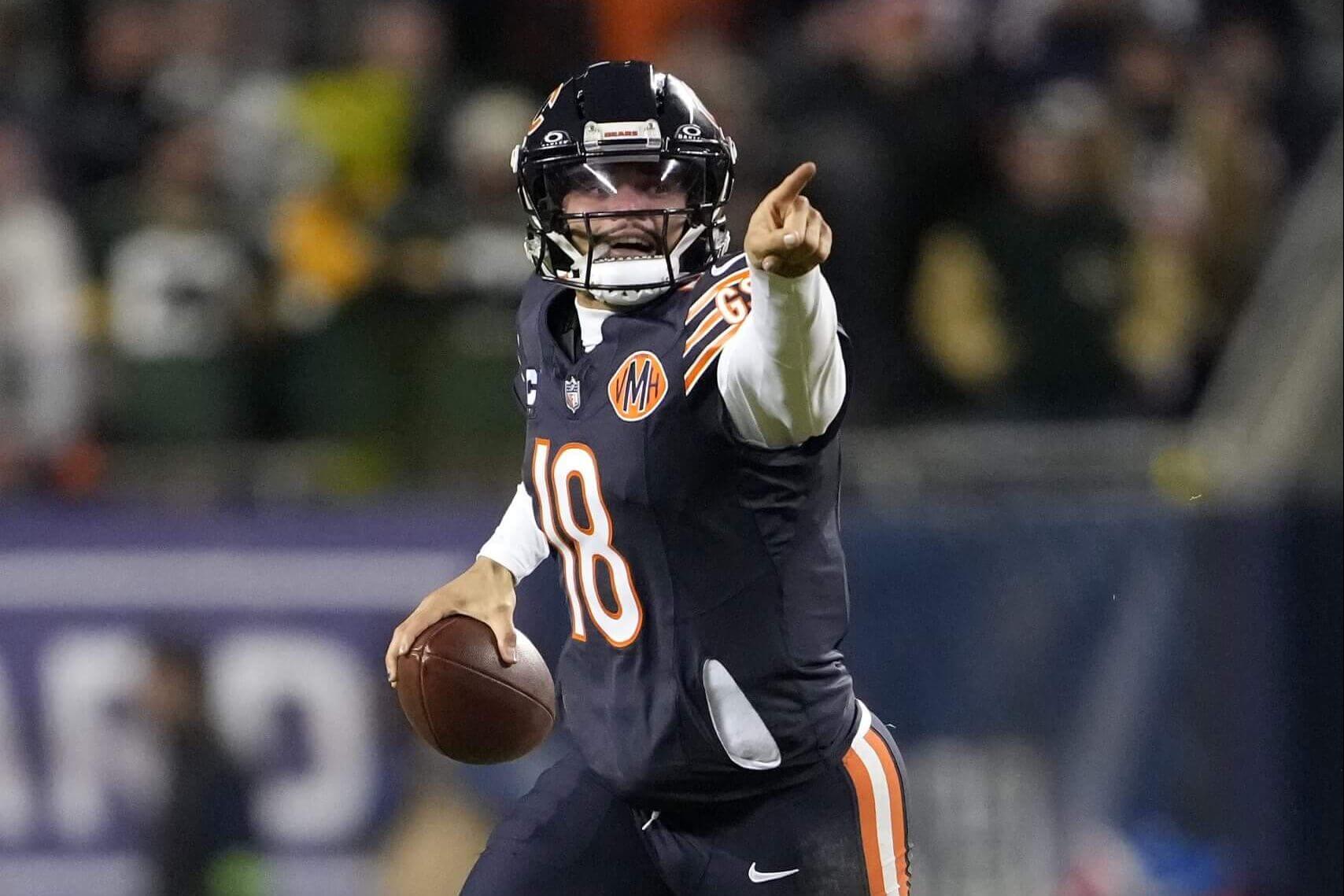
The Bears love Caleb Williams’ late-game artistry, but they want to help him become more efficient early in games. (Patrick McDermott / Getty Images)
Growth chart
Naturally, the load on Williams’ shoulders will increase this spring as he works to further his ascension. Johnson has already been hard at work formulating a priority checklist for his starting quarterback. The outside world will have the next five months to more deeply discuss specific details folded into Williams’ 2026 development. And Johnson is already beating the drum for improved accuracy and greater production in end-of-half two-minute situations, among other things.
But on the surface, it’s understood that increased efficiency has become a non-negotiable.
Johnson would never discard the late-game artistry Williams flourished with last season. “When we need to be at our best in the fourth quarter, that has to stay the same,” he said.
But there will also be a push to create a more surgical mindset for Williams as he understands the nuances of playing the position at an elite level and the consistency it requires, series after series, game after game.
Why, for example, did the Bears spend so much of November, December and January struggling to score through the first three quarters before frequently exploding in the fourth? That’s something Johnson has wondered aloud.
He has also been consistent in pushing for his wish of a 70 percent completion rate for Williams — eventually. The next stop on that path will hopefully be a spike from 58 percent to 65 percent, which last season would have required 40 more completions across 17 games.
“When you watch our self-scout (video),” Johnson said, “we’ve probably got 80 to 100 completions left on the table. I think he’s going to recognize that.”
Some of the desired improvements may come from quicker decision-making. Some should result from better footwork. Some will stem from better ball location.
As Johnson told The Athletic on Monday: “There are going to be a number of snaps on tape where he’ll look at it and be like, ‘Man, I’ve got to put this ball six inches further out in front.’ Or ‘I need to put this a little bit lower.’ Things of that nature. Really, he’s got to challenge himself. We’re going to challenge him. But he has to acknowledge, ‘I need to be better in these areas.’”
The big push
There may be no one better at keeping a thumb on Williams with a constant push for improvement than Johnson. And that will continue this spring.
“I wish I knew all the right answers. I don’t,” Johnson said Monday. “But there are things I believe in that I try to impart on him.
“We’ve had a healthy amount of time apart this offseason and away from football a little bit. And I know this: the conversations we’ve had on the phone have been really positive. I think he’s getting that itch again. He wants to know where his game needs to improve and how he can help us the most.”
That’s why Johnson is so eager to begin the offseason program at Halas Hall in three weeks. And it’s why that recent Family Fest review registered as reassuring and energizing.
“Just to see the growth that not only (Caleb) had but that we had as an entire offense,” Johnson said. “There were baby steps throughout the season. Yet when we see things from the start of camp there all the way until the end, it’s like OK, we’re cooking here.
“The point is we have to start there here in the springtime. If we do, we’ll see another big step for the entire unit.”