
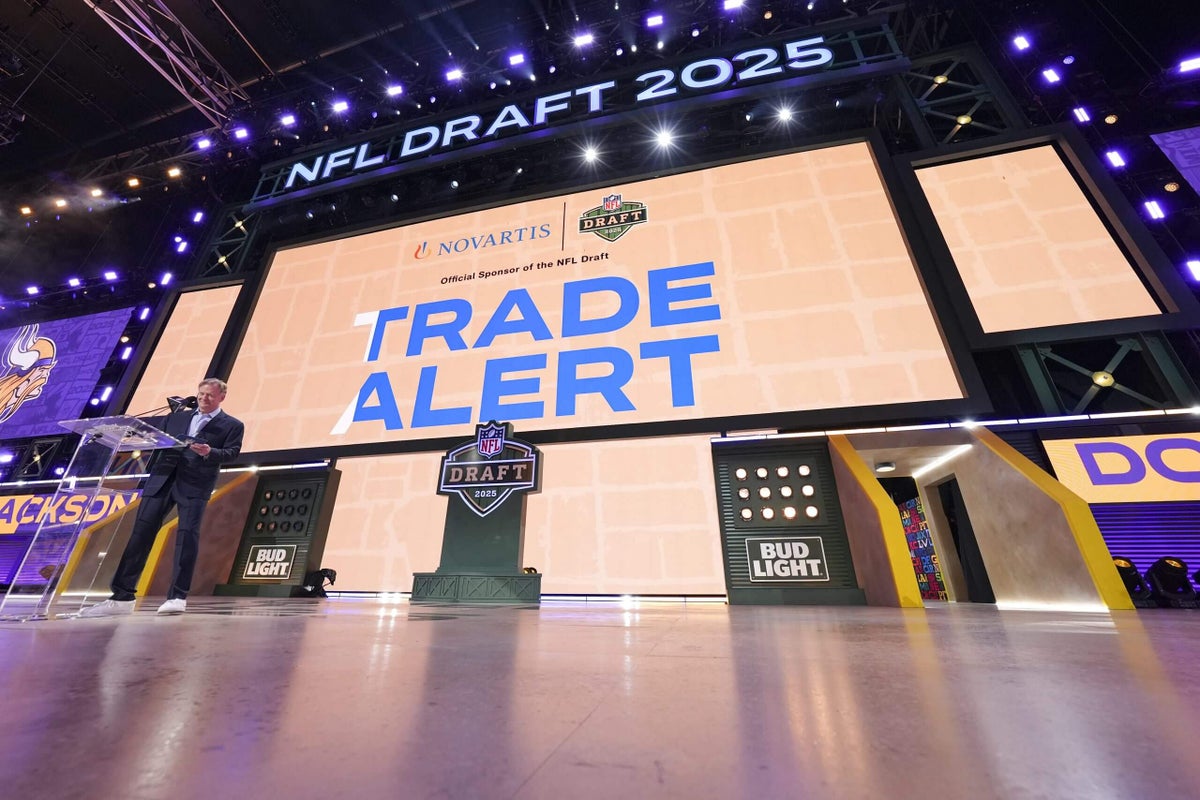
PHOENIX — Even before committees formally met this week at the NFL’s annual meetings to discuss a recent Cleveland Browns’ rule proposal, it had no chance of passing.
The rule, which would have allowed teams to trade draft picks as many as five years into the future, did spark some interesting conversations between teams and among current and former executives, owners and coaches, some of whom were intrigued by the potential of a new team-building strategy.
Still, much of the chatter about the proposal among many team officials as they arrived at the Arizona Biltmore on Sunday and began to mingle was that it would not receive much support.
Los Angeles Rams coach Sean McVay, who is a member of the competition committee, even said the quiet part out loud on Monday morning, remarking, “there’s zero chance it gets through.” A couple of hours later, the Browns made it clear they would withdraw the proposal.
One high-ranking league source told The Athletic that the team is expected to re-submit an amended version of the proposal; another was not so sure it would be Cleveland that would try again but did think some version of the proposal would continue to come up at future meetings.
A high-ranking league source with knowledge of teams’ discussions of the proposal believed it actually had more interest within some front offices than those teams were willing to share publicly. Sometimes proposals are floated within the competition committee as test balloons even though they aren’t expected to be passed — either to understand the details of any support or opposition, or to simply inspire discussion between teams and externally. If multiple teams are interested in an idea, they can compromise on which team will officially sponsor the proposal.
Multiple league sources believed that was the case for the Browns’ proposal.
Bill Polian, the Hall of Fame executive who also spent two decades on the NFL’s competition committee, said in a conversation with The Athletic this week that it was not historically unusual for teams to float test balloon proposals they knew would not be approved.
While more than one team owner or representative was publicly interested in the potential of the Browns’ proposal — Colts owner Carlie Irsay-Gordon said she’s “always a proponent for more flexibility” though she recognized that some long-term effects of such a rule change couldn’t yet be known — none have been as vocal as Los Angeles Rams COO Kevin Demoff.
Leading up to the meetings and during the sessions, Demoff reiterated that he would back the proposal.
“For those of us who look at trading future picks as a meaningful component of team-building, this builds opportunity,” he said. The Rams have been in a picks-for-players team-building model twice in the McVay coaching era, during which they’ve swapped multiple first-round and other picks for players at premier positions such as quarterback or cornerback. The first iteration ultimately resulted in a Super Bowl title, and the second began this offseason.
A different former general manager who spoke to The Athletic recently said he wouldn’t like the rule change if it had been applied during his tenure. He said that teams structurally change too frequently over five years — sometimes entire front offices and coaching staffs are turned over within that span.
Demoff said that less job stability within most current front offices — employment terms that used to be five years or longer on average now can be three or less, depending on the owner — creates risk-averse organizations and short-term thinkers, and that the rule proposal might force executives and owners to take a longer-term approach to their roster construction.
“I would hope that we would shift the discussion (about the proposal) away from, ‘GMs would get desperate to make trades to save their jobs’ into ‘we’ve changed the GM into a short-term position when their whole focus should be on building for the long term.’
“When we only give them two to three years to prove their value, we make them short-term thinkers. If nothing else, I would love this to start a conversation about how we make the GM more of a long-term thinking job than what we’ve done over the past decade in changing out GMs so often. … We have created our own mess of churn in coaches and GMs every two to three years without building up the bench, without teaching people the prerequisite skills needed to succeed at the job, and just hoping that by chance the next people will be better.”
Polian thinks that all of the coaching turnover (there were 10 head coaching openings in this past cycle), plus the increase in cap space in recent years, already has boosted activity at the trade deadline and in free agency as new regimes move for players they are familiar with — and because coaches now have a “shorter time to prove themselves.”
He and other current league personnel who spoke with The Athletic were interested in what the perceived value of draft picks beyond three years would be — especially if the team giving them away believed doing so would make them more competitive (therefore decreasing the value of the picks they were trading).
McVay said in his public comments about the proposal that there were “really not enough tangible reasons to say why we would change a system that’s kind of worked.” Privately, the Rams’ highest-ranking team officials do not typically break opinion from each other about conceptual or strategic ideas.
Irsay-Gordon noted that detractors of the proposal could argue that it would make it easier for teams to stockpile elite talent or, conversely, tank by trading away assets. But, she added, any such teams would have to ultimately pay for those actions.
Demoff said, “it seems everybody thinks that the consequence is that GMs would automatically just trade their future picks. (There are) three to four cases since the new CBA in 2000 where teams even trade the third year.” (Demoff was referring to teams moving a third-year first-rounder; the Browns were one of those examples. They traded three future first-round picks for quarterback Deshaun Watson and then signed him to a five-year, $230 million guaranteed contract which is widely considered one of the worst sequences of decisions in NFL history.)
“Almost no teams trade (even) three years of picks,” Demoff continued. “(But) there’s a risk aversion that exists in the NFL and I think this just probes at that risk aversion that exists by so many teams — and the fact that probably 25 teams would never contemplate trading three years’ worth of picks means they certainly couldn’t contemplate trading five years’ worth of picks.”
Browns GM Andrew Berry, who introduced the short-lived proposal, noted that the idea only offered more flexibility to teams — the choice to use it would be their own.
Polian said he and his former colleagues on the competition committee helped establish the NFL’s current rule that teams can only trade picks three years in advance.
“The reason we’d limited the use of draft choices beyond the minimum there now is because we were afraid that the consequences down the road would lead to non-competitiveness at some point,” he said, “and that’s not in the spirit of the collective bargaining agreement (CBA). The CBA is designed (to) give everyone an opportunity to compete, and that universal competitiveness — that universal hope among the fans — that everybody can win at some point in time. …
“That’s what drives the league’s popularity, is competitive balance. This could affect competitive balance down the road.”
Still, he thought the proposal could come back around but with different terms — maybe four years, a different league source also suggested.
“If I were on the committee this year, I probably would have suggested that we table it for a year, and study it, and take a look at what some unintended consequences might be,” said Polian, “and then allow it to come back next year.”
— James Boyd and Zac Jackson contributed to this report.