
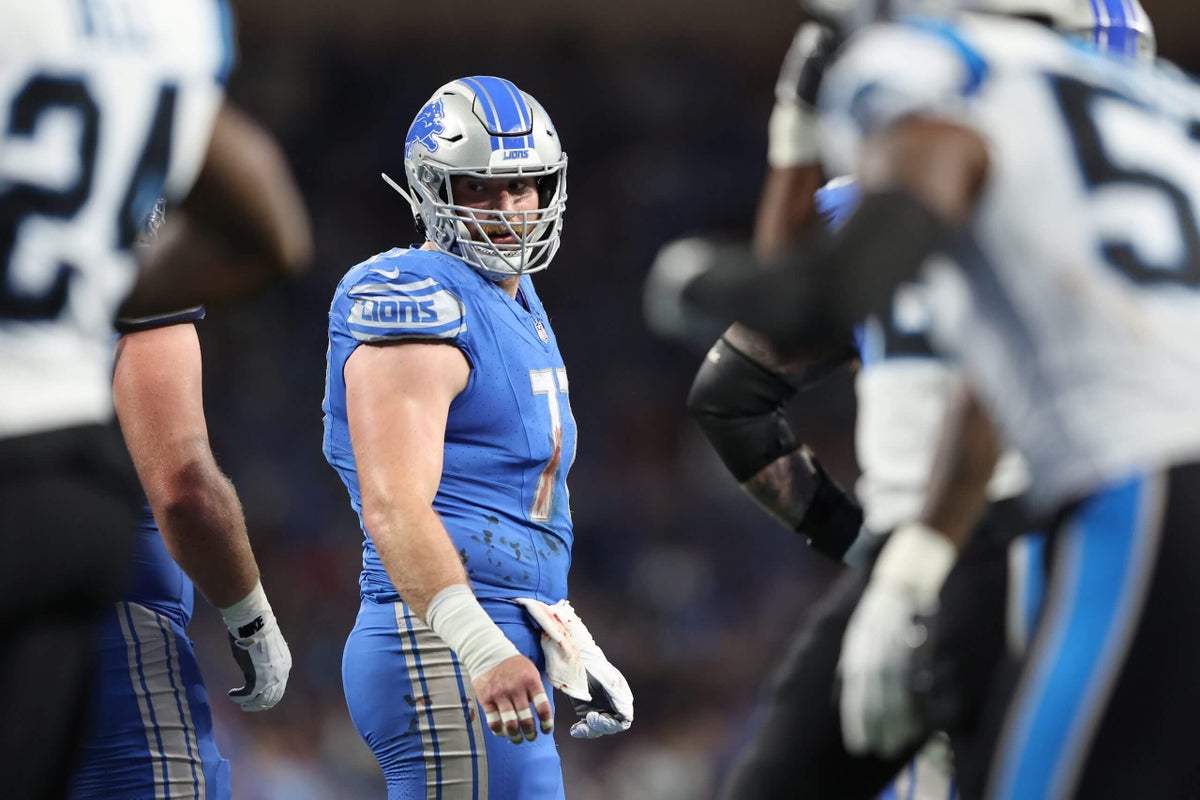
PHOENIX — The Detroit Lions, once again, find themselves at the forefront of a public financial situation regarding one of their former top players.
Lions president Rod Wood, set to retire after 11 years in the role, told the Detroit Free Press this week that the Lions sought a portion of Frank Ragnow’s prorated signing bonus back, after the former All-Pro center retired abruptly last June at the age of 29. Ragnow suffered a number of serious injuries in his career and cited a desire to prioritize his health in his retirement announcement, after years of putting his body on the line for his teammates. An attempted comeback in November when the Lions needed center help was further proof of that, but a failed physical revealed he’d suffered a grade 3 hamstring strain — a complete tear. The Lions signed former Panthers center Cade Mays to a three-year deal in free agency, signaling a new era at the position.
And yet, this headline reads as more of the same from the franchise.
Not long after Hall of Fame running back Barry Sanders retired three years into a six-year contract, he was ordered by an arbitrator to pay back a portion of his signing bonus. The relationship between player and team was strained for years, before a reconciliation occurred years later — only for the Lions to have another falling out with one of their own. The organization asked Hall of Fame wide receiver Calvin Johnson to repay $1.6 million of his signing bonus when he retired in 2016. Johnson was publicly critical of the organization and the relationship deteriorated. However, the Lions and Johnson were eventually able to smooth things over and are now on good terms.
All this to say, the Lions have a habit of asking their stars for their money back.
“Our precedent goes all the way back to Barry Sanders,” Wood told the Free Press. “… And I think the reality is, they’re not paying back their money, they’re returning our money, because they were paid in advance for services that they hadn’t completed.”
Needless to say, it was a topic in NFL circles Tuesday.
What former Lions and NFL players said
As the news made the rounds, a handful of former players offered their take on social media.
Former Lions safety Quandre Diggs: “Love the Lions but with seeing how other franchises have handled these situations, it may be time to change how you’ve done things in the past.”
Former Lions linebacker Alex Anzalone: “(Ragnow) played through a fractured throat, (played) one week post-meniscus clean-up w/stitches barely out, inoperable/unrepairable toe, etc. ‘Hey let me get that prorated signing bonus back.’ Do business as business is being done.”
And finally, former Eagles center Jason Kelce went a bit longer with his thoughts on the matter. As a former center, he understands better than anyone the physical toll the position can have on a player.
“This is interesting,” Kelce wrote on X. “It feels like it’s obvious that Frank retired because he was physically fighting through injuries and pain, and it got to a point that he no longer could play the game in an enjoyable, effective, or healthy way. … What makes this interesting is that Frank likely retired “voluntarily,” meaning, he wasn’t declared medically unfit to play by a doctor, which allows the team to ask for a prorated amount of his signing bonus back. Had he been medically deemed unfit to play football by a doctor before he retired, the team wouldn’t be able to recoup part of the signing bonus.
“Let me say this first, if a player truly just retires without reason, or because they’ve lost the desire to play, I completely get and acknowledge teams should be able to recoup compensation when players don’t fulfill their contractual obligations and agreements. However, Frank was known for being hurt and playing through injuries most players wouldn’t play through constantly. … His body clearly had deteriorated to a degree that made football no longer a viable option, physically, and probably mentally. In my opinion, the signing bonus is supposed to protect players from future physical ailments limiting their availability on the field, that’s one of the reasons you want more guaranteed money upfront. While I get that the team has a right to ask for money back, in the spirit of the agreement, I think it’s bulls––– Frank is being asked to return money.”
What a cap expert had to say
Jason Fitzgerald, founder of Over the Cap, shared his thoughts on the Ragnow situation earlier Tuesday. In 2021, Ragnow signed a four-year, $54 million extension with two years remaining on his rookie contract, essentially turning it into a six-year contract through the 2026 season. He was given a $6 million signing bonus as part of the new deal. Ragnow played out four of the six years, but because he retired in 2025, a portion of the bonus was subject to forfeiture.
Here’s what Fitzgerald wrote:
“To chase after a signing bonus, when there is only one year left that you can chase after the bonus, and after 67 percent of a long-term contract has been honored, is petty on the part of a team. This was not a blindside situation. He had been contemplating retirement and it was very clear that the team knew this since he announced his retirement on June 2, which was the day the Lions could place him on the retired list and split his dead money across two years. He didn’t belittle the team, demand more money, or anything else. In fact, he tried to come out of retirement during the year and it didn’t work out. I don’t think any other team in the NFL would have done this, to be honest, even though it is their right.”
What the Lions are saying
At the NFL annual meetings in Phoenix on Tuesday, Wood sat down with a group of Detroit reporters to discuss a wide range of topics, including the fallout with Ragnow. While Wood declined to further elaborate on his comments, he did emphasize that the Lions will always do what they feel is best for the organization.
“I don’t really have much more to say than (what) I’ve said other than I’ll just say I really don’t spend too much time looking at what other teams do, and I don’t imagine they spend too much time looking at what we do,” Wood said. “We have to do what’s right for our organization, and if I worried about optics, you wouldn’t do a lot of things. But I’m very comfortable with where we are, and every situation has been handled separately and differently.”
While you can understand it from a team perspective, the Lions aren’t likely to win the battle of public opinion here. Wood and the Lions seem comfortable taking the optics hit, as they’ve shown in the past.