
Lately I’ve been taking a refresher tennis class on Sundays. It begins at 4 p.m. But at 4 p.m. PT last Sunday, there were still more than three minutes left in the UConn-Duke Elite Eight game, so there was zero chance I was getting out of my parked car and putting away my phone.
Needless to say, that all-time ending was worth missing warmups. And it elicited some great combo football-basketball questions from my readers.
(Submitted questions have been lightly edited for length and clarity.)
What’s the college football equivalent of Braylon Mullins’ shot? Any contenders? —Phil T.
While Mullins’ long-range buzzer-beater will be the enduring image from that moment, what truly sent the shock factor soaring was Cayden Boozer’s unfortunate and ill-advised pass that gave UConn the ball back. Just hold it and wait to be fouled, and the shot never happens.
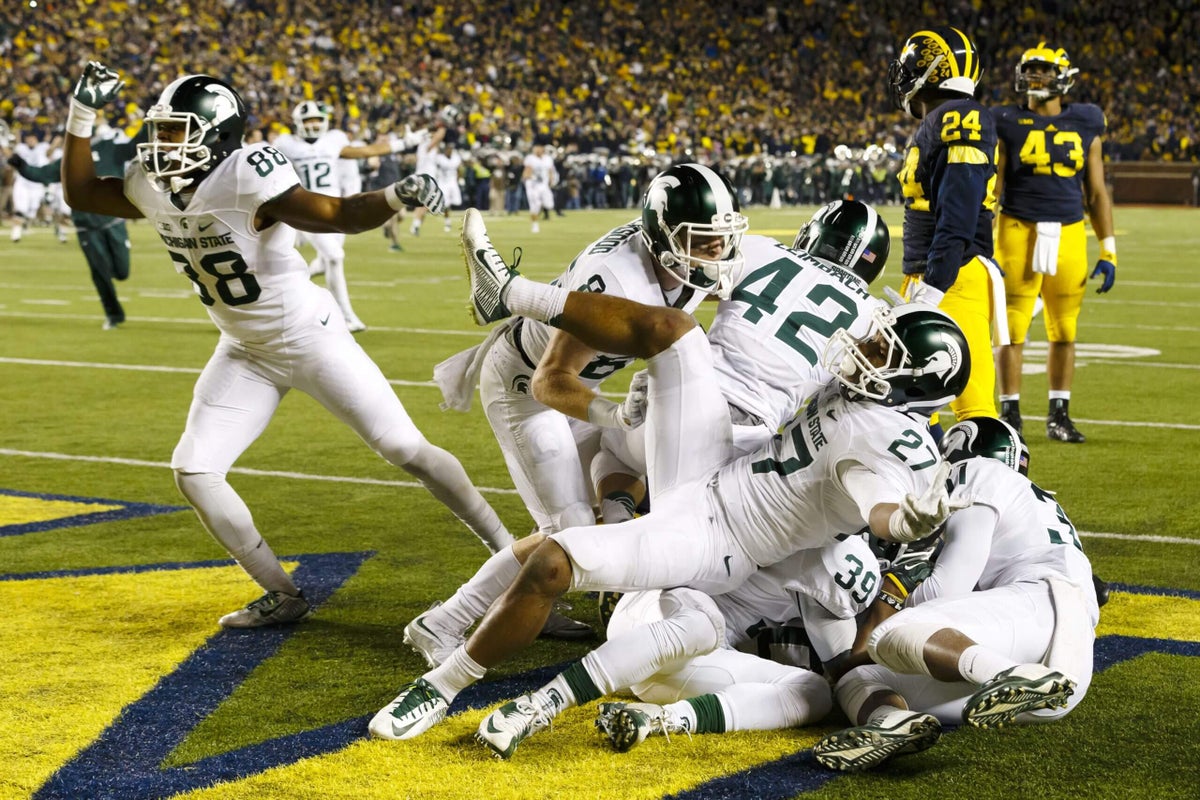
So, while college football has had no shortage of walk-off touchdowns or game-sealing interceptions, you really need something that swung on an incomprehensible screw-up. The play that came to my mind immediately: “Trouble with the snap!” — the 2015 Michigan State-Michigan game.
So I re-watched the clip, and man, they’re almost exactly the same.
Duke led UConn by two points with 10 seconds left? Michigan led Michigan State by two points with 10 seconds left.
All Boozer had to do was hold the ball and get fouled? All Michigan punter Blake O’Neill had to do was field the snap cleanly and get off the punt.
Boozer inexplicably tries to pass into traffic? O’Neill inexplicably bobbles the snap, tries to pick the ball up instead of diving on it and loses it again when he gets walloped.
The basketball gets tipped in the air, right to Mullins? The football gets tipped in the air, right to Michigan State’s Jalen Watts-Jackson.
Two key differences were: A) Mullins passed it to Alex Karaban before getting it back and hitting the game-winning 3, whereas Watts-Jackson kept it and ran for the game-winning 38-yard touchdown; B) The clock hit 0:00 on his way into the end zone, while there was 0.3 seconds left for Duke to attempt a miracle.
Meanwhile, one more similarity: Sean McDonough’s famous cracked-voice call of that 2015 ending was absolute perfection, and so were Ian Eagle and Bill Raftery.
But of course, that was a regular-season game, not a postseason game with a Final Four trip on the line. Which brings me to …
After seeing that unreal UConn-Duke ending, what are your top five postseason college football endings?— Rob W., Columbia S.C.
No. 1: Vince Young’s touchdown scramble on fourth-and-5 (the 2005 BCS championship)
I know there were still 19 seconds left, but all anyone remembers is his run. It was an epic finish to the most hyped game of my career, as the Longhorns denied that star-studded Pete Carroll/Matt Leinart/Reggie Bush USC team an unprecedented third straight title.
No. 2: The Boise State Statue of Liberty (2006 Fiesta Bowl)
This was pre-College Football Playoff, when the other BCS bowls were still a big deal, and Boise State was still a Cinderella going up against Bob Stoops’ Oklahoma. A game-tying hook-and-ladder, a game-winning Statue of Liberty in overtime and Ian Johnson’s marriage proposal all in one finish.
No. 3: Deshaun Watson to Hunter Renfrow (2016 CFP championship)
I could flip a coin between No. 3 and No. 4, but Clemson beating Alabama in a national title game felt so novel at the time. The Tide went up 31-28 with 2:07 to play, only for Watson to lead the Tigers right back downfield and hit Renfrow with 1 second left.
No. 4: Tua Tagovailoa to DeVonta Smith on second-and-26 (2017 CFP championship)
It was the most abrupt ending I’ve ever experienced. Ten seconds earlier, the Bulldogs were on the verge of sealing their first national title since 1980. One freshman-to-freshman overtime bomb later — nope. Nick Saban wins another one.
No. 5: Jameis Winston to Kelvin Benjamin (2013 BCS championship)
This one never gets its proper due. Florida State was 13-0 and had dominated everyone, but a charmed Auburn team went up 31-27 with 1:19 remaining. The polarizing Heisman winner hit Benjamin in the end zone with 13 seconds to spare.
Other candidates include Ohio State’s missed 50-yard field goal against Georgia (2022 Peach Bowl semifinal), Michigan’s goal-line stop in overtime against Alabama (2024 Rose Bowl semifinal) and Jamari Sharpe’s interception to seal Indiana’s title win over Miami last season.
It seems like national sportswriters have been smacked down by the cold reality of the past two seasons and they are no longer forecasting a “ceiling” for Indiana. But with so much roster turnover and this being Curt Cignetti’s first real total reboot at Indiana, what is the program’s “floor” for the coming season? — John M.
Great question. Everything about Indiana right now is a first, with its first post-national championship expectation level as the next frontier.
I wouldn’t call it a total reboot. The Hoosiers lost Heisman Trophy winner Fernando Mendoza as well as a core of key players from Cignetti’s first transfer class (linebacker Aiden Fisher, cornerback De’Angelo Ponds, receiver Elijah Sarratt and others) who will likely hear their names called come draft time. But they still have some key returnees at a couple of very important positions.
First and foremost is the offensive line, which was arguably IU’s biggest strength last season beyond Mendoza. Former Notre Dame center Pat Coogan moves on, but All-American LT Carter Smith and fellow fifth-year seniors Drew Evans and Bray Lynch are back. The interior D-line should be very good as well, with All-American defensive tackle Tyrique Tucker Jr. and fellow DT Mario Landino.
But yes, there are areas where IU is basically starting over, mainly defensive end, running back and receiver/tight end (outside of stud Charlie Becker). … Oh, and quarterback. But Cignetti brought in experienced Power 4 transfers at all of those positions and more, including three-year TCU starting QB Josh Hoover, Michigan State receiver Nick Marsh and Kansas State defensive end Tobi Osunsanmi.
Somehow, despite losing 13 starters who were fourth-, fifth- or sixth-year players, early projected depth charts for this season list as many as 15 fourth- or fifth-year players. Cignetti loves his “old” teams.
Finally, and just as importantly, Cignetti brings back nearly his entire coaching staff, led by offensive coordinator Mike Shanahan and defensive coordinator Bryant Haines. QB coach Chandler Whitmer, now with the Tampa Bay Buccaneers, was the only on-field assistant who departed, and Cignetti replaced him by bringing back his 2024 QB coach, UCLA’s Tino Sunseri.
All of this is a long way of saying: Indiana should still be very, very good. It has a light, breezy walk to starting 6-0 before home games with Ohio State and USC and trips to Michigan and Washington.
I’ll set the floor at 10-2, which will likely come with a third straight trip to the CFP.
I saw a comment rebutting the statements about college football viewership and ratings being at an all-time high, saying that it’s not because of genuine excitement but rather because of bettors worried about their money. What do you have to say about that? — Graham B.
No question, legalized gambling has spiked interest in viewership across lots of sports. It’s just hard to quantify how much. I wish there was a way to ask all 30 million people who watched the Indiana-Miami game whether they had money on it.
But I’d also note that people have been betting on sports for as long as people have been playing sports. It’s just that the gladiators weren’t sponsored by DraftKings.
Speaking of betting …
If you had to place money on a team to make the Playoff next year and couldn’t choose anyone from the SEC, Big Ten, Notre Dame, Texas Tech or Miami, where would you place your bet? — Eblairj, Decatur, Ga.
This feels like an unfair ask. In eliminating 37 teams, you’ve taken more than half of the Power 4 off the table. I suppose I could pull a workaround and try to guess the Group of 6 team — my answer would be Boise State — but that seems unwise given those schools only get one shot.
I’ve got to go with BYU. The Cougars are coming off back-to-back 11-win seasons and narrowly missed last season’s Playoff. QB Bear Bachmeier played admirably as a true freshman starter and seems likely to make a second-year jump. Senior RB LJ Martin is coming off a breakout season of 1,560 total yards. The O-line is experienced, and Kalani Sitake’s defense is always stout.
The obvious question mark: Pass-catchers. Top receiver Parker Kingston’s dismissal in February leaves BYU without last year’s top three receiving targets in Kingston, Chase Roberts and tight end Carsen Ryan. But Sitake brought in some notable transfers, led by talented USC tight end Walker Lyons and Oregon receiver Kyler Kasper, a former four-star recruit who struggled to crack the Ducks’ rotation.
The main argument against BYU: The Cougars will need to win the Big 12, and we saw them get exposed, twice, by last year’s conference champion, Texas Tech. But I’m not sure this year’s Texas Tech team will be on that Texas Tech team’s level. There are certainly other contenders — I’m high on Houston for one, and Arizona had a nice rebound last fall — but other candidates, such as Utah, Kansas State and Iowa State, are all going through significant transitions.
Another option, of course, would be in the ACC. It’s hard to pick anyone other than Miami, but I said the same thing about Clemson this time last year. I’d like to know the odds I’m getting before selecting another team, but you might be able to talk me into SMU.
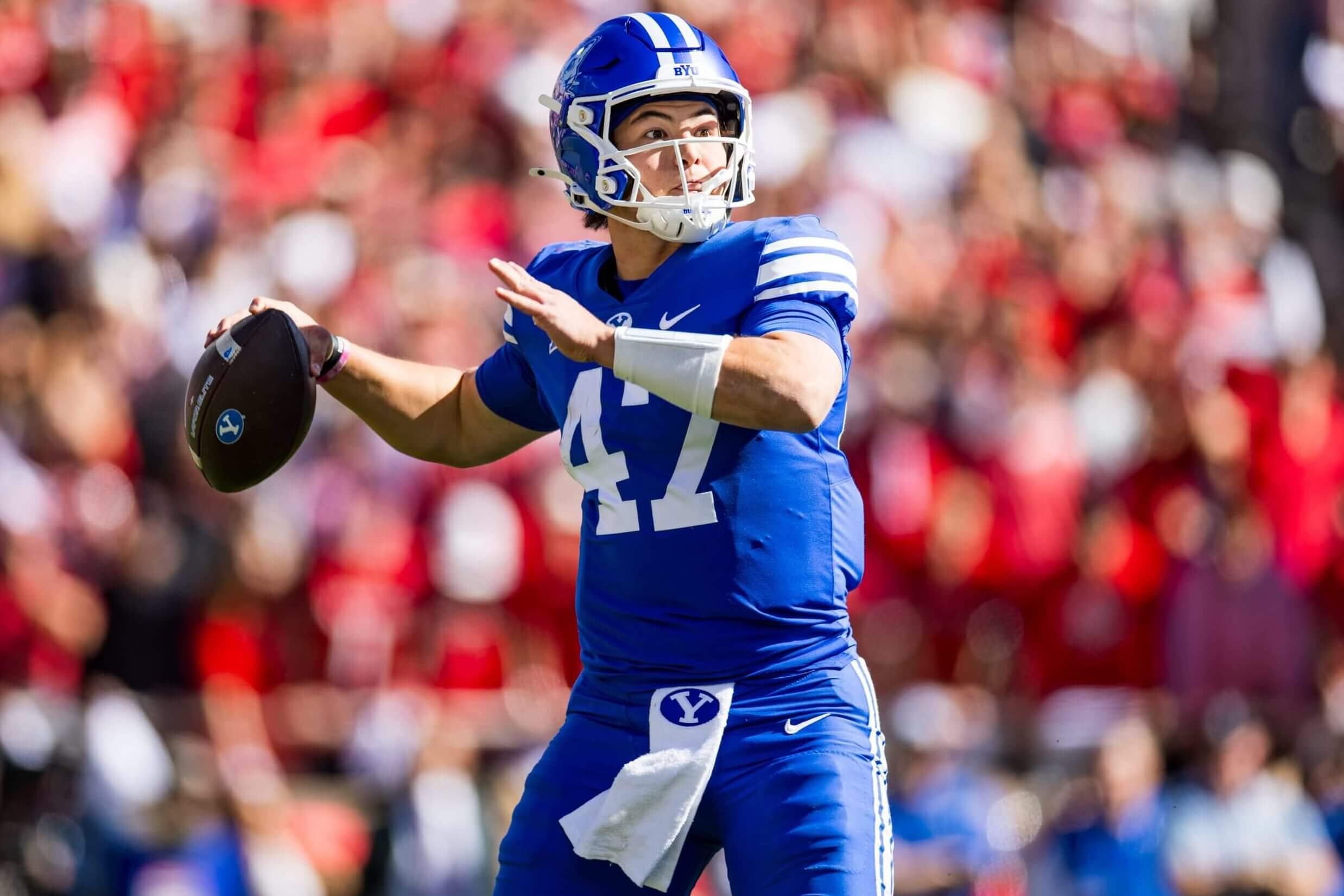
BYU could make another deep run in the Big 12, and possibly win the conference, while some programs around the Cougars rebuild. (John E. Moore III / Getty)
With both UConn hoops teams in the Final Four (again) and with the football program’s recent resurgence (two straight nine-win seasons), will they ever get a Power 4 invite? Seems crazy that a school that supports its sports at a high level (both hockey teams made the NCAA tournament as well) has been on the outside looking in for a decade and a half now. — John L.
What Jim Mora (now at Colorado State) pulled off there the last couple of years was remarkable. Bob Diaco and Randy Edsall (the second time) drove the program into a ditch, at which point the school sent the football team to purgatory as the price to get the hoops teams back into the Big East. Hard to argue with that decision now, given Dan Hurley quickly turned UConn back into a behemoth, Geno Auriemma may have his most dominant team yet this season and football is no longer on life support.
Because of that, I’m not sure it’s a no-brainer decision for UConn to accept a Power 4 invite if it means ditching the Big East a second time.
This first came up a couple of years ago, when Big 12 commissioner Brett Yormark had expansion conversations with UConn leadership. Having just added the four Pac-12 schools, he began eying UConn as a basketball power play. It never got off the ground, as the league’s football-minded schools wanted nothing to do with it.
Around that time, I asked UConn fans whether they’d even want to join that league if it meant leaving the Big East, and was surprised at the results. While they were split, more favored it than not, seeing it as a matter of survival in a world where Power 4 football revenue dwarfs everyone else’s anything. Football relevance would be nice, too.
The better alternative, if ever offered, is the ACC. The money is roughly the same, it would keep the school in a mostly East Coast conference and Hurley’s program would reunite with former Big East foes such as Syracuse, Boston College and Pitt. That Jim Phillips’ conference hasn’t even considered it, despite its current clunky 17-team football lineup, tells you those schools, like the Big 12’s, don’t have much confidence that UConn can field a consistent Power 4 football program.
Personally, if I were UConn, I’d stay where I am. Why mess with a good thing? But a Power 4 invite, especially from the ACC, would likely prove irresistible.
Amid the LSU spending spree and Texas Tech buying players with a billionaire, is there any pride left in college football about being frugal in the new era? Any examples of overspending hurting a program long-term? Feels like the big-time programs can print money, sometimes committing it before it’s even funded, and I don’t see repercussions from overspending. — DJ K., Omaha
Well, here’s the thing: You can probably count on one hand the number of programs that are “printing money,” i.e. can seemingly spend whatever they want: Texas, Texas Tech, Miami, LSU and Oregon. Maybe a couple of others who are spending more than I realize. These are the teams we assume have $30 million to $40 million rosters (at least).
The pool of teams spending $25 million-plus, albeit with a limit, is deeper, though hard to pin a firm number on, given the total lack of transparency around roster spending. But for the sake of this exercise, let’s say it’s an additional nine in the SEC, seven in the Big Ten, three in the ACC, two in the Big 12 and Notre Dame.
That’s around 40 percent of Power 4 programs. The other 60 percent are doing exactly what you described and trying to play Moneyball with the resources they have. Most, but not all, are spending the full $20.5 million revenue share cap, with around $14 million allocated for football, but they don’t have a billionaire plying them with over-the-cap money.
If you’re not seeing repercussions from overspending yet, you will soon. The consequence will be coaches getting fired. Florida State’s Mike Norvell would already be gone if not for his huge buyout; his program lit a lot of money on fire in building two straight losing rosters. Texas boosters are going to be expecting a lot better than 9-3 from Steve Sarkisian this season. And Lincoln Riley’s top-ranked recruiting class at USC did not come cheap. Whoever paid for it isn’t going to accept 9-4.
Stewart: I’ve been a reader for almost 20 years. I’ve asked a similar question before. I got your book “Bowls, Polls, and Tattered Souls” and enjoyed every page of it and it is still on my bookshelf. How relevant is the book given all we’ve seen in college football since its release in 2007? — Hoosier Steve from outside Atlanta
First of all, I’m touched and blown away that anyone even remembers this book, much less keeps it on their shelf. I feel like it comes up more than it should, given it was not exactly a “New York Times” bestseller.
This question is particularly timely, too, because I only now found out that the publisher recently released an audiobook version. Why they did this 19 years after the fact, I couldn’t tell you, but they hired a real narrator who must have been utterly perplexed why he was being asked to read a book that mentions Ryan Perrilloux, Vidal Hazelton and the Diamond Walnut San Francisco Bowl.
But while many of the names will seem dated, many of the underlying themes do hold up surprisingly well. Starting with one particular sentence on page 3: “I think it’s important to understand one underlying truth about college football … and that is: Nobody’s in charge.” Just as true today as it was then.
While we’ve long since adopted a Playoff, the chapter “One Nation Under the BCS” still serves as a useful history lesson on why college football can never seem to figure out the postseason.
If you can’t get enough realignment history, “How Boston College and Clemson Became Neighbors” might interest you, even if those two schools now seem within reasonable distance of each other. And while the specific “scandals” mentioned in “Everybody Cheats — Just Not My School” may seem quaint in the NIL era, the underlying themes about tribalism and warped perspective hold up well. See: Michigan/Connor Stalions.
But the chapter that remains just as relevant today as it was then: “What’s the Deal With Notre Dame?” It begins with a couple of emails from readers beside themselves over a clause in the BCS contract allowing the Irish special access to those bowls. That was in 2007. In 2026, I’m getting those same comments over ND’s new top-12 CFP clause.
So thank you, Steve, for allowing me the opportunity to do a shameless plug. For anyone out there who’s never read it, I hope this convinces you to give it a try. And for anyone out there who refuses to read it, good news: You can listen instead.