
Editor’s Note: In the lead-up to the 2026 NFL Draft, Phil Perry is identifying the best fits for the Patriots at each position based on the traits that Mike Vrabel and Eliot Wolf value, as well as intel from coaches and scouts.
First up were offensive tackles and tight ends. Today’s installment: edge defenders.
Patriots head coach Mike Vrabel knows what he wants in his edge defenders.
“I think that there’s got to be a violence,” he said at this year’s NFL Scouting Combine. “There’s got to be an ability to move off the football and to create some sort of disruption. You have to be able to factor in on the quarterback. You have to be able to make plays on the football. We know the quarterback is responsible for the most turnovers in football so can they affect the quarterback?
“And then the ability to set the edge, rush and have enough coverage acumen that the few times we ask them to do it, they can do it.”
How Vrabel structured that answer felt telling.
He’s looking for those who will make an impact on the passing game, get after quarterbacks and create turnovers. The other stuff matters, Vrabel acknowledged. Stopping the run matters. Being able to drop into coverage matters. But it seemed as though he listed the traits he was looking for in order of importance.
That one answer about one of the game’s most valuable positions is fascinating for a few different reasons. First, the Patriots just ran into a buzzsaw defense in Super Bowl 60. The Seahawks had a rotation of tail-kicking edge defenders who seemed to be more of the rugged all-three-downs type than the designated-pass-rush type. Their rushers had enough juice to get after the quarterback, but none had more than 7.0 sacks last season.
Additionally, in today’s NFL, one could make the argument that those types of bullies on the edge make sense. Defenses are structured in such a way that it has become more challenging to throw the ball down the field.
More bodies are deployed deep. Fewer are in the underneath areas, almost daring offenses to run. Therefore, if you have some real grind-it-out edges to make it harder to hand the ball off in those situations? There’s value there.
Of course, just because Vrabel highlighted the value in edges hitting quarterbacks and jarring footballs loose doesn’t mean he’s uninterested in players who will excel on first and second down. The Patriots just signed a bigger-bodied edge in Dre’Mont Jones who has the ability to play across situations and in multiple alignments on the line of scrimmage. His career-high in sacks is 7.0. No one is confusing him for a designated pass-rusher.
What, then, will Vrabel want at that position if he dips into it in the 2026 NFL Draft?
The players who saw the most time at that all-important spot during Vrabel’s time in Tennessee included his 2018 second-round pick and 2025 Patriots captain Harold Landry (6-foot-2, 252 pounds) as well as Rashad Weaver (6-foot-4, 259 pounds), Bud Dupree (6-foot-4, 269 pounds) and Denico Autry (6-5, 273).
Last year it was K’Lavon Chaisson (6-foot-3, 255 pounds), Anfernee Jennings (6-foot-2, 255 pounds) and Elijah Ponder (6-foot-2, 258 pounds) who saw the majority of the work on the edges.
All had different body types. But they shared some qualities.
Those were high-energy players with enough size to hold up in a variety of situations and athletic traits to give opposing offensive tackles fits. They also possessed playing styles that might be deemed “violent.” No surprise there given what Vrabel values.
With that in mind, let’s have a look at some edges in this class the Patriots may be interested in. They’ve met with both the lighter pass-rush-only types in this draft class as well as some bigger bruisers, which may serve as an indication that they’re interested in adding more than one edge defender — perhaps one of each type? — during this year’s draft.
Day 1: T.J. Parker, Clemson
Jeff Blake-Imagn ImagesJeff Blake-Imagn Images
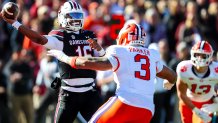
T.J. Parker is a high-effort rusher who racked up 16 sacks over the past two seasons.
At 6-foot-4, 263 pounds, Parker may be the best combination of edge-setting physicality and pass-rush polish among the players who could fall to the bottom of the first round. He’s a high-effort rusher with plenty of power and enough length (33-inch arms) to be a physical mismatch for opponents.
He’s not the quickest off the ball, but he’s strong enough to bull-rush his way into backfields and has a handful of moves that could help him win reps with savvy as a pro. In the run game, he has the violent demeanor Vrabel is looking for, and his motor doesn’t stop.
The Patriots reportedly met with Parker at the combine, and if he falls to No. 31 — he had a down season (9.5 tackles for loss, five sacks) after a monster 2024 (20 tackles for loss, 11 sacks, six forced fumbles) — he’d make sense as a do-it-all type who’d immediately factor into a rotation with Landry and Jones.
Day 1: Zion Young, Missouri
Highlights of Missouri defensive end/edge rusher Zion Young
A three-year starter between his time at Michigan State and Missouri, Young has a similar profile to Parker. He’s a force against the run, and he will not back down from a fight. At 6-foot-5, 262 pounds, he has an NFL-ready frame that’s built for dirty work at the line of scrimmage.
Young is the definition of heavy-handed, and he’ll need his strength to be his strength at the next level. He’s not incredibly twitchy, and NFL tackles won’t fear his speed. But if Vrabel is looking for a tone-setting edge-rusher who will go blow for blow with offensive tackles across all three downs, the Tigers captain would make sense at the back end of the first round.
The Patriots will have to determine how they feel about Young’s DWI arrest in December.
Day 2: Gabe Jacas, Illinois
Highlights of Illinois edge Gabe Jacas
We gave the Patriots Jacas early in the second round (after a trade back with the Cardinals) in our most recent mock draft. Why? He has some of the same qualities as the first two names mentioned on this list.
The 6-foot-3, 260-pounder is a mauling edge defender who will play to the echo of the whistle. A captain for the Illini, he’s thought to be an excellent teammate and is expected to be a positive influence on the culture wherever he lands.
Like Young, he’s not a springly or bendy edge rusher. But he’ll run through your face if you give him the opportunity. He has enough pop against the run and a violent style of play that he may have to control more effectively as a pro.
The question with him will be does he have enough juice to be a true threat as a pass-rusher. If the Patriots think so, he could be a steal on Day 2.
Day 2: R Mason Thomas, Oklahoma
Kevin Jairaj-Imagn ImagesKevin Jairaj-Imagn Images
R Mason Thomas pairs speed and flexibility with a relentless motor.
One of the most intriguing designated-pass-rusher types in this class, Thomas wins with his explosiveness off the line. He measured in at this year’s combine at 6-foot-2, 241 pounds and his college tape would suggest his frame will have a hard time consistently holding up against bigger offensive tackles on first and second down.
He also missed multiple games in three of four collegiate seasons due to injury. But he’s the definition of twitchy early in the down, with the speed and flexibility to turn corners on pass-protectors in a blink. He’s also powerful enough as a rusher to be able to topple tackles in embarrassing fashion with a speed-to-power move. His motor never stops and he’ll chase quarterbacks and ball-carriers down from behind.
Plenty to like there if you’re in the Patriots front office. The question will be whether or not you’d be willing to spend a top-50 pick (or thereabouts) on a player who may have a niche role.
Day 2: Romello Height, Texas Tech
Nathan Giese/Avalanche-Journal / USA TODAY NETWORK via Imagn ImagesNathan Giese/Avalanche-Journal / USA TODAY NETWORK via Imagn Images
Romello Height spent six years in college at four schools: Auburn, USC, Georgia Tech and Texas Tech.
Height profiles similarly to Thomas in terms of his role at the next level. In Indy, he measured in at just a shade under 6-foot-3 and 239 pounds. His broad jump (10-foot-5) and vertical (39 inches) were, however, impressive — and not surprising given the burst and bend with which he played at Texas Tech opposite soon-to-be first-round pass-rusher David Bailey.
Height helped himself at the Senior Bowl (where he weighed just 234 pounds) by flashing a speed-to-power move that indicated he could be more of a physical presence than what he demonstrated at times on his tape. A six-year collegian and four-school player — he also had stops at Auburn, USC and Georgia Tech — Height is older and his ceiling may be limited. Still, he might be a third-round pick.
If he’s going to be New England’s third, they may have to be comfortable with him being a designated pass-rusher since his frame will limit him against the run.
Day 2: Jaishawn Barham, Michigan
Tommy Gilligan-Imagn ImagesTommy Gilligan-Imagn Images
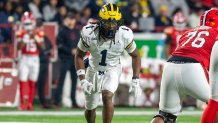
Jaishawn Barham racked up 10 TFLs and four sacks in 2025 after seeing more snaps on the edge.
Barham could go on Day 2 in a class where the talent level is relatively homogenous once you see the top-tier talents fly off the board early in the first round. Wherever he goes, he’ll end up providing his next team a violent presence on the edge — and with upside. Sound like something the Patriots could be interested in?
At almost 6-foot-4 and 240 pounds, his role changed this past season from full-time off-ball linebacker to seeing more end-of-the-line edge-setting reps. The new gig suited him. He finished with 10 tackles for loss, four sacks and three pass breakups. That kind of production in the Big 10, without much training at the position, would suggest there’s untapped potential with Barham (34-inch arms, 10-inch hands) if he’s paired with the right NFL staff.
He has a nasty demeanor against the run and he has the natural bend and quickness that some longtime pass-rushers in this class wish they had. His 4.64-second 40 at the combine (81st percentile) was strong, as was his 10-foot-3 broad jump (83rd).
Day 3: George Gumbs Jr., Florida
Matt Pendleton-Imagn ImagesMatt Pendleton-Imagn Images
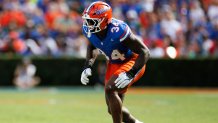
George Gumbs Jr. started his collegiate career as a receiver and tight end before shifting to defense.
The 6-foot-4, 245-pounder has physical characteristics that teams will find enticing. He jumped a whopping 41 inches in the vertical at this year’s combine and clocked an eye-opening 7.00-second three-cone time.
A walk-on at Northern Illinois, Gumbs started his collegiate career as a receiver. After shifting to tight end for a season, he ended up on the defensive side of things and racked up 6.5 tackles for loss and two forced fumbles. From there he transferred to Florida, where he had 14.5 tackles for loss in 22 games.
In some ways similar to Barham, if he’s given time to develop in the right system, he has a path toward being a productive player because of his rare traits. But any team that takes him is making a bet that they can turn him into a more fully-formed version of the player he was for the Gators.