
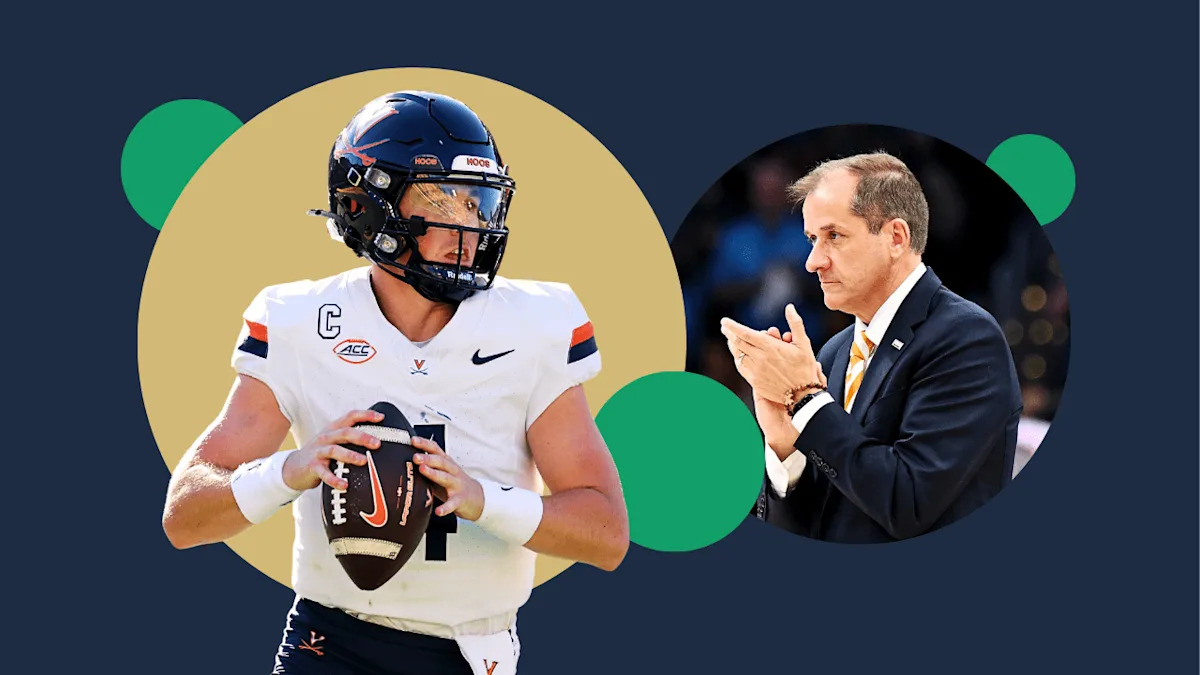
A judge in Charlottesville (Va.) Circuit Court on Thursday denied University of Virginia quarterback and graduate student Chandler Morris a restraining order to play a seventh season.
Judge Claude Worrell issued the denial during a hearing that aired arguments from attorneys on behalf of Morris, 25, and the NCAA.
Advertisement
More from Sportico.com
The denial comes in the aftermath of judges in Mississippi recently granting an injunction to allow Ole Miss quarterback Trinidad Chambliss to play a sixth year in a similar case. Both cases involve the NCAA denying waivers for quarterbacks who claim they were unable to play a season several years ago due to health reasons, but whose schools lack what the NCAA deems contemporaneous medical documentation to corroborate the claim.
The presence of inconsistent rulings could give Congress greater reason to pass legislation that provides the NCAA with legal protection to set eligibility rules. As a national association, the NCAA needs to be able to apply rules to member schools and conferences equally in every state. In a legal landscape where member institutions in some states are treated favorably on account of court rulings, NCAA rules won’t apply equally, and some members will gain competitive advantages in building rosters.
ACC commissioner Jim Phillips recently submitted an affidavit in Morris v. NCAA in which he maintained that “consistent application” of eligibility rules promotes fair play and “fair competition,” with schools and athletes in similar situations treated similarly.
Advertisement
Like Chambliss, Morris has already exhausted his NCAA eligibility, which is generally limited to four seasons of play in a sport within a five-year period. The limit is predicated on the idea that athletes should finish their collegiate careers around the same time as their classmates and shouldn’t hold roster spots that would otherwise go to incoming freshmen or transfer students. One concern with athletes sticking around indefinitely into their mid-20s or beyond is that college sports could start to look more like pro sports, except not as good as the NFL or NBA, resembling minor leagues, which are traditionally difficult to market.
Morris has played six seasons after he and other athletes were granted a COVID-19 waiver for the 2020 season, and because he redshirted the 2021 season, during which he played four games. Morris has played at four colleges: Oklahoma, TCU, North Texas and Virginia.
Morris and Chambliss argue they are third-party beneficiaries of the contractual relationship between their universities and the NCAA, and that they are harmed by the NCAA allegedly breaching an implied covenant of good faith and fair dealing in its relationship with Virginia and Ole Miss, respectively. Chambliss has succeeded in arguing that as a third-party beneficiary, he enjoys an enforceable legal interest in Ole Miss’s membership contract with the NCAA being performed, while Morris has thus far failed to persuasively make that assertion with respect to UVA.
Both players claim the NCAA wrongly denied waiver requests filed by their schools. The requests concern a previous season when the player says he lacked an opportunity to play due to circumstances beyond his control. For Morris, his mental health struggles during the 2022 season formed the basis of Virginia’s request. The NCAA denied it because of the absence of contemporaneous medical documentation. UVA’s application included session notes from Morris’ mental performance consultant in 2022, but the consultant wasn’t a licensed psychologist and doesn’t count as a medical professional.
Advertisement
While the Morris and Chambliss litigations are different from other eligibility lawsuits on account of the role of a health-related waiver request, the NCAA says there have been 71 eligibility lawsuits filed across the country since 2024.
Vanderbilt quarterback Diego Pavia started a domino effect that year, when he sued for more years as an intercollegiate player. By remaining in college, these athletes can potentially earn millions of dollars in NIL and revenue-share deals and further hone their skills in hopes of boosting their professional prospects.
Of the 71 lawsuits, courts have denied preliminary injunctions in 33 of them while granting 11. As a practical matter, this means athletes and their schools in different jurisdictions are being treated differently, with some conceivably gaining competitive advantages.
In the Morris litigation, the NCAA has been represented by Rakesh Kilaru, Taylor J. Askew and other attorneys from Wilkinson Stekloff and Holland & Knight.
Advertisement
In a statement, an NCAA spokesperson said the association is “pleased” by Thursday’s win in court. The spokesperson added the ruling “protects the integrity of collegiate competition.”
The spokesperson also alluded to the reality that more eligibility lawsuits are inevitable, and maintained that as “additional lawsuits challenging common-sense, academically-tied eligibility rules are filed,” the association “will continue to defend against attempts to rob high school students across the nation of the opportunity to compete in college and experience the life-changing opportunities only college sports can create.”
Along those lines, the NCAA says it will continue to push for Congress to “provide stability for all college athletes.”
The Cavaliers prepared for the possibility of Morris being denied 2026 eligibility by signing two transfer quarterbacks, Beau Pribula and Eli Holstein. Still, the loss of Morris stings, as last season he led Virginia to an 11-3 overall record (7-1 in the ACC) and was named MVP of the Gator Bowl.
Advertisement
Best of Sportico.com
Sign up for Sportico’s Newsletter. For the latest news, follow us on Facebook, Twitter, and Instagram.