
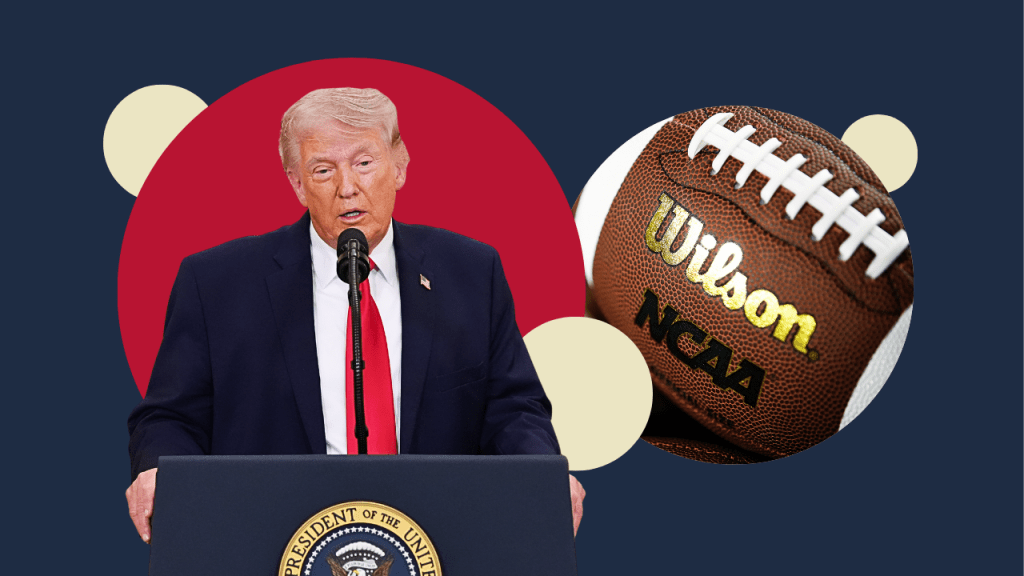
President Donald Trump signed an executive order on Friday intended to provide greater legal protection to the NCAA in setting rules governing college athlete compensation. But as with any executive order, “Protecting the Future of College Sports Before It’s Too Late” is vulnerable to legal challenges that the president lacks the authority to institute such regulations without Congressional action.
According to a source, U.S. Attorney for the Southern District of New York Jay Clayton played an instrumental role in drafting the order.
A former chairman of the Securities and Exchange Commission, Clayton is an attorney with considerable experience—including in the sports industry. He has overseen SDNY prosecutions of financial advisors who defrauded Jrue Holiday and other NBA players and of individuals who have hacked sports betting and fantasy sports websites. Clayton is also a former NCAA athlete, having played soccer at Lafayette College.
Through Friday’s order, the president has directed federal agencies to “bolster the effectiveness” of rules related to transferring, eligibility and pay-for-play.
Trump wants to know whether these rules “render a university unfit for federal grants and contracts.” This description suggests that he wants federal funding for schools connected to whether they are complying with NCAA rules. In theory, at least, that edict could deter schools from violating NCAA rules by funneling money to recruits in ways that circumvent NCAA membership obligations.
In that same spirit, the order signals that colleges which cloak pay-for-play payments as NIL deals could get into trouble. NIL deals are supposed to reflect the use of players’ name, image or likeness—in other words, NIL deals are supposed to resemble endorsement deals—but often they are used more as a signing bonus in an employment context.
The order says that “improper financial activities” is defined as a school “intentionally devising or participating” in a “fraudulent” NIL scheme. Such a scheme also includes using federal funds or House settlement-endorsed revenue-sharing payments to benefit a coach or recruiter.
In addition, the order enunciates a series of rule recommendations that appear to match NCAA rules and support the collegiate governing body in antitrust litigation against those rules. Notably, one recommendation is that participating in college athletics “is permitted for no more than a five-year period.” That position is consistent with the NCAA’s legal defense in the more than 70 cases brought by relatively older athletes who wish to remain college eligible—and earn NIL and revenue-share money—after having played four seasons within five years. That line of litigation began when Vanderbilt quarterback Diego Pavia sued to extend his eligibility.
Trump also wants the rules to state explicitly that “professional athletes cannot return to college athletics.” Such a decree is a response to litigation such as former pro basketball player Charles Bediako’s case to return to play college hoops at the University of Alabama. The decree would forbid former G League players, European hockey players and potentially Canadian Hockey League players from joining college teams.
The order also supports the implementation of revenue sharing to protect women’s and Olympic sports. Revenue sharing in the absence of collective bargaining could trigger antitrust litigation, since it might lead to diminished compensation for football and basketball players.
Trump also takes issue with unlimited transfers, a policy that reflects a litigation settlement of the antitrust case Ohio v. NCAA. The president wants rules set up so that players can transfer once within a five-year period and one additional time if the athlete obtains a four-year degree.
Given its policy position, the order supports a deferential standard of review to the NCAA and its member schools in antitrust and other potential cases, such as those involving NIL, revenue sharing, broadcasting, transfers, eligibility and waivers.
Since the U.S. Supreme Court’s 2021 ruling in NCAA v. Alston, which clarified that the NCAA is not owed deference under antitrust law and is subject to ordinary antitrust scrutiny, the collegiate governing body has been besieged with lawsuits claiming its rules violate antitrust law. Those rules have included restrictions on transfers, NIL collectives and eligibility.
Cases against the NCAA typically invoke two antitrust theories, which Trump’s order is intended to repel.
The first is that as the overseer of conferences and colleges that “buy” the labor and marketing services of college athletes, the NCAA has no rival and acts as a monopsony.
The second is that as businesses that are supposed to compete, colleges and conferences conspire through NCAA rules to limit how each can economically compete for athletes. These restraints arguably deny the fruits of economic competition, since if colleges could pay athletes market rates—which reflect how schools otherwise compete for faculty, staff and other service providers—some of those athletes would earn more.
Trump has used executive orders at a high rate similar to former President Franklin Delano Roosevelt during the Great Depression and World War II. Like other presidents, Trump is empowered by Article II of the U.S. Constitution, which says the president should “take care that the laws be faithfully executed” and has been construed as an executive order authority.
However, some of Trump’s orders have faced setbacks in court. The main problem with executive orders is that while the president can ensure laws are “faithfully executed,” the president can’t unilaterally rewrite a statute.
Article I of the U.S. Constitution vests lawmaking power in Congress, so when an executive order travels into what might be regarded as “lawmaking,” courts can block the order. The president is not a dictator or king; presidential authority is restrained by the checks and balances of American government.
This was recently illustrated when the U.S. Supreme Court invalidated an order attempting to impose tariffs through the International Emergency Economic Powers Act. The court reasoned the text of the statute didn’t authorize Trump’s actions, and thus the president lacked the legal authority.
Potential legal challenges to Friday’s executive order abound. One is that it doesn’t comply with federal antitrust law or the U.S. Supreme Court interpretations of it. Alston makes clear that the NCAA is not owed deferential review.
There are also potential constitutional concerns, such as whether restricting NIL opportunities—and the ability for athletes to express themselves—runs afoul of First Amendment free speech protections and state right of publicity statutes, or whether allowing colleges to treat athletes differently from other students violates the Equal Protection Clause.
Trump’s order does not directly address college athlete employment, though it advocates for guardrails on athlete compensation that would not be borne through employment contracts or collective bargaining agreements. To the extent the order is used to deny college athletes’ potential employment, that too would invite legal challenge. As of now, college athletes are not recognized as employees and thus can’t unionize. However, that could change. The college athletes behind Johnson v. NCAA, which argues that college athletes are student employees within the meaning of the Fair Labor Standards Act and accompanying state labor laws, have enjoyed success to date.
There was also the Dartmouth College men’s basketball matter. While the players withdrew their unionization petition after the 2024 presidential election, recall that NLRB regional director Laura Sacks stated the players were employees within the meaning of the National Labor Relations Act. She reasoned that even though Ivy League athletes do not receive athletic scholarships, what’s important in terms of employment law analysis is that the players performed work in exchange for compensation (including priority admissions into an elite university, per diem and gear), and Dartmouth, through coaching and athletics officials, had the right to control that work.
Trump’s order can’t change the language of the FLSA or NLRA.
The order also could encounter problems with state employment laws. While the NLRB governs employment and potential unionization at private colleges, states control those areas at public universities. There are progressive, labor-friendly states that might eventually recognize college athletes at their public universities as employees who form unions.
The possibility of legal challenges to Trump’s order is important from a timing perspective. The order could be tied up in litigation for months, and potentially well past November’s midterm elections when the Democrats are expected to win a majority of the House of Representatives. Although Congress hasn’t shown much appetite for passing college sports legislation regardless of whether it is controlled by the Republicans or Democrats, it could pursue legislation next year that tries to counter Trump’s order.
The efficacy of the college sports order is also uncertain, given that some of his orders have proved more aspirational than instrumental. Last year he signed the “Saving College Sports” order, which directed several federal agencies to pursue policies intended to ensure the “long term availability” of college sports opportunities. There is little evidence the order has made a meaningful impact.
The reality is that the economics of college sports involve a vast array of federal and state laws. This complexity makes it difficult for any entity—including the president—to issue a sustainable edict that sets new rules, since the entity doesn’t control all of the applicable law.