
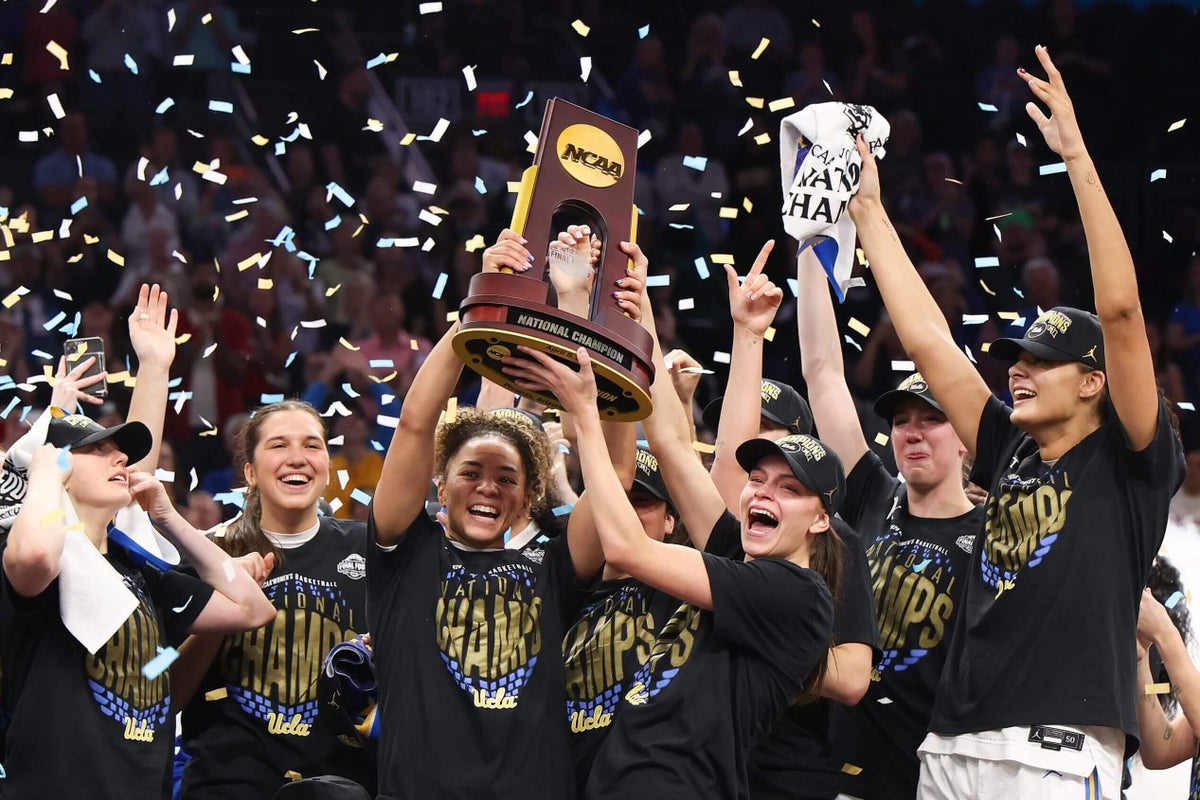
PHOENIX — When Michaela Onyenwere returned to UCLA as an assistant coach in the 2025 offseason, the two-time All-American noticed a shift.
There was a different energy about the Bruins than when Onyenwere was part of the program from 2017 to 2021, a period that included one trip to the Elite Eight and another to the Sweet 16. The UCLA players were more professional. They were coming into the gym before scheduled workouts and practices. They were more locked in to their mental preparation and film work.
The Bruins have a leadership council that acts as a go-between for the players and coaches every season. So many people wanted to participate before the 2025-26 season that the coaching staff had to turn them away.
“The way this team has embraced the hard and the work ethic and showing up early, staying late, it’s definitely shifted the culture in a great way,” Onyenwere said.
The UCLA assistant coach was easily able to identify the source of that change. For three years, Kiki Rice and Gabriela Jaquez had laid the foundation for a new Bruins era. They wanted to be in the gym all the time, and their work ethic was UCLA’s baseline. When their cultural impact coalesced with a massive talent infusion through the transfer portal, the Bruins captured their first championship in the NCAA era by routing South Carolina 79-51 on Sunday.
The seniors accounted for every point UCLA scored, starting with the two who had been Bruins for their entire college career. Rice’s calming poise and Jaquez’s relentless motor were the twin pillars of the team’s win, as they have been for much of their four-year tenure.
But the program was able to ascend to another level when 6-foot-7 transfer Lauren Betts arrived from Stanford as a genuine superstar who changed the way the Bruins were able to play and the way other teams had to defend them. The dreams that Rice and Jaquez had about bringing an NCAA championship to a program that hadn’t won one required the right pieces, and Betts was the missing ingredient.
After 15 seasons with UCLA, Cori Close can finally cut down the nets as an NCAA national champion 👏 pic.twitter.com/RLa7OeOzJV
— The Athletic (@TheAthletic) April 5, 2026
South Carolina has been the standard of women’s basketball for the last decade, but the Gamecocks had no one who could contend with Betts. Her size in the paint, her physicality as a screener and a sealer, her passing out of doubles, her rim protection — the general aura of dominance she brought to the floor every night, especially in her last two seasons — all of it was too much for South Carolina to deal with.
Madina Okot resorted to long jumpers to avoid Betts’ contests. Joyce Edwards was similarly unwilling to get into the paint. Alicia Tournebize and Maryam Dauda hardly shot at all. The foursome was similarly ineffective keeping Betts from getting to her spots, unable to deter lobs over the top of post-ups in isolation.
“She does so many things and she is such a generational talent that you’re never going to see another Lauren Betts,” UCLA guard Charlisse Leger-Walker said. “The way she can dominate a game and draw so much attention, it’s unheard of.”
Championship teams don’t generally win with a collection of good players. It’s the great ones who push them over the top. The presence of Betts was what allowed every other UCLA player’s talents to shine through.
Angela Dugalić got to feast in the post, always enjoying a size advantage with the biggest player covering Betts, scoring 9 points and adding five rebounds and four assists. The newest Bruins — Leger-Walker and Gianna Kneepkens — found their lives so much simpler in Betts’ orbit.
Kneepkens, never really known as a defensive stopper in her time at Utah, was emboldened and challenged to be disruptive in opposing guards’ air space with her length. She could be extra aggressive knowing Betts’ shot-blocking was behind her. Leger-Walker no longer had to self-create jumpers and could shoot 3-pointers off the catch thanks to the extra defensive attention Betts commanded in the paint.
“(Betts) just makes playing basketball so easy,” Dugalić said.
Betts’ talent raised UCLA’s ceiling. Her vulnerability rallied her teammates around her. The Bruins consistently expressed how much they wanted to win for one another, following the challenge Close had given to her freshmen three years earlier: “You’re on a great journey, but how do you bring someone with you?”
UCLA achieved its success because the seniors were able to work together and amplify one another. Rice could be quiet because Jaquez was louder. Jaquez could cut into open spaces because Kneepkens’ shooting occupied defenses. Kneepkens had the energy to challenge herself on defense because Leger-Walker and Rice were creating shots.
No one had to chase individual statistics. They believed in a culture of accountability and selflessness, set by Rice and Jaquez and lived out by everyone else who came in afterward.
The challenge for the program comes now, when all six seniors leave for the WNBA — they’ll be in training camp in two weeks — and the values have to live on through a new generation of Bruins.
There won’t be another senior class like this one, which changed what it meant to be a part of UCLA women’s basketball. The title has been won, the standard has risen. The next Kiki Rice will pick a different program to bring to its first Final Four and championship game.
Whatever happens in the locker room, the legacy of this senior class will always remain in the rafters. That is a tangible piece of culture that Close and the coaching staff can always savor.
“It’s just so rare in life that you can start a journey with a group of people and really envision something, then trying to reverse engineer a plan that will actually lead you to the point that we’re experiencing right now, that it actually happens,” Close said. “We are so fortunate to be experiencing that.”