
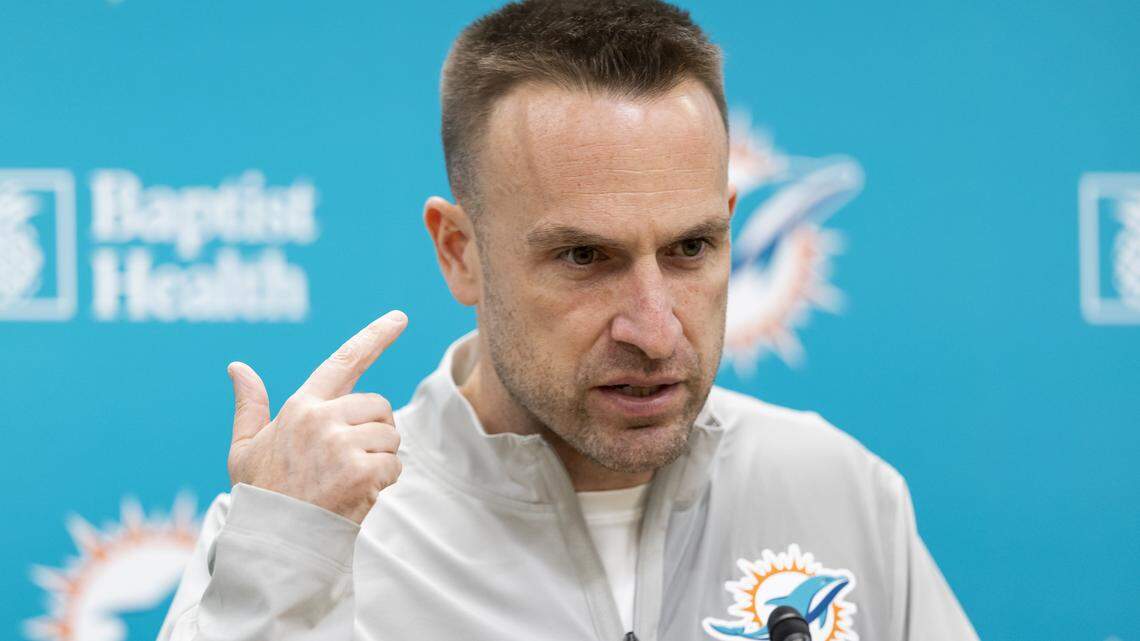
The Jeff Hafley era officially begins Tuesday.
For the first time as his tenure as Miami Dolphins coach, Hafley will meet with his team as offseason workouts begin April 7. The Dolphins will be one of 10 teams to start voluntary workouts as new coaches get the opportunity to begin earlier than the rest of the league, most of which will kick off around April 20.
“All we’ve been waiting for as coaches, is to get around our players,” Hafley said at the owner’s meeting. “Now we’re not allowed to do too much with them because it’s going to be Phase 1, but those are the things that I’m excited to be around. I’m going to continue to coach and get my hands on those guys and help develop them.”
As Hafley alluded to, Phase 1 of the offseason program allows for very little. There are meetings, strength and condition as well as even a little rehabilitation. Sure, it might not be the most glamorous part of the season. But for a team in search of its identity under a new coach, these workouts set the foundation.
“When we can be physical, we have to be physical,” Hafley said. “Does that mean sometimes there might be some live work in training camp? Yeah, there might be. I want to find out who can play the game of football. I’ve said this before, you know how you get good at football? You play football. You know how you get good at tackling? You tackle and you block and you get off blocks and you run to the football and you finish down the field and then you set a standard where this is how it’s going to look or you’re not playing.”
Added Hafley: “There are restrictions, so as I say the guys are going to be here in a week, we can’t do that in OTAs. It’s not a physical deal, but how we train, how we run to the ball, how we move, how we attack in the weight room, that has to be our mindset in everything that we do.”
More than that, it will be about whether Hafley can get players to buy in to the “standard” that he plans to set.
“You set a standard, and you talk to the players about what the expectation is, and you hold them to it,” Hafley said. “You make it very black and white — these are the things we talked about together, this is the standard that we want, this is how we’re going to hold each other accountable, and then we’re going to hold you to it.”
This will be even more important in 2026 than previous years. Not only will the season be rough due to the talent purge that occurred over the last few months, the Dolphins will have an excess of young talent as Miami owns 11 draft picks — seven of which come in the top 100 — as of this writing. Whatever foundation that you build today will become how the 2026 rookies and second-year players lead their rookies in the future.
“When you start to build that and create that,” Hafley said, “then all the young guys are going to see it and that’s how they’re going to practice.”
How Hafley adapts to coaching at the NFL level will be worth observation. The 47-year-old hasn’t been a head coach since 2023 — and even that was at the collegiate level. Sure, Hafley said he’s learned a lot from that experience yet time will be the ultimate judge of that.
For the time being, there’s offseason workouts, an opportunity for Hafley to begin to shape the Dolphins in his image.
“What I tried to bring to Green Bay was a play style on defense that we were going to play harder and more physical and more violent than everybody that we played,” Hafley said. “That’s what I wanted to add to the Green Bay Packers, and I think for the most part, if you turned on our tape, we played pretty hard. I want our whole team here in Miami to play with that same mind-set. This isn’t just about me coaching the defense now, this is about the culture of every person that touches that field, that’s what I want it to look like.”
Miami Herald
C. Isaiah Smalls II is a sports and culture writer who covers the Miami Dolphins. In his previous capacity at the Miami Herald, he was the race and culture reporter who created The 44 Percent, a newsletter dedicated to the Black men who voted to incorporate the city of Miami. A graduate of both Morehouse College and Columbia Graduate School of Journalism, Smalls previously worked for ESPN’s Andscape.