
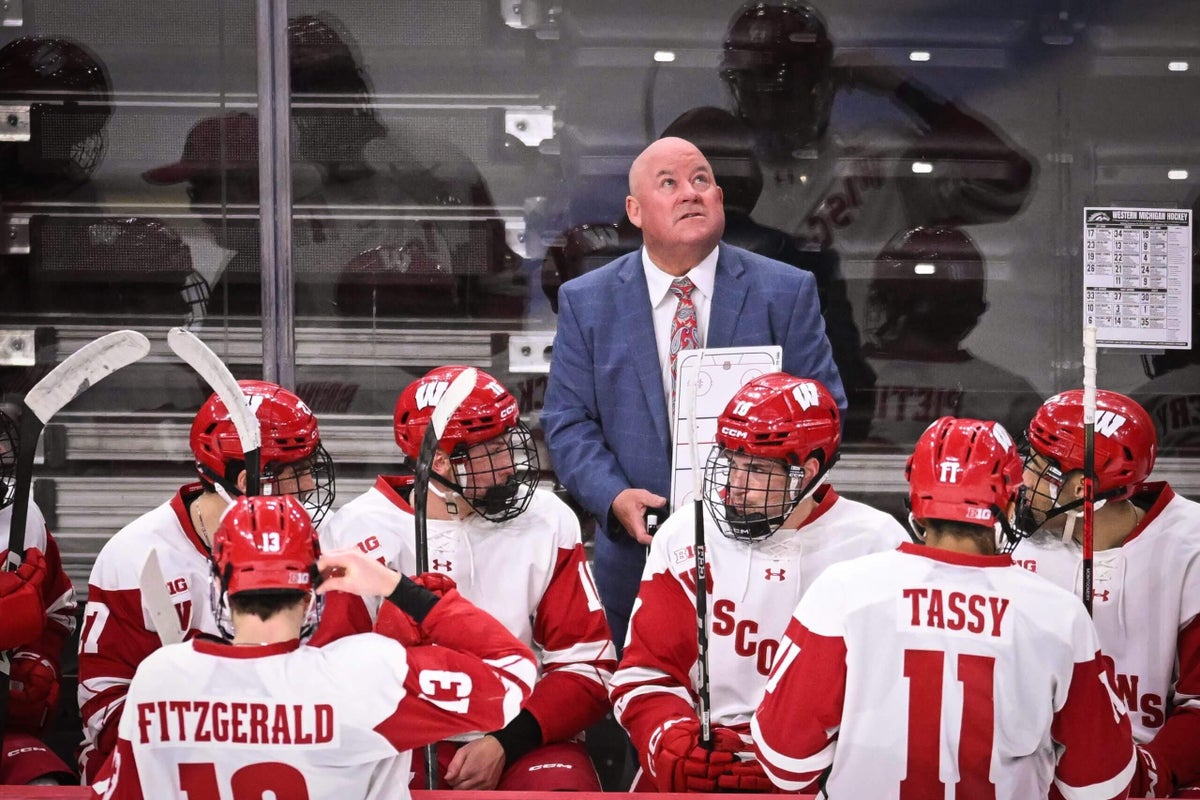
LAS VEGAS — Mike Hastings walked into the Wisconsin Badgers dressing room following their wild regional final comeback win over Michigan State in Worcester, and his face was already a bit red.
You could tell he was fired up.
Hastings, 60, the former long-time Minnesota State Mankato coach, had taken over the University of Wisconsin program just three years ago, when they were coming off a 13-23-0 season. It was a stark fall from grace for a school with the fourth-most national championships in college hockey history (six).
So when Wisconsin clinched their first Frozen Four berth since 2010 — rallying from a late two-goal deficit and winning in overtime — Hastings let his guard down.
“You know what, you don’t see me this way very often,” Hastings told the group.
Then his eyes got really big, and he screamed: “We’re going to f—ing Vegas!”
The team went nuts.
“On a day-to-day basis, he’s pretty even-keeled, and it’s more all business,” said captain Ben Dexheimer. “But when we’re doing well he gets a little excited. It was definitely nice to see a little more animated side of him.”
Dexheimer said Hastings is the king of the one-liners, often having the guys busting out laughing at what he’d come up with. But the one Hastings brought up later in that post-game speech was symbolic not only of this season, but his three-year run with the program itself.
“They started digging a grave for us earlier this year,” Hastings said. “And we refused to get into it.”
The Badgers were nearly buried in January after a mid-season funk, before a meeting with the leadership group started to turn it around. And they needed some help on the final weekend of the season to actually earn a bid into the NCAA tournament. Hastings was so antsy and stressed watching the games in his basement that his wife left the house to take their dog for long walk.
But as Hastings and the Badgers are set to face North Dakota in Thursday’s semifinal at T-Mobile Arena, they hope this is a sign of the program being back.
“Throughout the season, sometimes you need to taste that basement,” Hastings said. “So you can understand what it’s like to be back in the upstairs. By doing the work that you need to do.”
OH CAPTAIN, OUR CAPTAIN 🫡
DEXY SENDS US TO VEGAS IN OT!!!
🍎: Gavin Morrissey pic.twitter.com/uIOW6GqtP5
— Wisconsin Hockey (@BadgerMHockey) March 29, 2026
Hastings could have finished his career at Minnesota State, a program he revived and made his own.
The school had just one winning season in the previous nine years before Hastings arrived in 2012, immediately turning it around. He recorded at least 20 wins in every season he was there, finishing top in the conference in all but three years of his tenure. The Mavericks won three WCHA titles and two CCHA titles, making two Frozen Four appearances in 2021 and 2022. When he left, Hastings was in the middle of a 10-year contract, signed in 2017. His family, including his wife Jean-Ann and two kids, Hudson and Hannah, were happy. They were born in Omaha, where Hastings spent 14 years in the USHL, but then moved around a bit with his assistant stint with the University of Minnesota Gophers before settling in Mankato.
Hastings remembered a story when he took the MSU job and was driving home from the park with his family. Their son Hudson asked Jean-Ann, “How many times did your dad move?”
“Uh, he didn’t,” she replied.
It struck a chord with Hastings, who was hesitant to go anywhere. But he also remembered advice he got from former Gophers coach Don Lucia: “No matter how good or bad it’s going, if you can survive 10 years (with a program), no matter where you’re at and it is at, they’re going to get tired of your shtick,” Hastings recalled Lucia saying. “Your shelf life is 10 years.”
And when Wisconsin pursued Hastings three years ago after firing Don Granato, the former St. Cloud State defenseman was intrigued. He and his wife were empty-nesters now. The Badgers program was rich in history. And it was time for a change.
“I’m thankful for what I had at Minnesota State because it was a life-changing thing for myself, my family,” he said. “That’s a place I’ll never be able to repay. You don’t want to wear out your welcome, and when this opportunity came about, my wife and I were like, ‘We’re doing this.’”
His first speech to the Badgers got their attention. There was a lot of uncertainty around the program, who would stay and who would go. Dexheimer said Hastings told them it was a new era, and that they better be ready to go to work. He told them he’d make them not only unbelievable hockey players but unbelievable men when they left — it’s not all about hockey, it’s about life.
“How can I explain this — he demands us to work, but it’s not like he’s asking a ton,” Dexheimer said. “We want to do it for him. His biggest strength is getting the most out of his players. There are days you come to the rink and it’s like, ‘Oh man, I don’t have it today.’ Then you get to the rink with coach and his pre- or post-practice meeting, he’ll get you in the mindset to be ready to work, even on a Tuesday in January when there’s no one on campus and it’s cold and it’s the dog days. He gets the most out of you when you need it the most.”
After last season went awry a bit, the Badgers going 6-17-1 in the Big Ten after a 13-win improvement the year before and 13-21-3 overall, Hastings said the Badgers needed a reset over the summer. They met as a group and went through some subtle changes. A lot of it was team-building in the first eight weeks, from conversations to time together in the gym. Veteran leaders like Dexheimer invested in the younger guys.
“For the most part it was, ‘We can’t go alone,’” Hastings said. “We’re a heck of a lot stronger together than we are as separate parts.”
That showed in the turning point of the season: a chat with the leadership group in January after injuries and inconsistencies were putting them in danger of the season going sideways. He told them that it felt like when he really pushed, and it started to get hard, “We spit the bit.”
It sparked a really honest conversation.
“The general idea was, the past is the past and we can’t change that,” Dexheimer said. “Are we going to roll over and die or are we going to get up the next day? If we choose to just give up on the season after losing six games, we’re going to have a lot of regrets come March and April. (Hastings’) message was, ‘Just keep the group alive, keep the positivity up.’ His thing is ‘the sun does come up no matter if you win or lose,’ so the sun kept coming up and we kept going to work.”
Hastings hasn’t done it alone, crediting his coaching staff and, of course, his players. The Badgers have been boosted by the help of one of their legends, Joe Pavelski, who was part of their last national title team in 2006. Pavelski has worked with the team on and off the ice this year and will be in Vegas for the Frozen Four. He’s learned a lot about how Hastings operates up close.
“He’s just a fiery, competitive coach,” Pavelski said. “It’s just that passion for the game, and the passion for his players. There’s enough out there about him that he’s a demanding coach and stuff, but the guys cares as much as anybody. He cares about the player and the person. At the end of the day, it shows in big moments.”
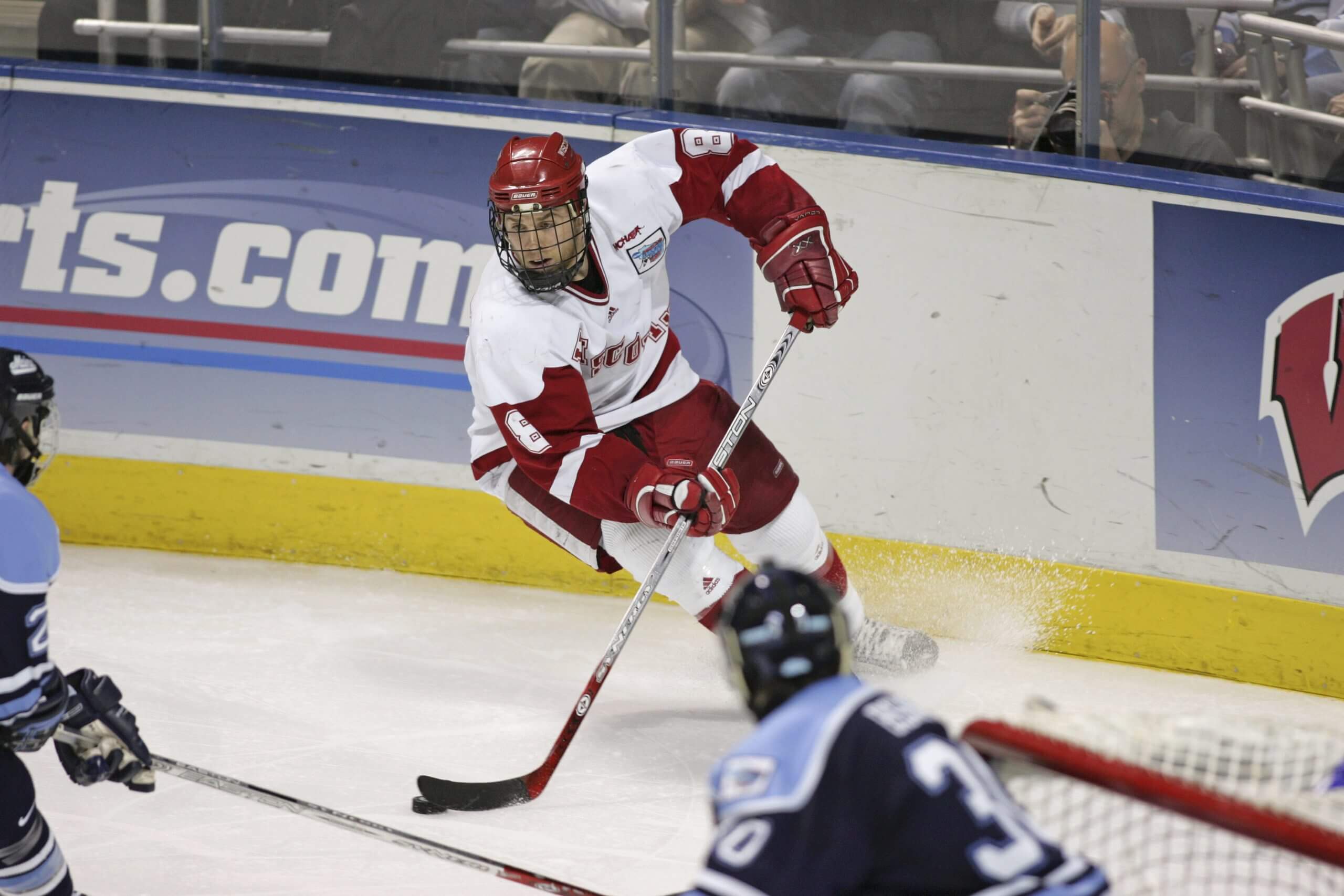
Joe Pavelski helped Wisconsin win its last national title in 2006 and is now a member of the Badgers staff. (G. N. Lowrance / Getty Images)
As much as the Badgers rallied down the stretch, they needed some help to make the tournament, earning the 12th seed. Hastings remembers anxiously watching Dartmouth in the ECAC tournament final, with Wisconsin needing them to win for them to earn an at-large berth. Jean-Ann tried to watch some of the game with Hastings, but it wasn’t much fun.
“She goes, ‘I’m taking the dog and getting out of here,’” Hastings said, laughing. “She’d seen enough of my act through the first period that she knew she wanted to be somewhere else.”
While Hastings has thought about the NHL, having relationships in the league like David Quinn and Jeff Blashill, it doesn’t sound like he plans on going anywhere else anytime soon. The job isn’t done.
“We’ve definitely come a long way,” Dexheimer said. “This program is extremely historic. The school and us as players weren’t happy with the direction it was going (three years ago) and they decided to go with a change and Coach Hastings came in. He’s done an absolutely phenomenal job. Guys respect him every single day and we go to work for him.
“But we’re not done yet.”