
The Washington Commanders don’t know who they’re taking with the seventh pick in the NFL Draft. They don’t know how the six draft slots ahead of them will fall, and though that could become clearer as the draft nears, they may not know fully until they’re on the clock in two weeks.
But after months of scouting followed by draft meetings and pro days and more draft meetings and top-30 visits and more meetings, the Commanders have gotten to know a number of prospects quite well — and they know they have a number of good options.
Washington’s draft is wide open and part of that is intentional.
“We don’t have to pick a certain position,” GM Adam Peters said last week at the NFL’s annual meetings in Phoenix. “… With what we did in free agency, it’s not like, ‘OK, we have to go get this because we have a gaping hole here or there.’”
The Commanders added to nearly every position of need in free agency, signing a trio of new pass rushers, an outside linebacker, a safety and two corners, a couple of receivers, a pair of veteran running backs and a pass-catching tight end. They also re-signed their backup quarterback, Marcus Mariota, locked up their left tackle, Laremy Tunsil, for the long term, and brought back depth across the board.
Yet, they didn’t complete any one positional group. They could still take another pass rusher, or seek out a starter in the secondary. They could add another linebacker, or a playmaker at receiver or running back. None of those options would or should surprise at No. 7.
Over the last few months, one word Peters and coach Dan Quinn have both used repeatedly when talking about the prospect they hope to land is “impact.”
“Pick No. 7’s a big pick,” Peters said. “And so just finding someone who can really impact our team — impact our team right away and impact our team long term.”
With that in mind, there’s an especially strong case to be made for a select few prospects, should they be available at No. 7.
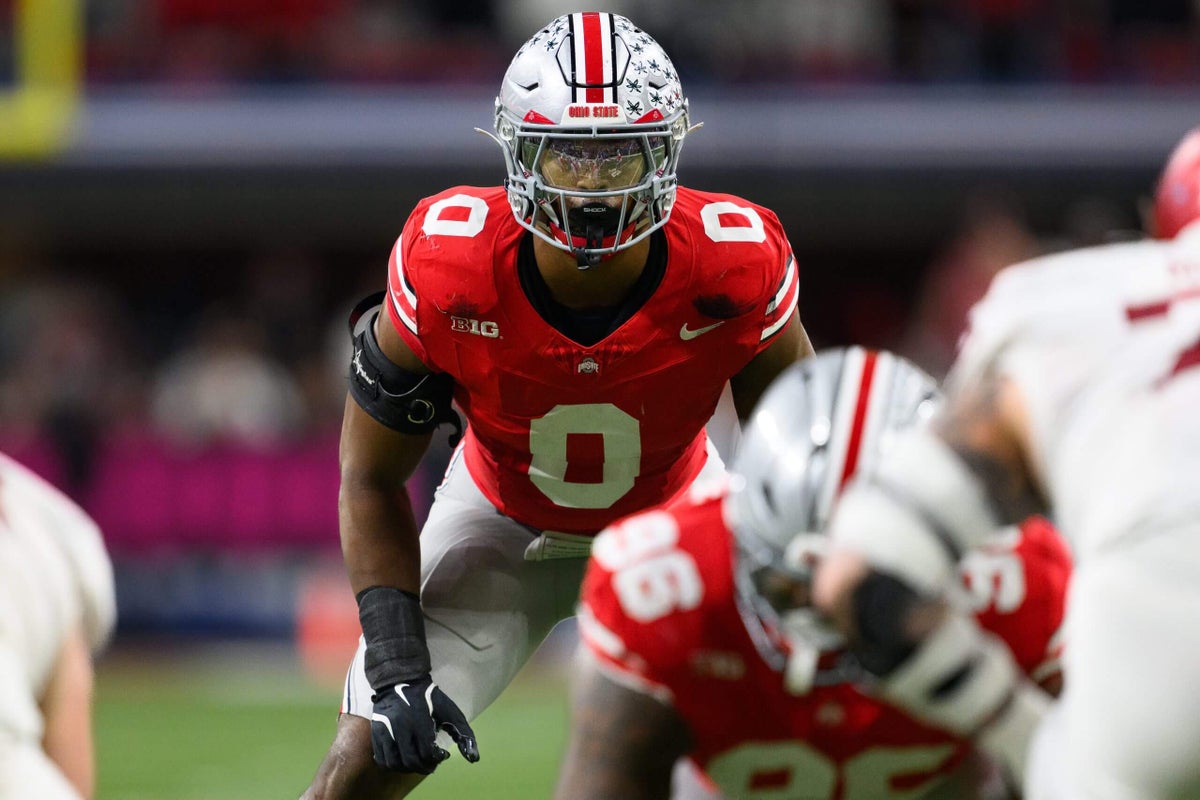
Sonny Styles, LB, Ohio State
The Athletic’s Dane Brugler ranked Styles as the fourth-best prospect in this draft class.
“With elite subpackage value, he has the talent to become an impact linebacker early in his NFL career,” Brugler wrote in “The Beast.”
Styles has the size, at 6-foot-4, 255 pounds, and the speed, as shown by his 40 time at the combine. He hit a top speed of 22.69 mph and crossed the line in 4.46 seconds. But what makes him rare is his range. Styles was recruited as a safety before switching to linebacker, so he can cover tight ends and slot receivers, rarely misses tackles and can diagnose and react quickly. Styles was also voted a senior captain last year and wore the green dot in Matt Patricia’s defense.
Said one NFC coach: “The guy’s quick, he’s athletic, he can do a lot. … This is a linebacker that can be an absolute every-down, call it, do it, lead it (player), and every team wants that.”
In Washington, he’d give defensive coordinator Daronte Jones another weapon to move around while immediately upgrading a linebacking corps that struggled with tackling and covering.
The Commanders’ defense has been a liability the last two seasons, and finding a Day 1 starter who could affect the run and pass game would be a boon. And although he doesn’t play a premium position, he has the rare traits to be a long-term asset.
“I had Fred Warner in San Francisco and I can’t tell you how much that guy impacted our team,” Peters said. “… I would like to say take the best player who can help us now and in the future and worry about the second contract later.”
Jeremiyah Love, RB, Notre Dame
It’s not exactly groundbreaking to declare Love (or any of these options) a potential impact player at the pro level. But Love is an interesting case because of his position, and the rarity of taking a running back as high as No. 7.
Peters, whose approach as a GM is shaped by his experiences as a scout and executive in New England, Denver and San Francisco, was a part of only two teams that drafted a back in the first round. In 2006, when Peters was an area scout for the Patriots, they drafted Laurence Moroney with the 21st pick. Maroney never played a full season and was traded to Denver before his fifth NFL season. It was his last in the league.
Then in 2009, when Peters was a regional scout for the Broncos, they selected Knowshon Moreno with the 12th pick. Moreno became the first Bronco to top 1,000 rushing yards and 500 receiving yards in a season (2013), but Denver didn’t keep him. He played one more year in Miami, then was out of the league.
That isn’t to say Peters wouldn’t take a running back high. It’s just that traditionally, most teams haven’t placed that type of value on the position. There have been some recent notable exceptions, however — Christian McCaffrey, Saquon Barkley, Bijan Robinson — and Love is widely projected to have such potential.
“I mean, I wouldn’t have any trepidation about taking anyone at seven that … we think can really help our team,” Peters said in Phoenix. “But you know, we got (Jacory) “Bill” (Croskey-Merritt) in the seventh round last year, so you can get running backs in a lot of different ways. … But if that person can impact your team in a certain way, then you would take them regardless of their position.”
Peters was with the 49ers when they traded for McCaffrey, one of the most versatile backs in the NFL. Peters has also been on the losing end to the Philadelphia Eagles because of Barkley. So he understands the value of a truly elite back.
It seems unlikely that Love is around when the Commanders pick at No. 7 — Brugler ranks him as the No. 2 overall prospect But if he is, he would be difficult to pass up.
Washington may not have to pick for positional need, but it desperately needs another top-tier playmaker on offense to complement Terry McLaurin. Love can affect both the run and pass game at an elite level.
He has rare speed — he’s 212 pounds and posted a 4.36 40 at the combine — and can run through contact. He can get to the edge quickly, allowing him to outrun a linebacker’s leverage, and his ability in the pass game goes well beyond just catching the ball out of the backfield.
As Brugler noted, Love can run seam or go routes, is a physical blocker and takes care of the ball. He didn’t lose any fumbles in his three years at Notre Dame.
David Bailey, Edge, Texas Tech
Some regard Bailey as the top pass rusher in this draft class. Brugler ranked him as the No. 2 edge player, behind Arvell Reese, which could give Washington fans hope that he may still be around at No. 7.
Bailey checks a lot of the boxes for Peters and Quinn, who have both said the most important trait for pass rushers is explosiveness.
“Beating somebody to the punch, having an explosive get-off to make someone feel overwhelmed, that’s what all the great rushers have,” Quinn said at the combine in February.
Bailey has one of, if not the, fastest first steps off the line among this year’s prospects. He also has incredible closing speed. And Bailey’s production says plenty; he led the FBS in both sacks (14.5) and pressure rate (21.3 percent), and was second in tackles for loss (19.5).
Adding another pass rusher may seem counterintuitive after the Commanders signed three defensive ends this offseason. But only one of them, Odafe Oweh, is a bona fide starter — and he’s still regarded as up-and-coming. K’Lavon Chaisson, a 2020 first-round pick, and Charles Omenihu each signed one-year deals and will compete for jobs but haven’t been guaranteed anything.
Plus, Dorance Armstrong and Javontae Jean-Baptiste are both coming off significant injuries, and both Armstrong and defensive tackle Daron Payne are entering the final years of their contracts.
The Commanders have lacked an elite edge rusher for years, and it’s cost them. Last season, their 32.5 percent pressure rate ranked 24th in the league, and their passing EPA per play allowed (plus-0.14) was the third-worst, according to Next Gen Stats. Armstrong’s season ended in Week 7, and yet he still tied for the second-most sacks on the team, at 5.5.
Filling a premium position and finding a long-term complement to Oweh could go a long way in transforming the Commanders’ defense.