
“The Beast” has arrived. Every year, The Athletic’s Dane Brugler delivers the NFL’s definitive draft preview. It contains 629 pages of absolute must-read information. While consuming it myself, I kept in mind the Philadelphia Eagles’ positional needs and compiled a contextualized list of prospects to keep an eye on. There is plenty to get to. So, we won’t waste more time on introductions. Today, we focus on the Eagles’ offensive needs.
A quick reminder of the Eagles’ 2026 draft picks.
First Round: No. 23
Second Round: No. 54
Third Round: No. 68 overall (from NYJ), No. 98 (compensatory pick)
Fourth Round: No. 114 (from ATL), No. 137 (compensatory)
Fifth Round: No. 153 (from ATL), No. 178 (compensatory)
Sixth Round: No. 197 (from ATL)
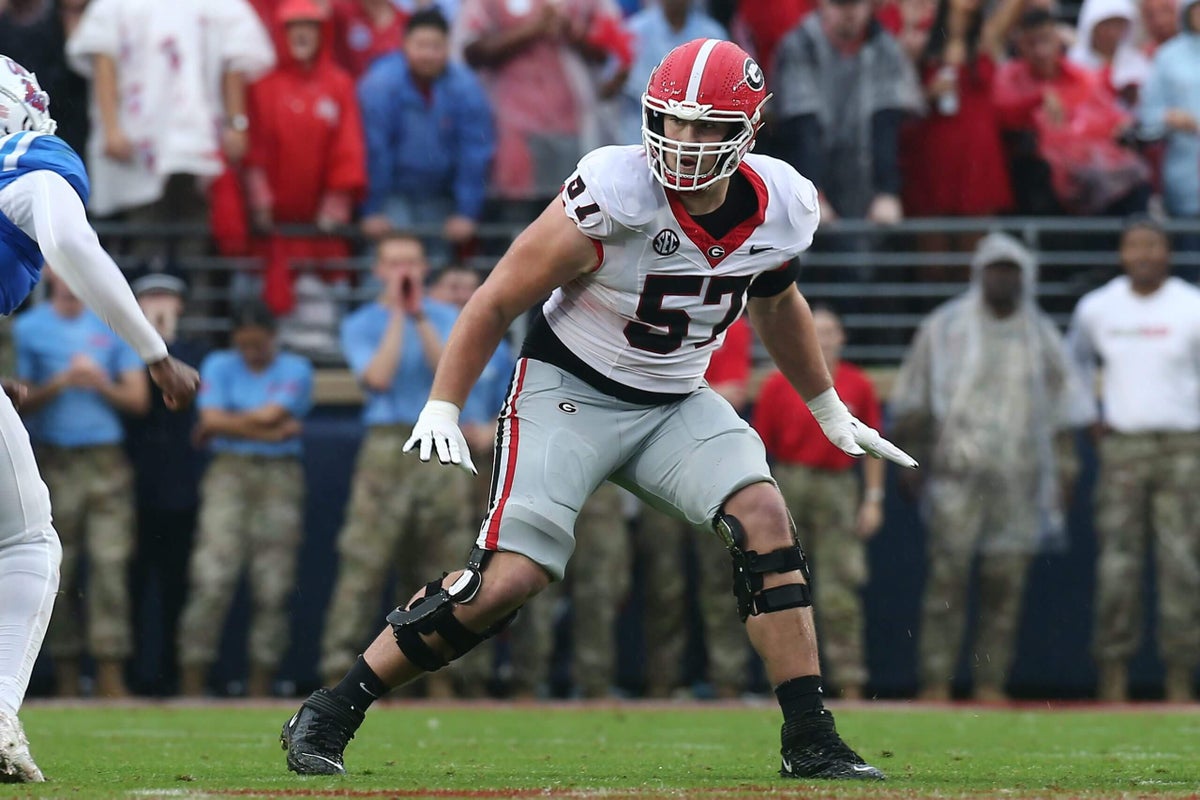
Offensive tackleMonroe Freeling, Georgia (No. 17, 1st-2nd)
The Eagles’ starting offensive line may not change at all in 2026, but general manager Howie Roseman said ahead of the NFL Scouting Combine that the organization needs to address the position group’s depth. Five-time All-Pro right tackle Lane Johnson is returning for his 14th season, but it behooves the Eagles to be proactive in securing a successor — especially after Johnson, who turns 36 in May, missed seven regular-season games and the NFC wild-card game with a Lisfranc injury. Monroe Freeling started at left tackle at Georgia but came off the bench to play some right tackle as a freshman. Freeling has a Jeff Stoutland-era frame (6 feet 7, 315 pounds) and added 75 pounds over the past five years.
Freeling played in both gap and zone schemes at Georgia. The Eagles are expected to use more zone blocking schemes under new offensive coordinator Sean Mannion, but coach Nick Sirianni has stated the Eagles won’t abandon styles that worked for them in the past. Still, Brugler notes some weaknesses in Freeling that should be kept in mind if the Eagles indeed major in zone. Freeling is “inconsistent out in space adjusting to movement,” “guilty of overextending himself in run game” and “can be beaten by late movement once he settles his feet.” Freeling seems to favor the vertical blocking scheme that the Eagles are steering away from: “Generates drive power in run game to displace defenders” and has “efficient timing and contact balance on combos/climbs.”
Key Brugler quote: “An ascending prospect, Freeling passes the eye test with his frame, length and movements off the ball. He is quick out of his stance, regardless of what the action requires, and uses his hands to latch and control defenders. Mixing up his pass sets, redirecting vs. skilled counters and using improved leverage in the run game will be the next steps in becoming a more complete player.”
Kadyn Proctor, Alabama (No. 19, 1st-2nd)
Proctor’s name is inescapable when discussing the Eagles and their need at offensive tackle. He’s arguably the most likely to be available when the Eagles pick at No. 23. He also fits the team’s classic mold at 6-7, 352 pounds. Roseman also has a knack for reinforcing the trenches with prospects who played in the Southeastern Conference. Proctor was a three-year starting left tackle at Alabama, although he briefly transferred to Iowa for the first few months of 2024, only to return to Tuscaloosa. Brugler notes that Proctor called his initial departure from Alabama “one of the worst decisions” he’d ever made.
One of the primary questions of this coming draft cycle is how much, if at all, has the Eagles’ prototype for an offensive tackle changed? When you read “enormous frame, with outstanding overall mass and body length” and “rare explosiveness for a player his size and density,” Proctor almost appears a no-brainer for the Eagles as we’ve known them for quite some time. I don’t expect the Eagles to suddenly start devaluing those kinds of tools just because they aren’t so much required in zone blocking schemes. Such a system is meant to assist offensive linemen, and if they happen to be massive and strong and can still move and operate in space, I don’t expect that’s a prospect the Eagles will easily pass on.
Key Brugler quote: “Proctor is big, strong and explosive, which is an exciting foundation for an offensive lineman, but that optimism should be curbed until his discipline and technique catch up. He has starting-caliber upside at left tackle, although some teams believe moving to guard would be best for his pro career.”
Caleb Lomu, Utah (No. 25, 1st-2nd)
If the Eagles lean more into skill sets in zone blocking, Lomu (6-6, 313) starts to emerge as a possibility. The Good: “light-framed athlete and spry out of his stance,” “above-average lateral quickness and adequate balance in his pass sets,” “showcases fantastic range and timing on GT counter and cross-formation pulls,” “processes things quickly in-game — intelligence will serve him well moving forward.” The Bad: “Underdeveloped play strength and can be rocked off his socks vs. power,” “doesn’t consistently fire off the ball in run game and can get knocked back,” “needs to mature footwork and technique on double teams.”
Perhaps the disparity is too wide and too risky for an Eagles team that will likely want to hold on to at least some of its power run game.
Key Brugler quote: “Lomu must get stronger and continue to develop his technique and grit, but NFL teams are understandably intrigued by his movement ability and ready-to-cultivate left tackle skill set. His upside points to him becoming an NFL starter.”
Max Iheanachor, Arizona State (No. 33, 1st-2nd)
The Nigerian-born Iheanachor, who began his career at East Los Angeles College, is becoming a betting favorite. His traits strike the balance that appears applicable to what the Eagles are aiming for. Iheanachor (6-6, 321) “comfortably wears 325 pounds,” Brugler writes, and has “big thighs, trunk and upper-body build.” He’s a “balanced athlete and moves well laterally to answer edge speed,” and played right tackle for 2 1/2 years at Arizona State. Some of his personality traits scream Eagles. “Mellow and quiet off the field but has an edge on it,” and “worked hard to develop body and mindset (NFL scout: ‘It’s not just the on-field development that’s encouraging. He learned how to take hard coaching and how to be accountable with his rehab. He’s no imposter trying to pretend he’s a football player.’)” His durability is also notable: He finished his career with 28 straight starts.
Key Brugler quote: “After he started playing football in the summer of 2021, the Nigerian native ascended quickly at the juco level before becoming a starter for the Sun Devils. He made clear improvements each of the past three seasons and played his best ball as a senior (zero sacks allowed). He was also one of the standouts during Senior Bowl week.”
Caleb Tiernan, Northwestern (No. 65, 2nd-3rd)
Key Brugler quote: “A-level work ethic (NFL scout: ‘Training staff said he’s in the building by 5 a.m., and always doing extras.’) … Durable — finished career with 43 straight starts. … Disproportionately shorter arms for his size (6-8, 323). … Balance too easily disrupted as a run blocker … would like to see more of a mean streak into first contact, both in run game and as a finisher. … Tiernan relies on refinement to compensate for his average length and redirect skills, using disciplined hands and poise to execute assignments. He’ll have swing tackle ability, although his best position long-term might be guard.”
Markel Bell, Miami (No. 97, 3rd-4th)
Key Brugler quote: “A no-star recruit, Bell wasn’t ranked by 247 Sports Composite in the 2022 class. … He committed to Holmes Community College outside of Jackson, Miss. … A juco transfer, he was primarily a rotational backup in 2024 before becoming an underappreciated part of the Hurricanes’ run to the 2025 national title game. He didn’t allow a sack as a senior (at 358 pounds) and got better throughout the season, logging 1,034 offensive snaps, fifth-most in the FBS in 2025. … Bell is a towering, top-heavy blocker (6-9, 346) who can engulf defenders with his initial movements and massive wingspan. His technical skill continues to mature with additional reps, although savvy rushers can attack his leverage and quickly force him into recovery mode.”
Austin Barber, Florida (3rd-4th)
Key Brugler quote: “Barber (6-7, 318) passes the eye test with his long frame and adequate muscle mass, and he has a basketball background as an athlete. However, he can be stressed by outside speed and gets walked backwards into the pocket by speed-to-power moves. His hands are erratic, in terms of punch tempo and placement, but he can displace bodies when he connects. Overall, Barber has NFL size, tools and demeanor but needs to polish his timing and technique to hold up against next-level competition. He is a developmental swing tackle prospect who might be better suited for a move to guard.”
Drew Shelton, Penn State (5th)
Key Brugler quote: “Shelton is an interesting developmental prospect, because of his impressive big-man athleticism. He will struggle to win at the NFL level, though, unless he improves his functional strength and finishing toughness. He projects as an NFL swing tackle with starting potential.”
Wide receiverMakai Lemon, USC (No. 13, 1st)
As Philadelphia braces for a divorce between the Eagles and three-time All-Pro A.J. Brown, it should not be shrugged off that the Eagles would take a wide receiver in the first round — especially if the value is there. Lemon should be long gone by the time the Eagles pick at No. 23. But stranger things have happened. Lemon (5-11, 194) was a unanimous All-American in 2025 with 1,156 receiving yards and 11 touchdown catches.
There are a few things that stick out in Brugler’s report about Lemon that relate him to the Eagles. His “angle cuts out of breaks are sharp and crisp,” and he’s an “instinctive zone route runner, feeling space and sitting down.” Sans Brown, the Eagles (who struggled against zone coverage in 2025) could use another receiver who can consistently create and find space against both man and zone coverage. Lemon was also the only Big Ten player with more than 500 yards after the catch in 2025 (a quality Sirianni favors) and was USC’s primary kick returner in 2024.
Key quote from Brugler: “Lemon was primarily an inside receiver (75.6 percent of career snaps aligned in the slot). … Lemon doesn’t wow with his size or athletic profile, but he is a smooth, manipulative route runner and catches everything thrown his way. Similar in ways to fellow former Trojans receiver Amon-Ra St. Brown, he already plays like a pro and projects as an NFL starter (Z or slot).”
Jordyn Tyson, Arizona State (No. 20, 1st-2nd)
If the Eagles desire another outside receiver in the draft, Tyson appears to be the top-rated prospect sensibly within their range. Tyson (6-2, 203) does have outside-inside versatility, and Brugler likens him to Stefon Diggs. Tyson was also coached well; former NFL wide receiver Hines Ward was his position coach at Arizona State. Tyson began his career at Colorado in 2022, felt he wasn’t “wanted” by new head coach Deion Sanders and his staff, then became quite desirable at Arizona State, where he totaled 1,812 yards and 18 touchdowns in his final two seasons.
Like Lemon, Tyson is “nifty in releases to quickly create separation and outpace coverage” but does not have elite speed. He could become a trusty target for Jalen Hurts with “terrific in-motion concentration to stab off-target balls” and “impressive body fluidity and hand strength to attack the ball mid-air and make some special catches.” Tyson has medical red flags. He missed multiple games in each of his four college seasons with hamstring and ankle injuries, plus a broken left collarbone and a torn ACL, MCL and PCL in his left knee.
Key quote from Brugler: “Overall, Tyson’s injury history is concerning, but on the field, he is a sleek, twitched-up athlete who can create his own separation and win outside his frame at the catch point. He projects as an NFL starter (inside or outside).”
Omar Cooper Jr., Indiana (No. 22, 1st-2nd)
Cooper reportedly has a top-30 visit scheduled with the Eagles. He is an intriguing option for Mannion’s offense. Newly signed free agent Hollywood Brown can play both outside and inside, but if the Eagles want another receiver in that mold, Cooper fits the bill. Brugler writes Cooper “will be an attractive draft target for the NFL teams that put high value on ball skills and run-after-catch ability.” Check. Cooper had 30 plays of 20-plus yards over the past two seasons, which includes a 75-yard rushing touchdown.
Cooper (6-0, 199) has the size to play both inside and outside. Cooper played quarterback and linebacker in youth football before sticking to quarterback as a high school freshman, then ultimately moving to wide receiver as a sophomore. Cooper was a full-season starter for the Hoosiers only in 2025, but he proved he can compete at the highest level in the biggest games. He had an impressive game-winning catch against Penn State and was Heisman Trophy-winning QB Fernando Mendoza’s top target in a 2025 season that produced the school’s first national championship.
Key quote from Brugler: “Cooper will have his doubters because of the way he was used within the Indiana offense, but he checks the boxes with his play strength, athletic coordination and competitiveness at the catch point. He opens his stride to create windows for his quarterback and shows a savvy awareness of his surroundings to secure the ball mid-air. He has a feel for creating with the ball in his hands and is both slippery and powerful because of his contact balance and strong core, which leaves tacklers falling off him.”
Denzel Boston, Washington (No. 26, 1st-2nd)
Key quote from Brugler: “Boston was primarily a perimeter receiver (81.3 percent of snaps aligned wide). … A good-sized athlete, Boston (6-4, 212) plays big and balanced with vacuum hands (3.1 percent drop rate). He treats the catch point like he’s a power forward in the paint, boxing out and using his rangy frame and focus to secure the football. Ball placement wasn’t a strength of Washington quarterbacks, which created opportunities for Boston to show off his catch radius. He doesn’t have the juice to simply run by NFL man coverage, and he won’t be known for his after-the-catch skills, but he is a proven chain mover (79 percent of his 2025 catches resulted in either a first down or touchdown).”
Chris Bell, Louisville (No. 47, 2nd)
Key quote from Brugler: “Looks the part (6-2, 222) with large, muscular frame and proportioned bulk. … Outstanding body control and play strength to make difficult catches. … Big body makes it tough for defenders to go through him (12.7 percent of routes were slants, third-highest rate in the FBS). … Dangerous run-after-catch weapon. … Inconsistent setting up open-field moves … erratic blocking effort … torn left ACL (Nov. 2025) late in senior season; underwent surgery (Dec. 2025) … sidelined for the 2026 NFL Draft process (Bell: “I’ll hopefully be ready for training camp.”)
Antonio Williams, Clemson (No. 59, 2nd-3rd)
Key quote from Brugler: “Glider in space, with enough speed to work vertically. … Efficient on option routes to read coverage and settle in open zones. … Very little lag going from receiver to runner after the catch. … Can win at the line with his feet, but needs to prove he can defeat jams with his hands. … Missed two games as a senior because of a hamstring injury (Sept. 2025); ankle and toe injuries sidelined him for eight games during the 2023 season (redshirted).”
Malik Benson, Oregon (4th-5th)
Key quote from Brugler: “A deep-ball weapon, Benson (6-0, 189) is a fleet-of-foot athlete who can really fly once he opens up on downfield patterns (caught 11 of 17 targets of 20-plus yards in 2025). He can loosen coverage with the threat of his speed, but lacks the rhythm and efficiency to easily separate at the top of routes. He extends well to pull the ball in, although his lack of desired size and strength will be tough to mask in NFL traffic. Overall, Benson is undeveloped in the quick game and intermediate area, but his gliding speed and tracking skills will be valued by teams looking for a pure vertical receiver on the perimeter. His usefulness will also show on punt returns.”
Josh Cameron, Baylor (6th)
Key quote from Brugler: “Unique size (6-2, 220), with running-back bulk, long arms and tapered waist. … “Freaks List” alum (395-pound bench press, 528-pound squat, 319-pound power clean). … A big-bodied target, Cameron is a physical presence on the outside and has above-average ball skills (1.4 percent drop rate). He is an adequate athlete, by NFL standards, who tracks the ball well at every level and tramples defensive backs after the catch. However, nuance is missing from his route inventory. He gives away too many indicators and doesn’t have the stop/start burst to easily uncover.”
Tight end
Kenyon Sadiq, Oregon (No. 16, 1st-2nd)
The Eagles may have re-signed Dallas Goedert to a one-year, $7 million deal. But nothing precludes them from finding a long-term option in the draft. The Eagles can financially handle it if they add competition and wind up offloading Goedert in training camp. Will the Eagles find a draft-day option with the caliber to start over Goedert as a rookie? I wrote last month that it would be a market anomaly if Sadiq fell to the Eagles. Brugler noted that NFL teams believe Sadiq has the talent to be a top-10 pick.
Key Brugler quote: “A ‘Freaks List’ alum who backed it up at the NFL combine, Sadiq is a brawny athlete with a unique combination of explosiveness and play strength. He brings both short-area quickness and long speed to the position and can outpace coverage and win at all three levels. … Sadiq has mismatch-creating potential in the NFL, because of his ability to out-quick and out-tough defenders as both a pass catcher and blocker. He projects as a versatile, Vernon Davis-like weapon and has his best football ahead of him.”
Eli Stowers, Vanderbilt (No. 63, 2nd-3rd)
Key Brugler quote: “A two-year starter at Vanderbilt (three-year starter overall), Stowers was a detached tight end (70.7 percent of snaps in the slot) in offensive coordinator Tim Beck’s run-heavy scheme. … Stowers will need to prove himself as a serviceable blocker at the NFL level, but he is explosive as a pass catcher, and I love the way he maximizes his catch radius. He has mismatch-creating potential and can eventually develop into an NFL starter.”
Max Klare, Ohio State (No. 66, 2nd-3rd)
Key Brugler quote: “Klare is a good-looking athlete (6-5, 246) and shows speed and urgency that suggest he has yet to play his best football. He needs to improve with some of the pacing and subtleties of getting open, but his route movements are crisp and fluid. He has the body control to play the ball well in the air and flashes a burst after the catch. The foundation is there to be a serviceable positional blocker, although it will likely never be a strength of his game. Overall, Klare has a low ceiling as a blocker and needs to continue adding refinement as a route runner, but his combination of athleticism, toughness, and ball skills gives him a modern-day skill set. He projects as an F tight end, similar in ways to Dalton Kincaid.”
Sam Roush, Stanford (3rd-4th)
Key Brugler quote: “A three-year starter at Stanford, Roush (6-6, 267) worked primarily inline as an attached Y tight end in former head coach Frank Reich’s offense. … With his rugby background, Roush prides himself on trying to be the toughest and most physical player on the field. He works to center his blocks and strains to sustain, even moving defensive linemen against their will at times. As a pass catcher, his quickness at the snap helps him uncover in the short-to-intermediate parts of the field, although his catch-point consistency must improve (12.5 percent drop rate in 2025).”