
“The Beast” has arrived. Every year, The Athletic’s Dane Brugler delivers the NFL’s definitive draft preview. It contains 629 pages of absolute must-read information. While consuming it myself, I kept in mind the Philadelphia Eagles’ positional needs and compiled a contextualized list of prospects to keep an eye on. There is plenty to get to. So, we won’t waste more time on introductions. Friday, we focused on the Eagles’ offensive needs. Today, we focus on their defensive needs.
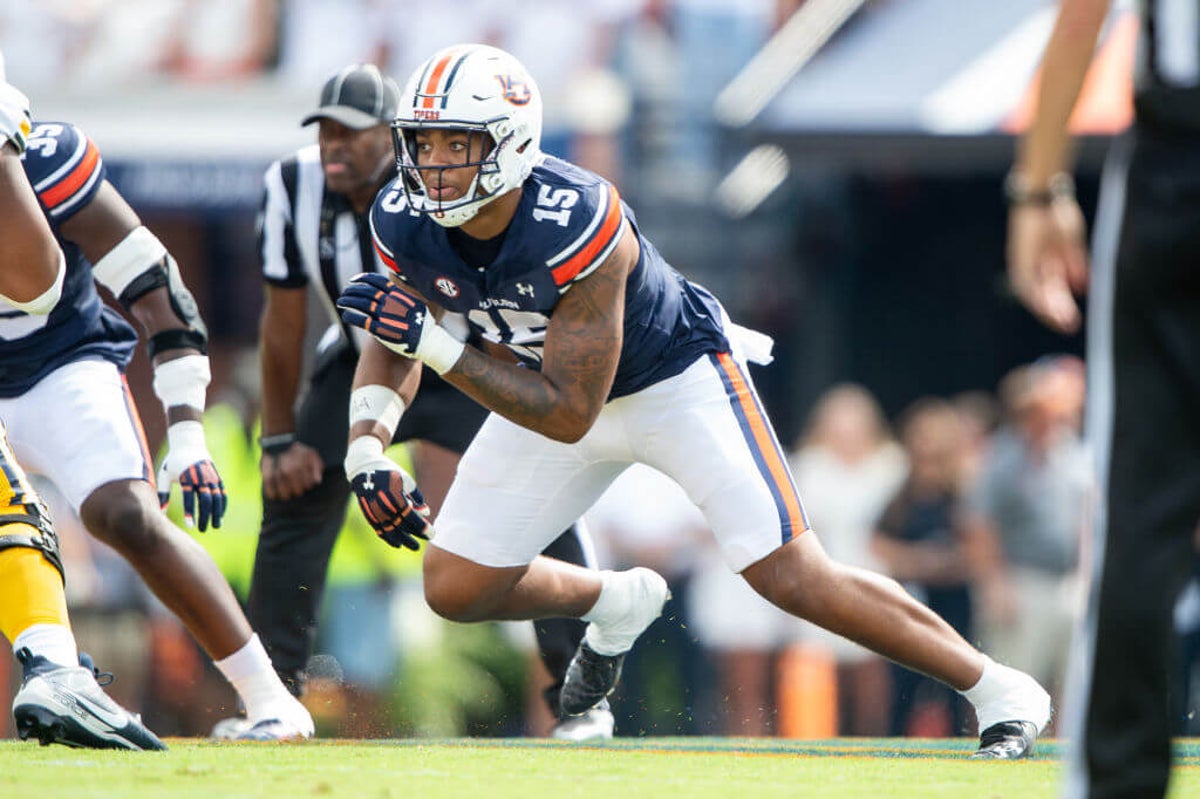
Edge rusherKeldric Faulk, Auburn (No. 15 prospect, 1st-2nd-round grade)
Faulk could fall to the Eagles at No. 23 if other teams have higher priorities on their draft boards. General manager Howie Roseman has a history of seizing value in the 20s: think Quinyon Mitchell in 2024. Edge rusher is arguably the Eagles’ biggest positional need. They lack the large-framed edge-setter that Jaelan Phillips and Josh Sweat embodied in DC Vic Fangio’s system the last two seasons.
Faulk (6-foot-6, 274 pounds) fits the bill. He’s long used his size as an advantage. A nice detail in “The Beast”: Faulk first signed up for football in the first grade and often played up a level during youth football because of his size. His 10 sacks in three college seasons don’t distinguish him. Here’s what he does: Faulk primarily played a shade inside the offensive tackle or head-up in Auburn’s three-man fronts. Fangio used Brandon Graham that way when dropping Zack Baun along the edge. Faulk’s flexibility, size and tools make him a scheme fit. The chief concern is that the Eagles don’t improve their sack totals by adding him.
Key quote from Brugler: “He needs better consistency with his pad level and instincts but rarely misses tackles and offers position flex along the line. Overall, Faulk has more ‘almost’ plays than impact ones on his tape, but you bet on a developing, 20-year-old player with his exciting traits.”
Akheem Mesidor, Miami (No. 28, 1st-2nd)
There is a lot to like about Mesidor. He had exceptional production across six seasons with 35.5 sacks and 52.5 tackles for loss. He led the Hurricanes with 12.5 sacks and 17.5 tackles for loss in a 2025 season that ended in the CFP national championship. The Eagles do favor college defenders who played in big games and against premier competition. But there are a few things in Brugler’s report that show Mesidor may not be the right fit for the Eagles.
Playing with discipline does not appear to be Mesidor’s strength. He “plays in overdrive — finds himself out of position to gear down and make a play.” He “launches as a tackler; needs to keep his feet underneath him and eyes up to finish.” He “plays with his hair on fire.” Those qualities can actually be channeled into strengths within defensive fronts that are more vertically attacking. That’s just not the way Fangio’s defense typically operates. Mesidor (6-3, 259) also just turned 25 and had surgeries on his right foot, left foot and shoulder in his college career.
Key quote from Brugler: “He is a physical run defender with adequate play strength, although he can get stuck on blocks and needs to continue maturing his escape maneuvers. Overall, Mesidor won’t be universally loved because of his age and injury history, but he is a disruptive force off the edge who is always playing 100 mph.”
T.J. Parker, Clemson (No. 31, 1st-2nd)
Some may remember that Parker initially committed to Penn State and former head coach James Franklin before re-opening his recruitment and ultimately signing with Clemson. Parker made an immediate impact. He was a Freshman All-American in 2023 with 5.5 sacks and 12.5 tackles for loss. He leveled up in 2024 by leading the Tigers in sacks (11) and tackles for loss (19.5) and set the school’s single-season record with six forced fumbles. That’s the sort of consistent destruction the Eagles lacked from edge rushers not named Jalyx Hunt last season.
Parker does not have a history of playing inside, but at 6-4, 263 pounds, he could add flexibility to his game. But even if he remains an edge-only prospect, he’s been notably efficient from that spot (32.4 percent of his career tackles were for loss). The Eagles need more depth behind Hunt, Nolan Smith and Arnold Ebiketie. It’s just worth wondering whether the Eagles would get maximum value out of a first-round pick if the edge rusher can’t play in a flexible role. Parker’s production offers an easy rebuttal, but he will have to answer for a setback season in 2025 when he totaled five sacks and 9.5 tackles for loss in 12 games.
Key quote from Brugler: “Parker is at his best when he finds a runway and uses his get-off, forward lean and length to drive blockers backward into the laps of their quarterbacks. Though his speed-to-power attack is formidable, NFL blockers will be expecting it — how he develops his setup and secondary rush will determine his pro ceiling. There are times when he is worn down by size, but he throws his hands around like anvils and closes quickly on the ball.”
Zion Young, Missouri (No. 37, 1st-2nd)
A team captain and first-team All-SEC selection in 2025, Young led Missouri with 16.5 tackles for loss and had a penchant for trash-talking that calls to mind Brandon Graham. Young also had a strong Senior Bowl week and visited with the Eagles in Mobile, Ala. Young (6-6, 267) is “built like an NFL defensive end, with broad shoulders and sculpted definition.” He embodies an edge-setting defensive end. Brugler notes that people should see his run game reps against Alabama offensive tackle Kadyn Proctor when their teams played last season. (Young had a sack and tackle for loss in Missouri’s 27-24 loss.)
However, Young was arrested and charged with suspicion of DWI, speeding and failing to properly affix a license plate to his vehicle in December. When initially playing at Michigan State, Young was one of seven players suspended for the final four games of the 2022 season and charged with assault following a postgame altercation at Michigan. (Young pleaded guilty to misdemeanor aggravated assault and received probation.)
Key quote from Brugler: “Overall, Young doesn’t have the pass-rush quickness or diversity that will scare NFL offensive tackles, but he sets a firm edge in the run game and uses his NFL-caliber measurables and heavy hands to open pathways to the pocket. He has the floor of a quality backup and the ceiling of a starting base end for a physical NFL front.”
Keyron Crawford, Auburn (No. 54, 2nd-3rd)
If the Eagles go elsewhere in the first round, Crawford could offer value in the second round. Like his teammate Faulk, Crawford (6-4, 253) is a gifted athlete. Brugler notes Crawford has a “shredded physique, with a six-pack and defined musculature.” Crawford “accelerates through contact to put blockers on their heels,” “flashes burst to close when he has a path to the QB,” and has a motor that’s “always revving.” Crawford “describes his play style as a ‘Rottweiler or bulldog — something that is going to bite you.’” There are notes that Crawford “often plays too hot,” but they seem in lesser supply or concern than that of other prospects.
Crawford’s character traits should endear him to the Eagles. Brugler writes that he’s a “high-character person and player” and quotes an NFL scout saying, “You always see him working, but the coaches say he does even more when people aren’t watching.” Crawford began his career at Arkansas State, where he compiled 5.5 sacks in 2023. He transferred to Auburn in 2024, but didn’t become a starter until 2025, when he recorded 5 sacks and 9.5 tackles for loss. Despite Crawford’s limited SEC play, the Eagles proved by picking Hunt out of Houston Christian in 2024 that playing in a major conference isn’t the end-all, be-all.
Key quote from Brugler: “NFL scouts focused this past fall on the Auburn defensive line to see Keldric Faulk — and left buzzing about Crawford. He explodes off the ball with purpose and a growing repertoire of pass-rush moves. He lacks ideal length and lower-body power, and he feels undersized at times on tape, especially once bigger bodies latch onto him. But his effort consistently pops as a pass rusher, run defender and dropper.”
Dani Dennis-Sutton, Penn State (No. 60, 2nd-3rd)
Key quote from Brugler: “Overall, Dennis-Sutton (6-6, 256) will find sack production harder to come by against NFL blocking, but he is a commanding presence and has the size, strength and quickness to be a force player on the edge. He will be more appealing to teams looking for a ‘high-floor’ role player, as opposed to a ‘high-ceiling’ pass rusher.”
LT Overton, Alabama (4th)
Key quote from Brugler: “A starter for one-and-a-half years at Alabama, Overton (6-3, 274) played the ‘Bandit’ position (70 percent of snaps over, or outside of, the offensive tackle) in defensive coordinator Kane Womack’s multiple scheme. … Evaluators are split on whether Overton fits in the ‘versatile’ bucket or the ‘tweener’ pile — there is a case to be made on each side. He is a gap-sound, unselfish run defender and uses his long arms to get extension into contact and control blocks. … He moves well for his size and has inside/outside rush upside, but his technique and overall plan aren’t there yet.”
Max Llewellyn, Iowa (4th)
Key quote from Brugler: “A one-year starter at Iowa, Llewellyn (6-6, 258) played left defensive end (three-point and stand-up) in defensive coordinator Phil Parker’s 4-3 base scheme. … Llewellyn needs to improve as a run defender if he wants to be an every-down NFL defender, but his relentless, high-effort pass rush will give him a chance to find a long-term role. He projects as a subpackage defensive end at the next level.”
Anthony Lucas, USC (5th-6th)
Key quote from Brugler: “A starter for one-and-a-half years at USC, Lucas lined up as a five-/seven-technique defensive end (with some snaps reduced inside) in former defensive coordinator D’Anton Lynn’s scheme. A native of Haiti, he is still young in football years, having not played the sport until high school. … Lucas has NFL-quality size, with the power profile and quickness to be a firm NFL edge setter and work-in-progress pass rusher.”
Trey Moore, Texas (5th-6th)
Key quote from Brugler: “Moore (6-2, 243) is a tweener prospect and doesn’t have a dominant trait that will stand out on a field alongside NFL athletes, but he plays hard to maximize his ability. He projects best as a subpackage rusher at the next level.”
Safety
Emmanuel McNeil-Warren, Toledo (No. 23, 1st-2nd)
A vacancy at safety opposite Andrew Mukuba opened up for the Eagles when Reed Blankenship signed with the Houston Texans in free agency. The Eagles also traded 2023 third-round pick Sydney Brown to the Falcons for a swap of late-round picks. Michael Carter II, a career nickel, is for now the frontrunner after restructuring his contract to stay in Philadelphia. The Eagles also signed Marcus Epps and J.T. Gray to one-year deals to create competition and depth. Expect the Eagles to add to this room, but it’d be somewhat surprising to see them snag a safety in the first round for the first time since the 1970 merger, given the positional needs and talent that should be available.
Do the Eagles go back to the Toledo well? Sirianni has a documented history with Toledo and its former head coach, Jason Candle, who left for UConn after the 2025 season. Quinyon Mitchell, Philadelphia’s No. 22 pick in 2024, just earned first-team All-Pro and Pro Bowl honors in his second season as the Eagles’ cornerback. It’s also worth noting that safety Maxen Hook, Mitchell’s roommate at Toledo, spent part of the 2025 season with the Eagles as an undrafted rookie. McNeil-Warren was teammates with Mitchell for two seasons before becoming a full-fledged starter in 2024. McNeil-Warren totaled five interceptions in his final three seasons and twice led the Rockets in forced fumbles. He also had a 37-yard pick-six last season.
Key Brugler quote: “Thanks to his footwork and hips, McNeil-Warren is a fluid mover with functional range and improved instincts versus the pass, which allows him to mirror and match tight ends and running backs. He drives on the football in run support and took a master’s class on the ‘Peanut Punch.’ You’d wish there was more meat on his bones and will want to see him continue to improve his take-on and tackle-finishing skills. Overall, McNeil-Warren is an impressive size/speed athlete on the back end who is at his best when roaming to read his keys, flow to the ball and quickly close space. He has the rangy tools to push for starting safety reps as an NFL rookie.”
Keionte Scott, Miami (No. 53, 2nd-3rd)
Key Brugler quote: “Scott plays like a linebacker in a cornerback’s body. His ability to set the edge, avoid blocks and make stops at the line of scrimmage is coaching tape for young nickels. He screams downhill as a blitzer and chases down runners in pursuit, although he comes in hot, which can lead to breakdowns in the open field. He sniffs out passing lanes downhill but doesn’t show the same anticipation when working in reverse.”
A.J. Haulcy, LSU (No. 70, 2nd-3rd)
Key Brugler quote: “Haulcy was given the nickname ‘Mr. Give Me That’ in high school because of his ability to create turnovers, which then translated to the college game. With very little hesitation in his reactions, he displays outstanding instincts to bait throws and get early takeoffs to close on routes. He covers a ton of ground and looks just as comfortable in the deep half as he does near the box. His tackling and block evasion need to be cleaned up, but he is more than willing to stick ball carriers. Overall, Haulcy has some wild tendencies. Given his recognition and range, though, teams will be comfortable betting on him to reach his ceiling as an NFL starter. Teams will also appreciate his coachability and intangibles, which will show on special teams.”
Jalon Kilgore, South Carolina (No. 88, 3rd)
Key Brugler quote: “Kilgore is an impressive height-weight-speed athlete and consistently made plays on the football from the nickel position. Though his athletic traits are outstanding, he lacks functional control in his pedal and break movements, which allows receivers to uncover on his watch. He wasn’t asked to range over the top in coverage, but that should be his best position at the next level. Can he deploy his athleticism more efficiently from deep coverage? Overall, Kilgore is a tough eval when projecting him at a position other than nickel, but his size, athletic talent and ball-hawking skills should give teams confidence to make that bet. There is a high-risk, high-reward scenario waiting for the team that chases his upside.”
Michael Taaffe, Texas (5th)
Key Brugler quote: “A three-year starter at Texas, Taaffe was a versatile safety in former defensive coordinator Pete Kwiatkowski’s 4-2-5 base scheme. … Taaffe is an easy player to appreciate because of his feel for the game and toughness — even if his size, strength and athletic traits fall below what most teams desire at the position. He is at his best working from the post, as opposed to near the line of scrimmage (where his lack of size is more noticeable). His anticipation helps him make plays, although a misstep can be a death sentence.”