
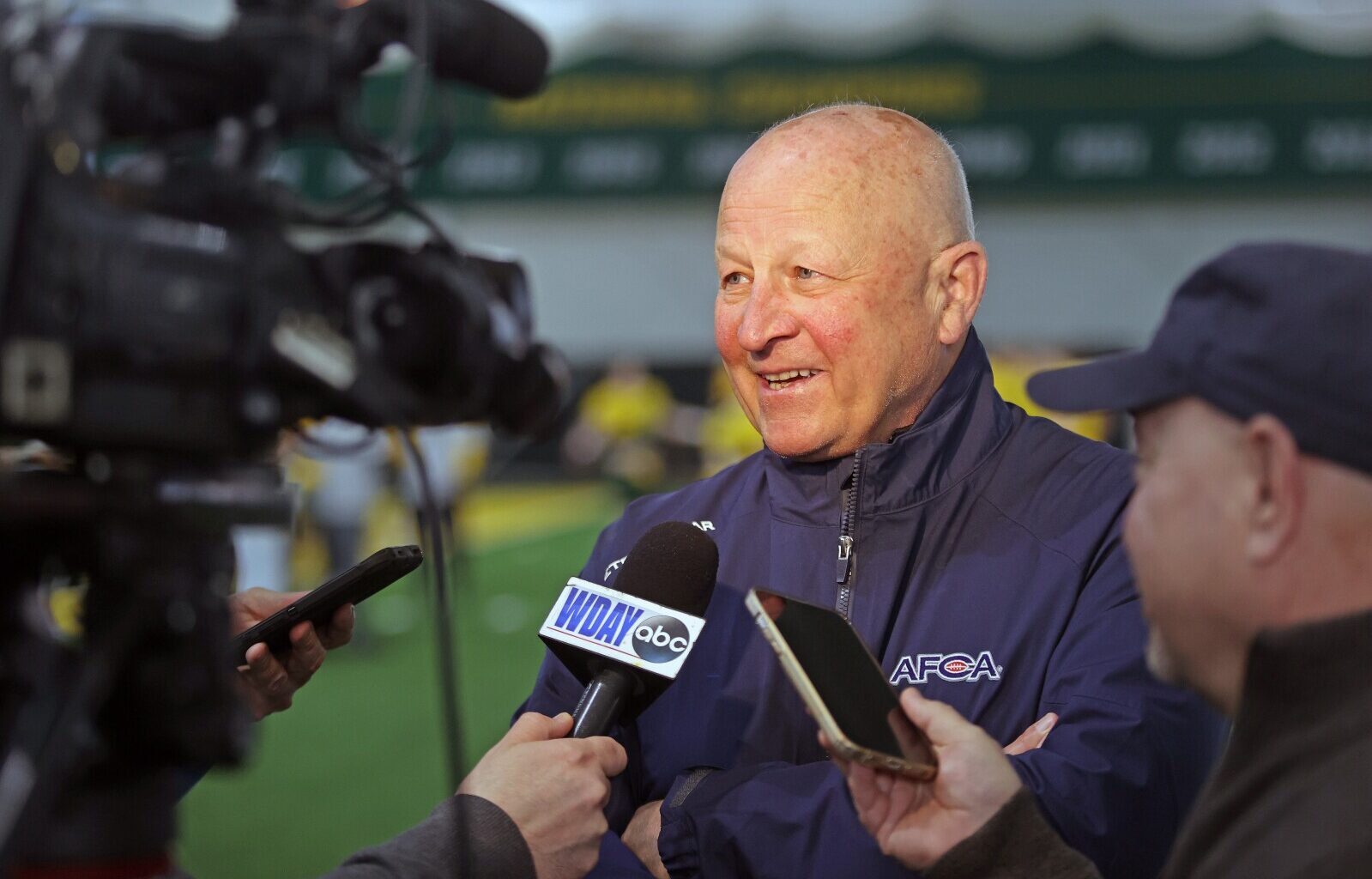
FARGO — Craig Bohl could’ve rode off into the sunset, literally, after a long and successful college football coaching career. He and his wife own horses they keep at their home base in Wyoming.
The lake home in northern Minnesota is complete, a legacy property he enjoys now but was built for all the next generations of Bohls. His son Aaron has a budding coaching career underway at Wyoming. The old ball coach’s resume includes building a dynasty at North Dakota State from 2003-2013 and winning more games than he lost in Laramie from 2014-2023, a rarity in the last 30 years.
He was sneakily influential in NDSU’s migration to the Mountain West Conference and the Football Bowl Subdivision, something he said Friday was a great move and one for which he showed great enthusiasm watching the Bison practice at their indoor facility.
There is, presumably, enough money in the bank that the 67-year-old Bohl could be spending more of his time sitting in the small-town watering hole not far from his lake property, sipping on a Grain Belt and listening to the locals gripe about the Minnesota Twins. Or the Vikings. Or the politicians.
He chose to not do that. Instead, he’s one of the leading figures trying to figure out how to get college football — and all college sports, by extension —
Not back to how things used to be,
as President Donald Trump and others have said
they want. But perhaps back to sanity, or something resembling it.
That’s one of his messages in his latest gig.
After retiring from coaching in late 2023 from Wyoming, he was named executive director of the American Football Coaches Association. The organization is one of the underrated entities that drives policy in college football since it represents the voice of the coaches.
The AFCA used to deal mostly with relatively minor things like making certain punt formations legal or the definition and penalties for targeting.
Now Bohl is one of the people in the room trying to
these days.
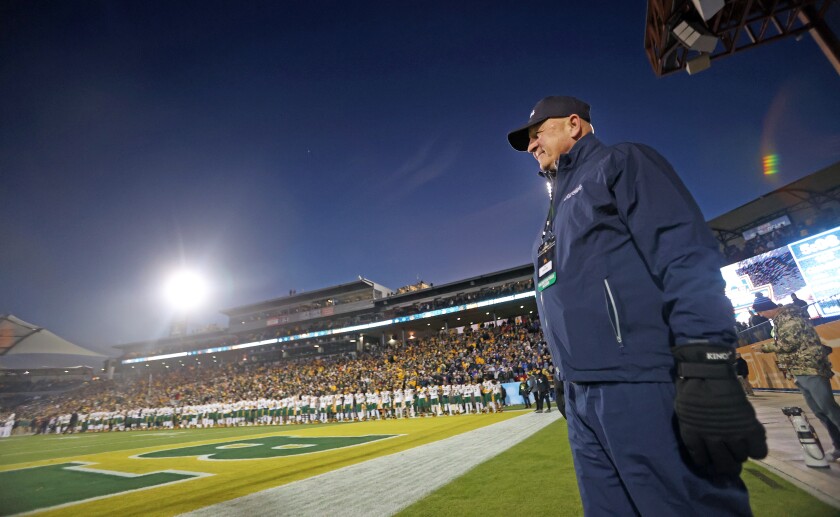
Former North Dakota State head football coach Craig Bohl watches the Bison from the end zone during the NCAA FCS championship game at Toyota Stadium in Frisco, Texas, on Monday, Jan. 6, 2025.
David Samson/The Forum
But does it need “saving,” as Trump and others have suggested?
“We need to recognize that the TV ratings are off the charts, attendance is up and there are great storylines. The sky is not falling, OK?” Bohl said. “The old days, that horse has left the barn. That one’s gone. But it doesn’t mean we can’t have good days going forward. We just have to find the right path. We need to make sure we’re educating players, which sometimes gets lost in this. I think we need to come up with some semblance of stability, so you don’t have guys just coming and going. Obviously players have the right to secure the best situation they can, but I’m convinced we’re going to come out in a good place.”
Bohl was in Fargo at the invitation of Bison head coach Tim Polasek, who had high school football coaches at practice as part of a day-long clinic. Bohl spoke to the coaches and was excited to talk about NDSU’s new adventure into the Mountain West. But frankly, when chatting with a handful of media types, the conversation kept going back to all the other stuff currently happening in college football.
How could it not? Bohl is regularly having Zoom meetings and face-to-face conversations with the U.S. senators and other members of Congress you regularly see on TV and read about in the newspaper. He tells stories of famous politicians who agree on specific aspects of policy that need to be made to aid college sports, but they won’t work together because they don’t like each other.
It seems Bohl would rather have a root canal than spend more time in Washington, D.C., but this is what he (sort of) signed up for.
One of the biggest problems, he’s discovered, is lack of communication. There are so many moving parts, so many interested parties, and they often don’t know what the others are thinking.
The “five for five” proposal that came out last week
— give college athletes five years to compete once they graduate from high school, with a few exceptions — was a perfect example. One group was terrified of endless litigation if the rule went into place, which is where the NCAA often finds itself these days, while another group said they believed the rule could stand. But nobody knew how the latter group felt because it had not been asked.

Wyoming Cowboys head coach Craig Bohl celebrates with the trophy after beating the Toledo Rockets in the Arizona Bowl on Saturday, Dec. 30, 2023 at Arizona Stadium in Tucson, Arizona.
Mark J. Rebilas/USA Today Sports
It was pushed by the AFCA.
“I am convinced that we’re going to come to a better place once we get all the stakeholders around the table and really have some meaningful discussions,” Bohl said. “For too long, we just operated in our own silos as coaches, administrators, conference commissioners, players.
“I do feel like the players need to have more of a voice simply because they are a stakeholder, too. I think for too long they’ve been put on the sideline.”
It’s complicated. Bohl says college sports needs an anti-trust exemption from Congress, which would shield the NCAA from most lawsuits, but there’s a tsunami of opposition to that because it’s seen as colluding to limit athlete compensation.
Bohl doesn’t pretend to have all the answers. But doing nothing, as they say, is not an option. Ohio State receiver Jeremiah Smith told a media outlet last week that had he entered the transfer portal, he could’ve commanded “over $10 million, easy” on the open market. Hearing some of the numbers former NDSU football and basketball players are allegedly making after transferring, it doesn’t seem unrealistic.
It’s not sustainable. Which led to Bohl giving the understatement of the day when asked to summarize the state of college football.
“It’s a state of change right now,” he said.

Mike McFeely is a columnist for The Forum of Fargo-Moorhead. He began working for The Forum in the 1980s while he was a student studying journalism at Minnesota State University Moorhead. He’s been with The Forum full time since 1990, minus a six-year hiatus when he hosted a local radio talk-show.