
G-Day has always been about more than a spring scrimmage. It is a first look, a controlled glimpse into what Georgia football might become in the fall. And this year, it may double as something else entirely: a uniform reveal.
Head coach Kirby Smart made that possibility clear in a press conference on March 17, when he said the Bulldogs could wear white helmets if subscriptions to Georgia Athletics’ new third-party fan engagement platform, Glory Glory, were to triple. The timing has only fueled speculation that Georgia’s annual spring game could be the stage for a long-awaited alternate look.
The helmets themselves aren’t entirely new. Georgia’s equipment staff teased the design on social media, and recruits have worn them in photo shoots, but they have yet to appear in a game setting. Since the 1960s, Georgia has built its identity around the red helmet, a constant that has become as recognizable as Sanford Stadium itself.
Georgia’s silver britches carry just as much weight. First introduced under head coach Wally Butts, who started as head coach in 1939, the pants were designed to complement the bright red jersey and quickly became a defining part of the program’s look. By the early 1950s, the phrase “silver britches” had taken on a life of its own, showing up in cheers, on banners and even on vests worn by fans proclaiming, “Go, You Silver Britches.”
That is what makes the idea of an alternate look so intriguing.
White helmets, or even an all-white uniform, would not just be a cosmetic shift; it would stand in contrast to everything Georgia has historically been on the field. It would be clean, modern and noticeably different from the red-and-silver combination that has defined the program for generations. For some, it would signal a willingness to evolve with the rest of college football. For others, it may feel like a departure from what makes Georgia, Georgia.
The history of alternate uniforms
Alternate uniforms, particularly black jerseys, exist in a strange space within the program. They are rarely worn, often debated and consistently requested by fans. Despite that demand and organized student section “blackouts” for Georgia night games, Smart has never fully embraced the idea that uniforms should drive energy inside the stadium.
“I don’t think that has one thing to do with the fan base,” Smart said. “I just think that’s hokey-pokey. It’s great for recruiting, and we may do it sometime. I’m not anti-doing it, but that shouldn’t do anything for your atmosphere.”
Smart’s stance has been consistent. The expectation is that the environment in Sanford Stadium should already be established, regardless of what color the team is wearing.
“Some of the best places I’ve played, great atmosphere, they never change their uniform, they’re traditionalist,” Smart said. “If it takes changing the uniform to get people fired up, then I’m at the wrong place.”
And yet, history suggests that uniforms do carry weight, even if that impact is difficult to measure.
The first “blackout” game against Auburn in 2007 remains one of the most memorable moments in Sanford Stadium. Georgia’s surprise wardrobe change from red to black jerseys created an immediate surge of energy, one that carried into a 45-20 win after 28 unanswered second-half points. The following Sugar Bowl win over Hawaii reinforced the momentum, turning a one-time experiment into something that appeared to be, at least briefly, a tradition.
But that energy has never been consistent. A highly anticipated game against No. 8 Alabama in 2008 resulted in a 41-30 loss after a 31-0 halftime deficit, and the mystique surrounding the uniforms faded just as quickly as it arrived.
Since then, alternate uniforms have appeared only in flashes.
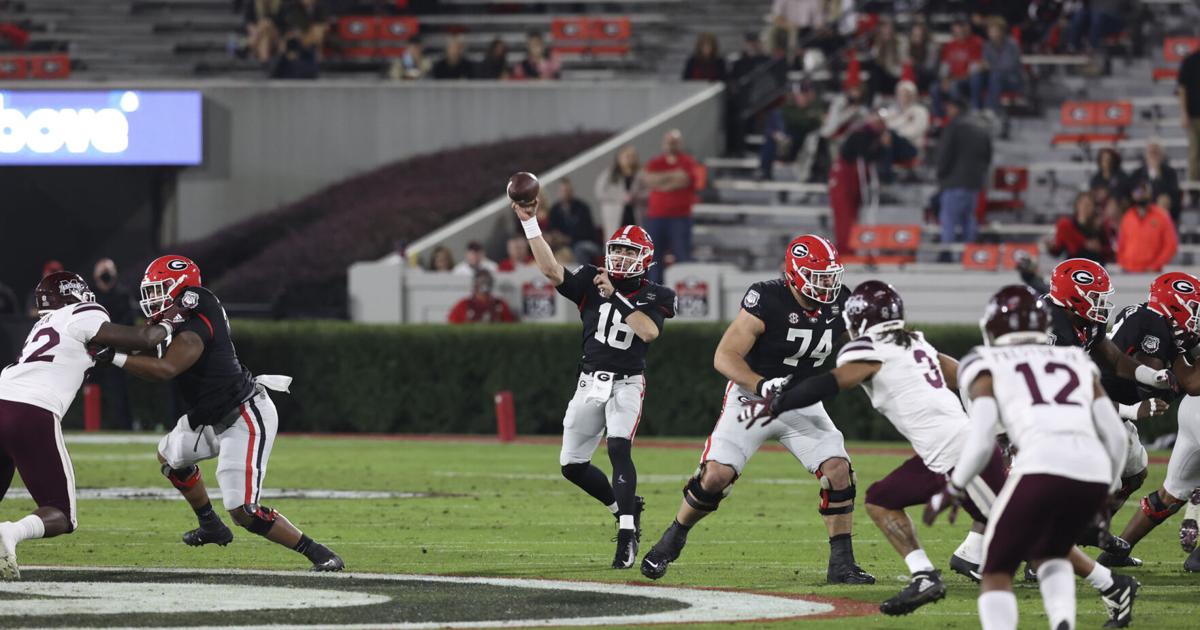
Georgia wore black jerseys once during Smart’s first season in 2016 in a 35-21 win over Louisiana-Lafayette, a game that did little to reestablish them as a staple. In the 2020 season, the Bulldogs introduced a redesigned black uniform with a spiked collar and block numbers, wearing those twice as well as a white throwback jersey once with limited fan capacity during the COVID-19 pandemic. The Peach Bowl win over No. 8 Cincinnati on Jan. 1, 2021, was the last time Georgia has taken the field in a non-traditional look.
The future
Alternate uniforms have never defined Georgia, but they never disappeared. They exist between tradition and curiosity, generating excitement without becoming expected.
That is where white helmets enter the conversation. An all-white look would feel new within a program rooted in consistency. Even though G-Day is only a spring scrimmage, it could signal a step toward alternate looks in regular season games.
Whether that results in white helmets on Saturdays or even another blackout remains uncertain. What is clear is that even in a program built on doing things the same way, the idea of change still has a way of capturing attention.