
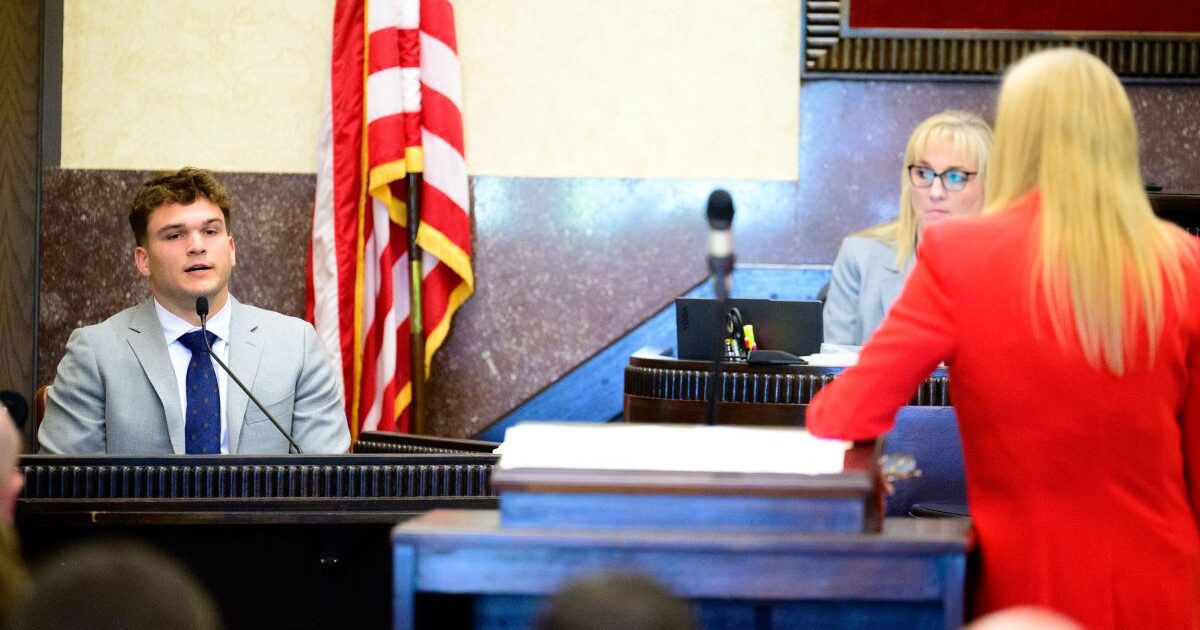
OU linebacker Owen Heinecke has been granted an injunction, allowing him to play one more year of college football. The decision was made Thursday afternoon by Judge Thad Balkman at the Cleveland County Courthouse.
Heinecke, a native Oklahoman and former walk-on who became a breakout star for the Sooners last season, took the NCAA to court after the organization denied his request for a fifth year of eligibility. His case centered on this argument: He has only played three seasons of college football, and the NCAA’s own rules give every student-athlete four.
On Thursday, Heinecke won his hearing, with Balkman granting him the injunction after an all-day hearing. Coach Brent Venables and General Manager Jim Nagy both testified at the hearing, backing Heinecke’s case.
Venables was the first witness to testify. His testimony mostly centered around the opportunities Heinecke would miss out on if he did not get the year of eligibility. Venables explained that Heinecke could be one of the best linebackers in college football. He compared Heinecke to former OU linebacker Danny Stutsman, who improved his stock after returning for his senior year.
“He’s just now coming into his own as a football player,” Venables said. “Becoming an All-American, competing for a Butkus Award — all of those things are sitting in front of him… He would likely be a captain, as well.”
Venables’ testimony was pivotal, as Heinecke’s legal team, led by Mary Quinn Cooper and Michael Lauderdale, sought to have him prove irreparable harm from being barred from returning. The NCAA, led by Taylor Askew, also asked Venables how Heinecke’s potential return would affect playing time for other players. Venables said OU rotates players regardless, especially at linebacker. He said he played six linebackers last season, implying it would have no effect.
Nagy took the stand with similar questioning. He also said that Heinecke would improve his draft stock. Nagy said Heinecke likely would be drafted in the fifth or sixth round this year. However, could go higher next year if he had another year to play.
“He has a lot to gain coming back,” Nagy said. “To have that bigger runway would be huge. The NFL tries to avoid one-year wonders. Owen’s a half-year wonder.”
The biggest complication for Heinecke was his freshman year at Ohio State (2021-22), where he played approximately 15 minutes of lacrosse across three matches before transferring to OU and walking onto the football team. The NCAA counted his lacrosse season as a used year of eligibility.
Heinecke argued that he was prevented from playing football that year due to COVID-related recruiting disruptions, injuries, and Ohio State not holding walk-on tryouts until spring 2022. Those circumstances, he claims, were beyond his control.
This was a major part of the hearing. Heinecke’s high school coach, J.J. Tappana, testified that Heinecke did not receive interest from major schools because they could not watch him in person. Tappana said Heinecke was the best player in Bishop Kelley High School history. And that if there had not been COVID, he would have certainly been offered by major schools.
When Askew stated that other high school athletes at the time faced the same difficulties, Tappana pushed back.
“A lot of those guys who weren’t recruited went and joined a frat and did keg stands,” Tappana said. “Owen didn’t. He climbed the mountain.”
Heinecke’s legal team also had a significant filing this week with a newly surfaced NCAA internal decision from October 2025, in which the organization granted an eligibility extension to a women’s basketball player under nearly identical circumstances — without requiring the same showings the NCAA demanded from Heinecke. That decision was never uploaded to the database that member institutions use to research precedent, meaning OU couldn’t have cited it.
OU Director of Compliance Brady Newville testified about this. Newville stated that the two cases were “identical” and that it would have helped Heinecke’s original petition. He said that, in his eight years working in compliance, he had never heard of a case not being uploaded by the NCAA.
The comparison played a major role in the hearing, as the NCAA pushed back, stating the case was not similar because the female athlete was already in college during COVID. But ultimately, the fact that the case wasn’t even made available for Newville to review was a major turning point in Heinecke’s argument.
Heinecke himself also testified on Thursday. His testimony was the longest of all the witnesses. He highlighted his struggle to get recruited and what happened at Ohio State.
He also spoke about what having another year would mean to him.
“To have a legacy at OU is really important to me,” Heinecke said. “Another year to cement myself … and possibly win a national championship — that would mean everything to me.”
Now, Heinecke will get that chance.